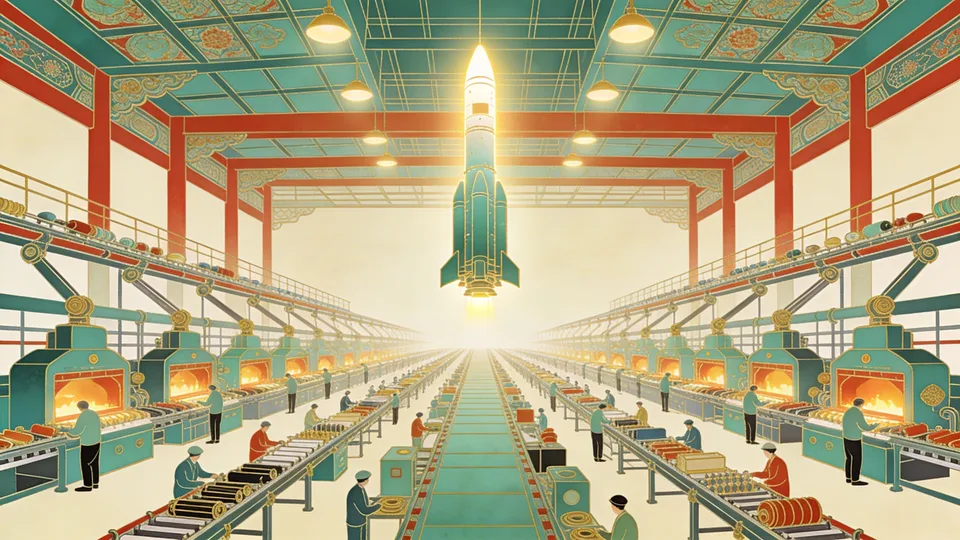
Nobody in Factorio needs the rocket. Without it, every assembly line on the map goes quiet.
Why do people who reach the thing they worked toward so often feel emptier afterwards? The factory game Factorio offers a strangely precise answer.
In Factorio the end goal is a rocket. The rocket is not useful in the player’s day-to-day game, but it is the thing that pulls forward all demand for commodities, intermediate products and final assemblies. The mines, smelters and conveyor belts exist because the rocket needs parts. Take the rocket away and none of the production chains has a reason to exist. The factory still stands, but it produces nothing.
The psychic economy works the same way. Impossible goals — love, enlightenment, “finding myself” — are infinite demand sources that keep the internal economy taut. Without them, the sub-units feel disconnected, a miasma of meaninglessness sets in, and the psychic economy falls into depression.
Why the goal has to be impossible
Think of every skill, habit, relationship and ambition as a production line that needs something to produce for. A finite goal, such as a promotion, a marathon time or a house, works until you reach it. Then the demand collapses, and the lines that existed to feed it go idle. Nothing broke, but nothing is pulling anymore. An infinite goal, such as the pursuit of love, truth or mastery, never runs out of demand because it never fully arrives.
The brain seems built for this. Dopamine is rigged for anticipation rather than satisfaction, rewarding pursuit more than arrival. That looks like a design flaw, since it guarantees permanent dissatisfaction, but a system that stopped wanting once satisfied would also stop producing. The restlessness behind much human misery is the same engine behind human achievement. The rocket is that dissatisfaction given a direction.
When the factory stalls
On this view, at least one kind of flatness is a demand problem rather than a breakdown. The production lines are intact: the skills, the relationships, the routines. But nothing pulls them forward, so they run for maintenance alone. You do what is necessary to live, and it slowly drains your will to live at all.
The opposite failure exists too. In Factorio, building two rockets at once creates shortages, starved lines and shutdowns, and if the breakdown reaches the power grid the whole factory stops, and restarting from a dead grid is agonizing. A purpose too grand for your capacity does the same when it exhausts the energy everything else runs on. So meaning operates like economic demand — it must be sufficient, infinite, and connected to the entire production chain. Too small and it collapses on arrival. Disconnected from your actual skills and relationships, it produces busy meaninglessness: the admired career that never reaches the parts of you that matter, which Mask and Daemon calls the esteem ceiling. Too large, it breaks the system.
That makes “what do you want to do with your life?” both the most important and the most dangerous question, because it is really asking what is your rocket? The answer does not have to be reachable. It has to keep pulling, at a rate your factory can bear. For anyone feeling flat after a success, the useful question is not what broke, but whether the rocket has already launched.
References:
- Factorio demand economics analogy (original notes)