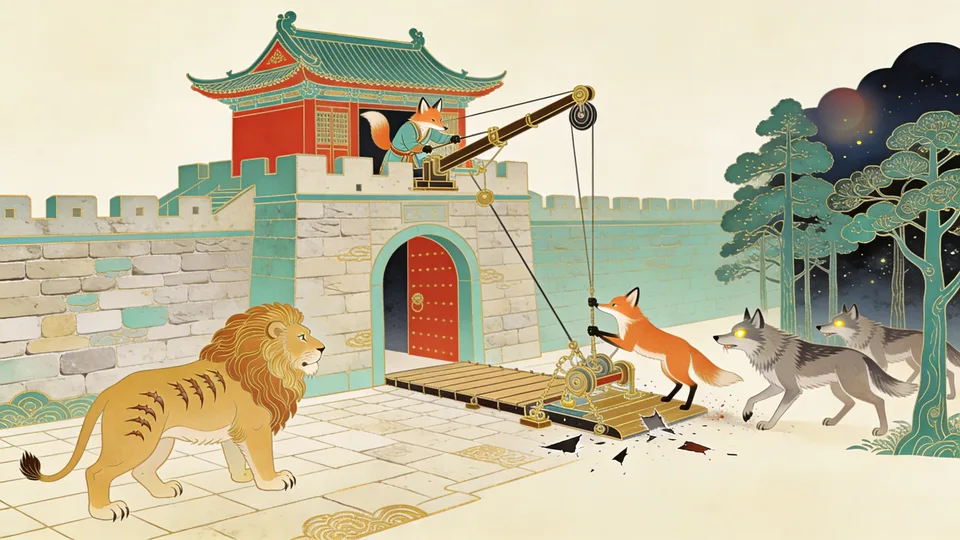
Wolves don’t read press releases.
When a government answers a real threat with a messaging strategy, the usual explanation is that the wrong people are in charge: they are cowardly, or stupid, or captured. Vilfredo Pareto offered a less comfortable one, which N.S. Lyons applies to Britain. The people in charge are often very capable. They were selected, over decades of peace, for exactly the skills that now leave them defenseless.
Lions, then foxes
Nations are founded by lions, a society’s natural warrior class. They establish and expand borders at the point of a sword. Their authority can be dictatorial, but it is relatively honest and straightforward. They have a firm sense of who is family and who is a prowling wolf. The security they establish is what lets the nation grow prosperous.
Security and prosperity then produce foxes, who are unsuited to force and prefer intellectual and rhetorical combat. They overcome obstacles through persuasion and through the manipulation of people, information, narratives and formal processes. Their talents are real: managing complexity and scale, navigating diplomatic nuance, extracting profit from an extensive empire. And as the state grows new layers of bureaucracy, law and procedure, those talents are what get rewarded. Lions are inarticulate and unprepared for the traps of more underhanded mammals. A wholesale replacement of the elite occurs: the lions are pushed out, marginalized and excluded by foxes who see them as brutish relics of a barbaric age.
Managing the story
The trouble starts when wolves arrive, internal or external. A fox’s signature move is to control the perception of a problem rather than the problem itself: downplay facts, obscure identities, memory-hole events, censor counter-narratives. Those who speak out are smeared with reputation-destroying labels like “racist,” “xenophobic” or “far right,” so that others stop listening. That is orthodoxy used as a governing technique: define a new heresy, and the legitimate concern becomes unspeakable.
Instability rises, and the foxes double down on what they know: misdirection, burying problems, buying off threats. When they finally lash out with violence, they do so indecisively, ham-fistedly, or in entirely the wrong direction. The wolves can instinctively smell weakness and just keep coming.
Why not simply switch tactics? Because they cannot use the lion’s tools without ceasing to be foxes. Their status and self-image are built on rejecting force and directness. To admit that some problems need the lion’s approach would be to admit that the long campaign to replace lions with foxes was partly a mistake. The fox strategy is Locally Optimal: brilliant in a stable environment, catastrophic when the environment changes, and impossible to abandon for people who have spent whole careers defining themselves against the alternative.
Not a case for strongmen
It would be easy to read all this as nostalgia: bring back the strongmen. Pareto doesn’t support that reading. Pareto’s observation is structural, not partisan: every civilization cycles between lion and fox elites, and both produce characteristic failure modes. Lions produce tyranny through excessive force; foxes produce collapse through excessive indirection. A healthy state needs both, and the historical record suggests that balance is extraordinarily hard to sustain.
So the danger in a fox-run country is not that the wrong people are in charge. It is that the people in charge have optimized so completely for fox virtues that they can no longer exercise lion virtues when survival demands it, and their instinctive answer to every threat is more process, more narrative, more control of perception. The wolves, who do not read position papers, just keep coming. Pareto’s cycle says what usually happens next: a new set of lions arrives, and they are rarely gentle.
References:
- N.S. Lyons, Britain’s Foxes Are Beset by Wolves, The Upheaval
- Vilfredo Pareto, theory of elite circulation