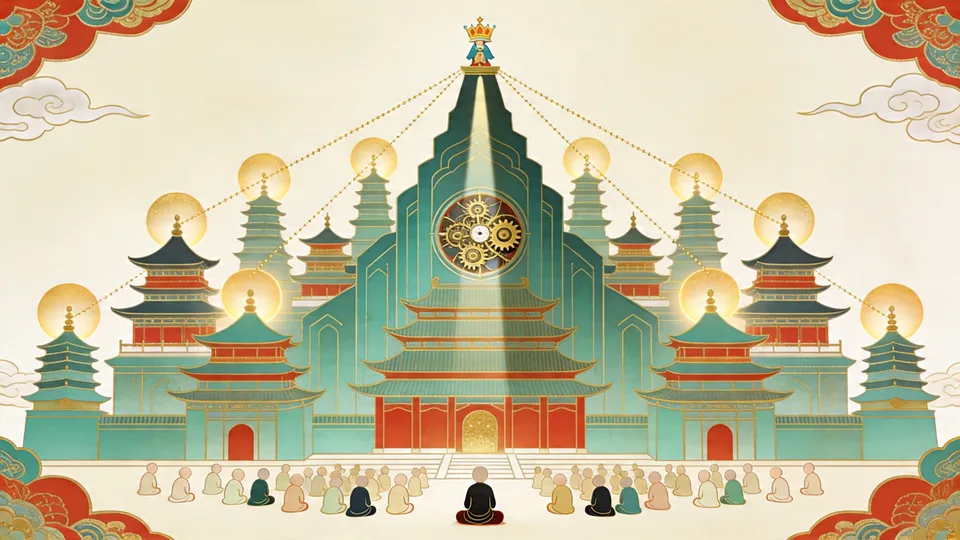
The president takes the blame. The people who wrote his options were never on a ballot.
In the 2026 US-Iran conflict, the naval blockade was branded “Operation Epic Fury,” and the President announced that he would personally extract Iran’s uranium with excavators. Most commentary split two ways. One side saw strength at last: the Navy in the Persian Gulf, Iran’s nukes about to be taken, the war about to end. The other saw a narcissist whose reckless demands over the Strait of Hormuz threatened global energy markets and risked a world war to lift his poll numbers. Both readings share one assumption: the man on television is the one steering.
Curtis Yarvin, who wrote for years as Mencius Moldbug, would ask who designed the blockade. His core move is to treat statecraft as systems architecture and corporate governance, and the spine of his thesis is a conservation law: power cannot be destroyed, only obfuscated. Every reform that claims to abolish a power center only moves it somewhere less visible. The American founding claimed to abolish monarchy, but the sovereignty didn’t vanish. It migrated into the structures the constitution never named: the credentialing institutions, the prestige press, the administrative state, the tax-advantaged philanthropic complex. Democracy, in this frame, is an obfuscation layer. By pretending power has been handed to the masses, it lets a decentralized consensus-making apparatus rule invisibly and without accountability. Yarvin calls that apparatus the Cathedral.
A church with no pope
Picture thousands of priests spread across many buildings. They never meet and never vote, but they preach roughly the same sermon on Sunday, and anyone who preaches a different one is quietly excommunicated. There is no conspiracy, only a network of institutions selecting for the same type of person, rewarding the same opinions and punishing deviation. The congregation mistakes the lack of a visible leader for the absence of one.
Each part of that network began as a genuine good. Academia exists to find truth and train the people who maintain civilization’s infrastructure; the press, to inform the public and expose corruption; the civil service, to keep the grid running and the mail moving whoever wins the election; philanthropy, to relieve suffering. Under enough scale and time, each became an organ of power that wears its original virtue as camouflage. Academia mints the credentials and sets the bounds of acceptable thought, so disagreeing with it gets you labeled anti-science. Prestige media tells every high-status person what the safe consensus currently is. The bureaucracy writes administrative law that bypasses the visible legislature, so elected officials pull levers disconnected from the machinery: The Cathedral dictates policy via inertia; attempting to change it is framed as “destroying democratic norms.” The NGO complex funds campaigns and drafts legislation beyond democratic oversight, and because it is legally charity, any audit reads as an attack on the vulnerable it serves.
That fusion is the system’s main defense. You cannot attack the control system without appearing to attack the virtue it grew from. Criticize academia and you hate science. Criticize the press and you hate truth. Criticize the bureaucracy and you hate stability. Criticize the NGOs and you hate the poor. The Cathedral’s power is absolute precisely because its mechanisms are universally coded as Good. It is slave morality institutionalized at the scale of a civilization: the content is genuinely kind, the function is coercive, and it rules by making opposition unspeakable.
The President as crumple zone
Back to the blockade. In Yarvin’s frame, power is not the ability to launch a missile. It is the ability to shape the menu of options from which the launch is chosen, while remaining anonymous if the missile misses. The real power in the Iran conflict sits with the permanent national-security apparatus, the shipping-insurance markets and the physics of the global energy supply chain. The U.S. military architecture needs Hormuz open to preserve the West’s macroeconomic equilibrium, so the bureaucracy uses the President’s need for a “historic deal” to carry out a complex blockade it authored. Trump manages the television narrative. CENTCOM manages the kinetic reality.
The arrangement protects itself whichever way the war goes. If the Strait stays closed and oil prices wreck the midterms, the President is ceremonially sacrificed, wiping the board clean without dismantling the state itself. If the blockade forces a favorable ceasefire, the permanent state quietly keeps the leverage. That is dishonest, and it is also an unusually robust risk-management system. A sovereign that cannot be fired can project force without ever facing ruin, and the outrage democratic politics generates has to land somewhere, so the President becomes the designated impact surface, the system’s crumple zone. A machine that ran on naked power with no moral story would be rejected by the human need for narrative, which is why the camouflage keeps the system stable even as it slowly ossifies. This is the post-war trade in a harsher key: a civilization that banished its strong gods to prevent fascism built a managerial Cathedral to carry the weight the gods used to carry.
Yarvin’s own fix, Formalism, is to align control with ownership: run the state like a joint-stock company whose CEO-monarch holds undivided authority but answers strictly to shareholders, and treat citizens as customers rather than captive participants. Whether that is desirable or even achievable is a separate question from whether the diagnosis is right.
What the frame can’t see
The diagnosis has its own weak point, and the blockade exposes it. If the President fails, the Cathedral sacrificed him; if he succeeds, the Cathedral absorbed the gain. A theory that reads every outcome as proof of the hidden sovereign can no longer be tested, and it risks dissolving real elected choices into the machine. The frame is strongest as a question to put to any decision (who drew up the options, and who pays if they fail?) and weakest as an answer settled in advance.
Still, there is no one to indict. Nobody designed the Cathedral, and everyone inside it is, by their own lights, doing good, which is exactly why it cannot be reformed from within. Goodness is the API wrapper for power. The underlying machine code is pure institutional self-preservation. Beating it on its own terms is impossible, because its terms are built to make that impossible. What stays open is whether you can name what is happening clearly enough that the naming itself becomes a small piece of ground the Cathedral does not own.
References:
- Curtis Yarvin / Mencius Moldbug, Unqualified Reservations
- Curtis Yarvin, Gray Mirror
- Mencius Moldbug, A Gentle Introduction to Unqualified Reservations (2009)