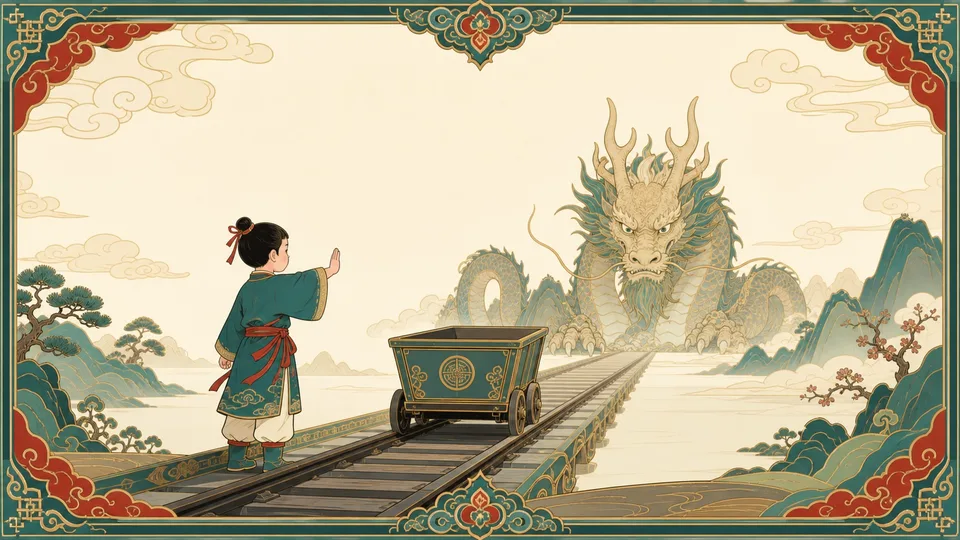
Nick Bostrom’s “Fable of the Dragon-Tyrant” is one of the cleanest moral machines in contemporary philosophy. A dragon eats thousands of people every day. The kingdom gradually treats this as normal. Entire bureaucracies, religions, philosophies, industries, budgets, and comfort rituals evolve around managing the tribute. Then one day a child asks the obvious question: why are we feeding it?
The dragon is aging, or more precisely senescence. It is not death in every form. Bostrom’s explicit argument is not “extend frail old age forever.” It is: extend healthy life by attacking the biological aging process itself. The target is not endless nursing-home existence. The target is involuntary collapse.
Simple Picture
ELI5: if a monster ate your grandmother, you would not say, “This is beautiful because stories need endings.” You would try to stop the monster.
That is the parable’s core move. It takes a horror that has become ambient and gives it teeth, wings, appetite, and a schedule. Once the death toll has a face, all the usual poetry starts to look suspicious.
The Steelman
The parable’s strongest move is that it de-normalizes death by old age.
Imagine the same death toll caused by a visible monster. Nobody would say, “Ah, the dragon gives life meaning.” Nobody would say, “Dragon consumption is part of human dignity.” Nobody would build a whole morality around gracefully entering the dragon’s mouth. We would treat it as a civilization-scale emergency.
That is the moral insight: normality is not morality. A horror repeated daily becomes “the human condition.” A horror made visible becomes tyranny. The manufactured normalcy field does not make the underlying event less grotesque. It only makes the grotesque feel scheduled.
Bostrom is especially strong on institutional capture. The kingdom does not merely suffer from the dragon. It adapts to the dragon. It builds railways, ministries, clerks, comforters, tribute logistics, dragonologists, and moral rationalizers. The monster becomes a central planning assumption.
This maps cleanly onto healthcare systems that mostly manage late-stage decline instead of attacking the upstream biological causes of aging. The mistake is letting damage-limitation replace the goal of addressing the underlying cause. Palliative machinery becomes the respectable version of surrender.
The parable also nails the psychology of death-apologetics. People say death is natural, meaningful, dignified, population-stabilizing, spiritually purifying, socially necessary. Some of these contain partial truths. But the parable forces the question: are these truths, or cope dressed as wisdom?
The stronger version is not “immortality at any cost.” It is: involuntary biological collapse is bad, and if science can reduce it, refusing to try is morally grotesque. Modern aging biology strengthens this intuition. Aging is not one mystical essence. It is a bundle of mechanisms: genomic instability, epigenetic alteration, loss of proteostasis, inflammation, cellular senescence, stem-cell exhaustion, mitochondrial dysfunction, and other processes that may be partially targetable.
The Critique
The parable is morally powerful but philosophically loaded. It wins partly by making aging look like an external predator. But aging is not literally a dragon. It is entangled with metabolism, development, fertility, cancer suppression, immune tradeoffs, resource allocation, and evolutionary history. “Kill the dragon” sounds like one decisive missile. Real longevity medicine is more likely to be a messy stack of partial interventions.
Second: the parable blurs death, aging, and immortality. These are not the same.
Stopping senescence would not stop accidents, violence, suicide, pandemics, war, or existential risk. It would not necessarily give anyone immortality. It would give negligible senescence, or radically extended healthspan, or perhaps a portfolio of interventions that shift the decay curve outward. That is still enormous. But the story can slide from “aging is bad” to “death itself is the enemy,” and readers can slide further to “immortality is obviously good.” Those are three different claims.
Third: the parable underweights the political economy of victory. Suppose anti-aging works first for billionaires, party elites, intelligence agencies, dictators, and asset owners. Then slaying the dragon could become feudal immortality. Incumbents never leave. Wealth compounds for centuries. Institutions stop refreshing. Young people become permanent latecomers. Death is a brutal succession mechanism. Remove it without designing replacement mechanisms, and you may create immortal gerontocracy.
The parable gestures at this near the end, saying society will need reorganization after the dragon dies. But that single word hides most of the civilizational problem. The turnover mechanism matters. One funeral at a time is a grim way for paradigms to update, but it is still a way. If funerals stop doing succession work, something else has to do it on purpose.
Fourth: there is a hidden utilitarian pressure tactic. Bostrom says delay costs lives, roughly “70 lives per minute” in his framing. That is emotionally and mathematically effective. But every moral emergency can use this move. Poverty, malaria, pandemics, AI risk, nuclear war, fertility collapse, climate disasters, antibiotic resistance, and war can all say: every delay kills.
The parable makes aging research look like the obvious top priority. Prioritization still requires comparing tractability, neglectedness, timelines, externalities, and opportunity cost. “People are dying” is not yet an allocation rule.
Fifth: “death gives life meaning” is often shallow cope, but not always. The serious version is not “death is good.” It is: finitude disciplines desire. It forces commitment. It gives shape to projects. An indefinitely-lived being may not become wiser. He may become infinitely postponing, infinitely cautious, infinitely bored, or infinitely captured by old status games. Death is evil. But limitlessness is not automatically salvation. Optionality can preserve life while hollowing out decision.
Straussian Reading
The surface message is: fund aging research.
The deeper message is: civilization is mostly a machine for rationalizing the intolerable once it becomes routine.
The dragon is not just aging. It is every giant background horror that society has metabolized into paperwork, ritual, and tasteful language. The priests are cope. The ministers are elite narrative control. The railway is bureaucracy. The dragonologists are experts who study the problem just enough to make its continuation seem sophisticated. The child is pre-theoretical moral perception: it eats people; it is bad.
That is why the parable works. It bypasses midwit verbal sophistication and restores moral eyesight. It is a load-bearing illusion detector. It asks whether our noblest explanations are true, or merely the embroidery around an unacceptable equilibrium.
Dimwit / Midwit / Highwit
The dimwit take is “death bad, kill death.”
The midwit take is “death is natural; immortality is hubris; society needs generational turnover; life has meaning because it ends.”
The highwit take is that involuntary biological decay is bad, but immortality is the wrong first target. The real target is optionality over death: healthy bodies, reversible aging, graceful voluntary exit, institutional turnover without forced funerals, and social systems that prevent longevity from becoming eternal oligarchy.
My Synthesis
The parable is correct against death-apologetics. Most “death gives life meaning” arguments are cope, Stockholm syndrome, or aestheticized helplessness.
But it is not a full proof of immortality. It proves something narrower and stronger:
Aging should be treated as a remediable source of mass suffering, not as sacred metaphysics.
The right position is not “everyone must live forever.” It is:
No one should be forced into biological collapse just because previous generations lacked the tools to prevent it.
Standing on one foot: the dragon parable is right that normalized death is still death. It is wrong only when readers confuse curing aging with solving mortality, meaning, politics, and civilization design all at once.
References:
- Nick Bostrom, “The Fable of the Dragon-Tyrant”