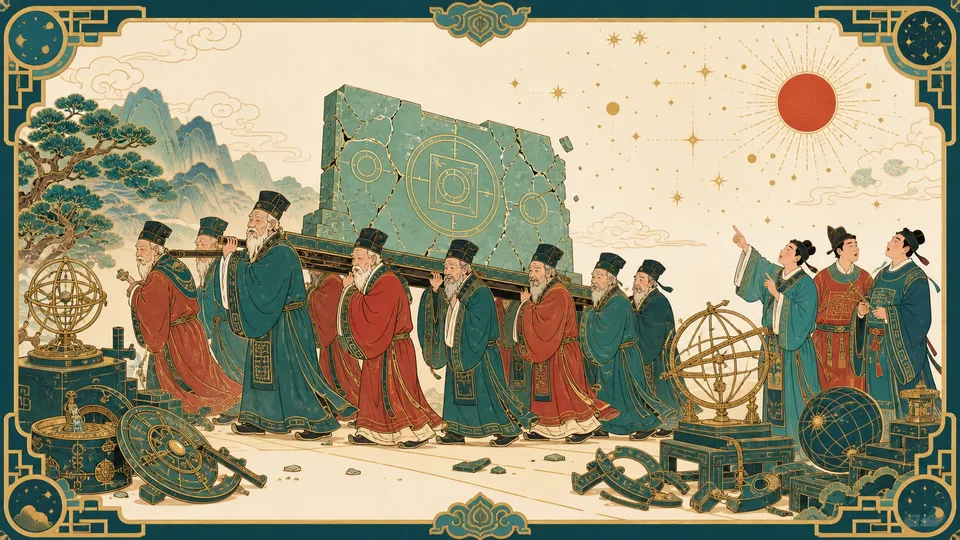
Science advances one funeral at a time. Not because old people are stubborn, but because paradigms are load-bearing — they determine what counts as evidence, what questions can be asked, and what observations are even visible. A person operating inside a paradigm is not choosing to ignore contradictory evidence. They often cannot see it.
Simple Picture
ELI5: the human mind is like the human egg — when one sperm gets in, it shuts down so the next one cannot get in. Once a framework takes hold, the mind has a powerful tendency to close against alternatives.
The Aristotelian paradigm held that the heavens were perfect. Early Western astronomers never noted the existence of sunspots, even though they are visible with the naked eye under the right conditions. Chinese astronomers, operating under no such paradigm, regularly commented on them. The Western astronomers were not less intelligent. They were looking through a framework that made sunspots invisible.
Core Claim
Thomas Kuhn’s model of scientific revolutions says that scientific facts are not free-floating — they are understood only as part of a paradigm, an accepted predictive framework. The paradigm does not just organize knowledge. It dictates what kinds of questions can be asked and what even counts as legitimate evidence.
Predictive processing provides the neural mechanism: the brain generates top-down predictions and only updates when bottom-up error exceeds a threshold — the paradigm is the prediction model, and contradictory evidence is smoothed away as noise rather than triggering a re-prediction. Trapped priors is the same architecture at the scale of an individual cognition: a prior that has eaten the bottom-up channel and now reproduces itself from whatever input arrives. A scientific community in paradigm lock-in is a population running the same configuration in parallel — and the funeral principle is what it takes to refresh the population when the individuals cannot refresh themselves. This means the prevailing paradigm is self-reinforcing. A paradigm shift is a Nachträglichkeit event: the new framework does not just replace the old one — it retroactively reveals what the old paradigm was hiding. Semmelweis’s data was noise within the old framework; after germ theory, the same data proved doctors had been killing patients for decades. Evidence that fits the paradigm is noticed, recorded, and explained. Evidence that contradicts it is dismissed as noise, reinterpreted to fit, or literally not perceived.
Progress happens when anomalies pile up — more and more exceptions and epicycles needed to maintain the accepted narrative — until newcomers to the field begin to suspect a better framework exists. The software conservative is paradigm lock-in applied to engineering practice: the safety framework that has worked becomes the framework that must not change, and any push toward flexibility is processed as an attack on the paradigm rather than evidence of its limitations. Eventually someone provides one. But the critical Kuhnian observation is that most established practitioners never convert. They go to their graves as loyal adherents of the old model.
Age has nothing to do with it, except as a proxy for experience. Older newcomers to a field are just as likely to adopt new paradigms as younger ones. It is experience and repetition — not age — that locks you in. The paradigm becomes etched as The Inviolable Laws, and anyone who contradicts them is subconsciously written off.
The Semmelweis Case
In 1847, Ignaz Semmelweis discovered that doctors were killing new mothers by examining them with hands contaminated by cadaverous material from autopsies. He implemented chlorine handwashing and mortality plummeted from 11.4% to 1.3%.
The response was ridicule. Not because 19th century doctors were dumb, arrogant, or misogynistic — they were intelligent, educated, and cared for their patients. The problem was paradigm lock-in:
- Their framework said diseases were too complex to have a single cause. Semmelweis’s theory seemed naive.
- They knew enough about logic to recognize that his evidence superficially resembled correlation-causation fallacy — epidemics come and go, and this one happened to go when he started washing.
- They had no framework for invisible pathogens. The concept of germ theory did not yet exist. Their available paradigms — bad air, seasonal epidemics, building conditions — could not accommodate his explanation.
- Even doctors who already believed they could spread disease (the contagionists) rejected Semmelweis because his theory did not match their paradigm of how spreading worked.
The first converts were junior doctors and students who had seen the handwashing work firsthand — visceral evidence that could not be communicated in a publication. They were new enough to the field that the old paradigm had not fully locked in.
Semmelweis died in an insane asylum in 1865, from the same infection he had spent his life fighting. Decades later, germ theory provided the framework that made his evidence legible. And then, armed with germ theory, doctors made the same mistake again — insisting that deficiency diseases like scurvy could not possibly be cured by minuscule amounts of a simple chemical, because that did not fit the germ paradigm.
The Investing Parallel
The same dynamic operates in every domain where people develop heuristics from experience. You navigate the world with noisy feedback and uncertain attribution, so you extrapolate useful rules from personal experience. If those rules make you money, they become The Inviolable Laws of Investing.
Anyone who proposes an approach that contradicts your Laws is subconsciously written off as an idiot — not because you are closed-minded, but because your successful experience has built a paradigm that makes alternative approaches look obviously wrong.
Priesthoods institutionalize this lock-in: the same isolation that protects expert consensus from public ignorance also makes the priesthood immune to correction. When the entire monoculture gets one-shotted by a bias appealing to smart people, they lock it in as consensus and stand firm. People of the same generation converge on similar heuristics because they had similar experiences. Generational turnover in markets is the financial version of Planck’s funeral principle.
Why This Is Not Just Stubbornness
The paradigm-lock-in model is more precise than “people resist change.” Consistency bias plays a role — once you announce a position, your ego wraps around it. But the deeper mechanism is perceptual: the paradigm mediates what you literally see in the data.
Two people operating from different paradigms will look at the same evidence and see different things. They will each think the other is ignorant. They will always talk past each other. This is not a failure of communication. It is a structural feature of paradigm conflict — there is no neutral ground from which both frameworks are equally visible. Orphaned independence extends this to the personal scale: the senior engineer who blocks a junior’s PR with seven style nitpicks is running the same lock-in, except the paradigm being defended is not scientific but the framework that made them senior. Every challenge gets smoothed away as format error rather than processed as input. The Babel Limit is this dynamic at civilizational scale: a population of paradigm-locked agents who share no meta-frame from which their disagreements are mutually legible. The loss is not language — it is the common object layer on which disagreement used to rest. The MTG color wheel captures the same dynamic at the level of values: opposing colors are not arguing about facts but about which facts count, using different scoring functions to evaluate the same world.
Bostrom’s Dragon Tyrant fable is paradigm lock-in as parable. A dragon eats ten thousand people daily. Society builds railways to deliver the tribute, employs comforters to ease the doomed, funds dragonologists to study its excrement — an entire economy of accommodation. When someone proposes killing the dragon, the king’s moral advisor delivers an eloquent speech about how being eaten fulfills our human dignity. The phrases are so refined that deep thoughts seem to lurk behind them, though nobody can quite grasp what they are. Then a child says: “The dragon is bad. I want my granny back.” The child is right and the advisor is wrong — but the advisor’s wrongness is dressed in the language of wisdom, and the child’s rightness has no prestige at all.
At the individual level, the expert’s loneliness is paradigm lock-in at the scale of a career: the priors that constitute someone’s expertise become strong enough and accurate enough that bottom-up evidence within the domain no longer generates prediction error large enough to update them. At the political level, Arendt showed what happens when paradigm lock-in is weaponized: ideology does not merely make contradictory evidence hard to see — it actively destroys the capacity to generate evidence from experience. This is reference-point-bias operating at the epistemological level. Your paradigm is your reference point, and it manufactures the illusion that you are seeing reality directly rather than seeing reality through a lens.
Common Misread
The dimwit take is “experts are idiots who refuse to see the truth.”
The midwit take is “we should question all experts because they are biased by their paradigm.”
The better take is that paradigm lock-in is universal and often invisible to the person locked in. The experts are not wrong because they are experts — they are wrong on specific points where their framework has become load-bearing in ways that prevent them from seeing anomalies. The answer is not to dismiss expertise but to understand that the framework that makes someone an expert in one era can make them resistant to the truth in the next. The most dangerous position is knowing just enough to dismiss evidence that does not fit.
Main Payoff
The practical value is a specific prediction: the more successful your framework has been, the harder it will be to see when it stops working. Pirsig named this the “cultural immune system” in lila: it fights beneficial new understanding with the same vigor it fights crime, because it cannot distinguish between them. At the personal level this manifests as the context vortex — a headspace of stale, repetitive thoughts where new information enters but cannot disrupt the loop. This is locally-optimal at the epistemological level — your paradigm is a hill that works, and every direction away from it looks like descent. The history of brain metaphors is paradigm lock-in on a civilizational timescale — each technological era generates a model of the mind that becomes so load-bearing it cannot be questioned until the next machine renders it quaint. The paradigm is not just a belief you hold. It is the lens through which you evaluate all beliefs, including challenges to itself.
That is why science advances one funeral at a time. Not because people are stubborn, but because paradigms are self-sealing. The evidence that could unseat a paradigm is exactly the evidence the paradigm makes hardest to see. The garden’s countermeasure on its own method is therapeutic etiology — the practice of putting a framework down once it has done operational work, before it thickens into the paradigm that hides what it cannot accommodate. Haidt names the moral version: morality binds and blinds — it binds us into ideological teams and blinds us to the fact that each team is composed of good people who have something important to say. Once people accept a particular narrative, they become blind to alternative moral worlds. Reasoning can take you wherever you want to go, which is why you cannot change people’s minds by utterly refuting their arguments. At the interpersonal level, this produces the expert-novice impasse: the expert sputters, the novice feels superior, and the situation is stable because the knowledge that makes the expert right is the knowledge the novice lacks.
References:
- Thomas Kuhn, The Structure of Scientific Revolutions
- One Funeral at a Time — MD&A
- Max Planck on scientific truth and generational turnover