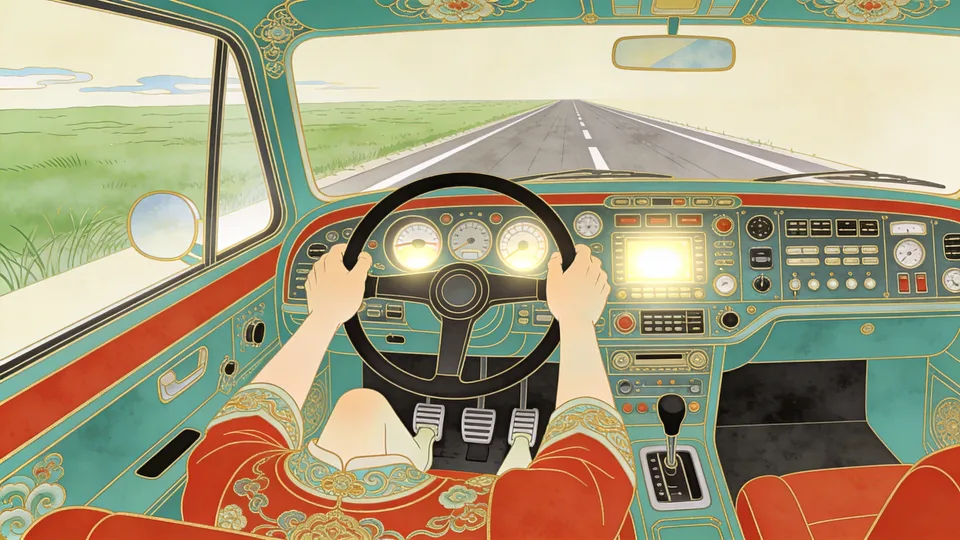
The better you drive, the harder it is to believe you could just get out.
Why do the people most dedicated to transcending the ego so often stay stuck? Scott Alexander has a parable that answers it:
Imagine you are in the driver’s seat of a car. You have been sitting there so long that you have forgotten that it is the seat of a car, forgotten how to get out of the seat, forgotten the existence of your own legs, indeed forgotten that you are a being at all separate from the car. — Scott Alexander, Universal Love, Said the Cactus Person
The person in the car isn’t stupid. They have driven every highway and mastered every control. Then someone tells them about getting out, and they ask the only question their life has prepared them to ask: which buttons do I press?
The sage says it isn’t about buttons; just get out. The driver asks which buttons will lead to getting out. The sage says to stop thinking about buttons. The driver wonders whether rotating the tires might improve their driving enough to make getting out easy. The sage shakes his head, and the driver speeds off calling him a moron.
Every technique is a button
Meditation, therapy, affirmations, breathwork and psychedelics all look, from the driver’s seat, like dashboard controls. Each was meant to point beyond technique, but the driver can only use them as techniques, because driving is the only category of action they have left. Getting out isn’t a harder maneuver. It is the thing driving can’t do.
That is Watts’s ego trap in narrative form. The “I” trying to solve the problem is the problem, and every tool the “I” has for solving problems is an ego tool. Self-improvement is a button. Even “trying to let go” is a button: it is Self 1 pressing the “let go” button on the dashboard, which is still driving. Gallwey saw the same loop on the tennis court. The zone arrives only when Self 1 steps aside, but Self 1 likes the idea of the zone and grabs for it, and the grabbing is what keeps it away.
Why the driver gets angry
The car works. It gets you places, and every problem you have ever solved, you solved from inside it. So the suggestion that the car itself is the limitation isn’t merely counterintuitive. It is threatening, because it means your greatest strength is your deepest trap.
That is why the driver reacts with contempt rather than curiosity. A harder technique, a skilled driver would welcome. The sage offers something worse: the claim that skill, control and mastery are irrelevant to the one thing that matters. And because you are both the driver and the car, you can’t fight your way out either. The ego is smarter than you; adopt a warlike posture against it and it simply becomes the general directing the war. The counterintuitive move is to lower your shields, not raise them.
So were the buttons wasted?
The easy conclusion is that techniques are useless and you should stop trying. That gets the parable wrong. Techniques are necessary preparation that cannot produce the final step. You may need to drive every highway to discover that driving cannot take you where you want to go. Watts says exactly this: it is only in the frustration of these attempts that you realize their absurdity. McKenna is blunter: ego wants enlightenment, but self cannot achieve no-self. The buttons are a curriculum whose final lesson is that the curriculum is complete, and you can tell the lesson has landed when the button-pressing quietly stops, not out of refusal but because pressing again would be redundant.
The easiest thing you have ever done is the one thing you cannot do from inside the car. The sage isn’t withholding a secret, because there is no answer to withhold. The answer isn’t a button; it is noticing that you have legs. McKenna’s Dreamstate puts it as a paradox: the problem cannot be fixed because there is no problem. And that is the problem. Krishnamurti said the same about truth:
Truth has no path, and that is the beauty of truth, it is living. A dead thing has a path to it because it is static. — Krishnamurti, Freedom from the Known
The car is a path. Getting out is not.
References:
- Scott Alexander, Universal Love, Said the Cactus Person, Slate Star Codex