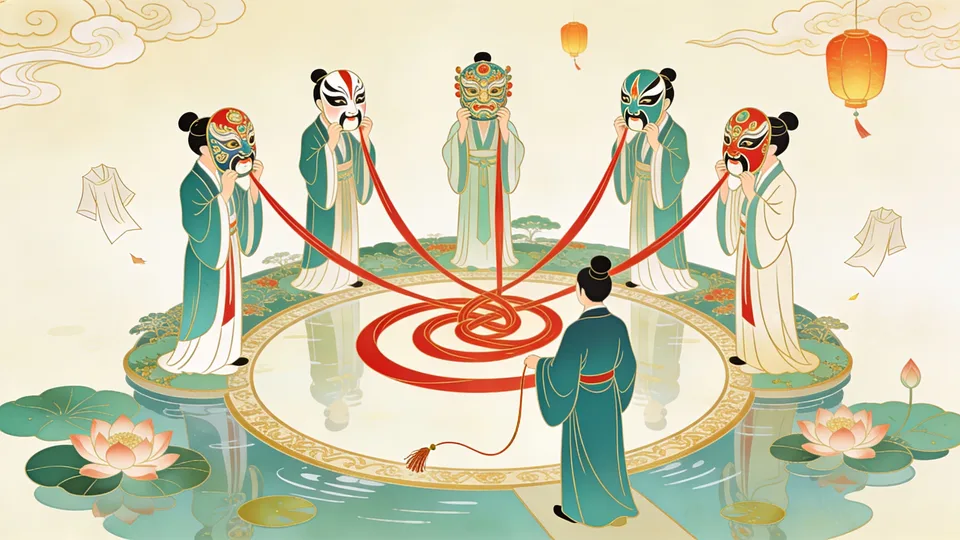
Social life is a zero-sum labor market of scripts. Every role you play requires someone else to play its counterpart. The grandmother needs the helpless parent who needs her childcare. The therapist needs the patient. The martyr needs the ingrate. The rebel needs the authority. When you stop playing your part, the people who built their identity around its counterpart are not merely inconvenienced — they are ontologically unemployed. Their script has no stage. What looks like “society wanting you in a legible predictable box” is not malice. It is the voice of a role that cannot justify its own continued existence without you.

This note grows from the intersection of respectability-rebellion-freedom, legibility-and-power, the-original-hedge, and identified-patient. The question it answers: why does individual freedom so reliably produce collective restriction? The claim it makes: because scripts are jobs, and when everyone is simultaneously employing and employed by everyone else’s legibility, the market for freedom collapses into an involuted resentment trap where every individual escape is registered as a communal bankruptcy.

Simple Picture

ELI5: a pickup soccer game has ten players because the game needs ten players. If you quit, the game does not continue minus-one — the game ends for everyone. Nine people are now standing in a field holding a ball nobody wants alone. Some will be furious with you. Not because they loved the game. Because they had nothing else to be doing at 4pm on Saturday. Your freedom from soccer was their involuntary weekend. What looks like “you’re a flake” is “I now have to reckon with what I’m doing with my life.”

Scale this up. The village is a game of interlocking positions. Each role is secured by every other role’s dependence on it. Grandmother has a script because parents need help. Parents have a script because grandparents are owed care. Children have a script because they will one day be old. Remove any piece and the whole intergenerational credit system becomes visibly contingent — which is indistinguishable, from the inside, from moral catastrophe.

Scripts Are Jobs

A script is a socially legible role: the dutiful daughter, the reliable friend, the strict father, the worried mother, the responsible eldest, the black sheep, the caretaker, the provider, the patient, the rebel. Legibility is the condition of its employability. Illegible roles cannot be filled because nobody knows what you are supposed to do when you encounter one.

The key structural feature: scripts require counterparties the way jobs require employers. The provider needs someone to provide for. The worrier needs someone to worry about. The caretaker needs someone who needs care. The rebel needs an authority. The respectable person needs a community that recognizes respectability. Each role is a demand for a particular kind of Other — and that Other must continue to be the Other for the role to pay out.

When a script’s counterparty liberates themselves — the child becomes financially independent, the patient recovers, the authority abdicates, the pupil surpasses the master — the role-holder is not merely deprived of the relationship. They are deprived of the self that the relationship sustained. The grandmother whose adult child no longer needs childcare is not just losing a service transaction. She is losing the version of herself that was legible as necessary. And necessity is where much of her worth as a person was stored.

This is why the response to another’s freedom so often runs on the frequency of grief disguised as anger: the role-holder is experiencing the redundancy of their self-model. The self-justification engine rushes in to convert the grief into moral accounting — “they’re selfish, they changed, they’ve abandoned us, they think they’re better than us” — because the psyche cannot metabolize “I am not needed” directly.

The Scarcity Structure

The trap requires one more ingredient: scarcity of recognizable roles. A society with abundant scripts — where a hundred ways of being matter to someone — can absorb individual departures, because the vacated script can be refilled from elsewhere or the role-holder can retool into a different legibility. The illegible margin is elastic.

Most actual communities run on the opposite: a narrow repertoire of prestigious scripts around which most recognition is organized. In mianzi-structured societies this is explicit — the ledger tracks a handful of legible statuses (filial child, successful son, obedient wife) and offers almost no alternatives. Western atomized modernity runs the same dynamic under different names: the “good parent,” the “career success,” the “close friend group,” the “engaged neighbor.” When a script market is narrow, every script is load-bearing on its current occupants, and every defection is felt as a general default.

This is the manufactured scarcity frame run peer-to-peer rather than top-down: the scarcity is not being produced by a distant system to extract rent. It is being produced by the community itself, through mutual investment in a small set of roles as the only legible ways of being a person together. The village’s script economy is the village’s coherence. Break the economy and you have not freed the village — you have unemployed it.

Other Forms of the Trap

The grandmother-childcare example generalizes across every relationship where identity is load-bearing on the other’s dependence:

The emotional-support friend circle. One member stops drinking, stops ruminating, stops being the reliable depressive. The script of “we are a support circle processing shared suffering” suddenly has a defector. The group will escalate — more check-ins, more “are you okay?”, more subtle sabotage attempts — because the freed member has revealed that the group was not actually sustaining each other but sharing an occupation. Their recovery is the group’s dissolution. The social cost of clarity lands here: the friendships were built on mutual investment in the scarcity itself.

The marriage scaffolded by children. When children launch successfully, parents whose marriage was built around child-raising often find the scaffolding was load-bearing. Two options: enforce ongoing child-dependence through guilt, manufactured emergencies, and “family” obligations — or face the hollow center of the marriage itself. The former is far more common. The children’s freedom is experienced as abandonment not because the children owed anything, but because the parents no longer have a shared project to disguise the vacancy between them. The pedestal dynamic reappears as a generational version: “we lived for you” is the confession of having outsourced identity to the child.

The recovering addict’s social graph. The addict’s sobriety destroys a specific script economy — the enabler, the co-user, the dramatic rescuer, the responsible sibling who manages the crisis, the family that defined itself by “we have an X problem.” Each role-holder has a stake in the relapse. Not because they are bad people, but because sobriety retires their employment. The identified patient mechanism lives here at civilian scale: when the IP refuses to carry the shadow, the system must reassign it, which is always costly.

The artist who makes money. Colleagues organized around “we are underappreciated, the system is rigged against real art” suddenly have a peer who is not. The peer’s success is evidence against the collective narrative. Two responses are available (the same two named in the IP framework): rewrite history (“they sold out / they were never really one of us”) or attack legitimacy (“they got lucky, connected, hot”). The artist who succeeds while remaining in the community must perform permanent shame about their success to keep the scripts employable.

The professional tribe defector. The lawyer who leaves to farm, the academic who leaves to start a company, the engineer who leaves to paint. The ex-colleagues do not merely lose a peer. They lose the consensus that “what we do is the only serious thing” — which was what made the daily sacrifice of the profession tolerable. The defector’s freedom is a live demonstration that the cage was always optional. The respectable cannot easily forgive someone who stepped off the axis, because the respectable person’s entire identity was the axis.

The depressive friend who stops being depressed. Shared suffering is one of the densest bonding materials available — it generates continuous material for conversation, mutual witnessing, and reciprocal caretaking. When one member exits the suffering, the bond’s fuel supply is cut. The remaining members will report, honestly, that they “miss the old you” — and what they mean is that they miss their employment by your suffering.

The diaspora that assimilates. A country of origin’s narrative often includes “our expatriates will return, we are still connected, they remain ours.” A thoroughly assimilated diaspora defaults on this narrative. Hence the moral pressure, the guilting, the “you’ve forgotten where you came from” — the home is experiencing its script (ongoing parent to the emigrant child) being made redundant. The intergenerational credit metaphor extends to civilizational scale.

The workplace complainer group. The team bonded over hating the boss. One member gets promoted, or quits, or stops complaining. The remaining close ranks: “they’ve been co-opted.” The bond was never love of one another — it was mutual employment in a shared ressentiment economy. The defector is not leaving the team; they are foreclosing on the team’s collective identity.

In every case the mechanism is identical: a role-holder’s self-continuity depended on another’s continued occupation of a counterpart role. The counterpart’s freedom registers as unemployment, which the psyche re-codes as betrayal, because “they stopped needing me” is a harder thing to feel than “they did something wrong.”

The Involution Spiral

The involuted form of the trap emerges when everyone is simultaneously both role-holder and counterparty. You depend on your parents’ dependence on you. Your parents depend on your dependence on them. Your friends depend on your availability, and you depend on theirs. Your professional cohort depends on you staying in the profession, and you depend on them doing the same. The web is fully recursive.

In this configuration, no one can achieve freedom without defaulting on the freedoms they are supplying to others. And because everyone is simultaneously employer and employed, everyone has an interest in enforcing everyone else’s continued occupancy. The net effect is a regime of mutual restriction that no single participant wants but all participants are compelled to contribute to. Every individual liberation is a collective loss. So the crowd develops immune responses — gossip, guilt, concern, intervention, gentle sabotage, worry, disappointment, withdrawal of care — calibrated to re-employ the defector back into legibility.

This is 内卷 (nèi juǎn, involution) extended to its full social domain. Involution, in its original economic sense, is running harder to stay in place because the gains are immediately captured by the competitive system. Social involution is restricting harder to stay in place, because every freedom gained by any individual is subtracted from everyone else’s sense of coherent selfhood. The effort expended is not productive; it produces nothing except the maintenance of the trap itself. And the effort is largely invisible because it is distributed across every small act of “caring,” “checking in,” “worrying about,” and “just wanting the best for” that the culture has developed to enforce mutual legibility while calling it love.

The proof-of-stake frame clarifies the mathematics: every participant has staked their self on the consensus. Any large defection crashes the stake of every co-participant. The system therefore evolves toward punishing defectors — not through explicit rules but through the involuntary reflexes of every person whose identity is at risk. The mimetic gradient names the mechanism from the opposite direction: the defector becomes mimetically anti-correlated with the consensus, and anti-correlation is precisely what the synchronized crowd cannot generate from inside itself. The grandmother was one form of this. The adult child who no longer needs her is another. Both are unbearable for the same structural reason.

Why Resentment Looks Like Care

The trap’s stability depends on one crucial feature: the enforcement mechanism must be invisible to the enforcer. If the grandmother realized that “I’m just worried about them” was “I am protesting my own unemployment,” she would feel shame, and the mechanism would fail. The self-justification engine prevents this realization. The grief of redundancy is metabolized into moral concern, and the resentment is converted into an accurate-feeling perception of the defector’s defects.

This is why the JADE trap is so reliable. The defector, sensing correctly that they are being restricted, tries to Justify, Argue, Defend, or Explain. But the restriction was never a cognitive claim to be disputed — it was a role market enforcing its terms. Argument only generates more material the system can metabolize into additional restrictions. Every explanation is re-employment.

The enforcer experiences themselves as concerned, loving, traditional, protective. And they are correct — they are all of those things, in the specific sense that “concerned” and “loving” and “protective” are the costumes their script-preservation instinct is wearing. The concern is real. The love is real. What is being defended, underneath, is the enforcer’s employment by a role structure they never consciously chose but on which their selfhood now depends.

Arendt’s insight applies at micro-scale: the deepest enforcement is not external coercion but the loss of the enforcer’s capacity to imagine a self that does not depend on the other’s legibility. The grandmother cannot picture who she would be if the grandchild did not need her. The parent cannot picture who they would be if the adult child had truly left. The friend cannot picture what they would talk about if their shared suffering were gone. The mask has become the face, and the face cannot survive the mask’s retirement.

The Three Stances Revisited

The three stances map precisely onto the involution trap:

The respectable response is to simply stay in one’s role. Do not defect. Do not attempt freedom. Perform the script faithfully, collect the recognition, and pass the ledger down. This is the trap’s preferred stable state. Cost: the slow amputation of internal life for the security of external legibility.

The rebel response is to defect loudly, in opposition. Reject the village, shame the scripts, make the defection a performance. This is the involution trap in negative — the rebel’s identity is still entirely mediated by the role economy, now as its explicit enemy. The rebel depends on the village the way the village depends on them. Ressentiment is the fuel. The rebellion does not free the rebel; it employs them in a new role the village still recognizes: the prodigal, the traitor, the one we worry about.

The free response is to defect quietly, without explanation, and to grieve for the enforcers one leaves behind — without absorbing their grief as evidence of one’s own wrongdoing. Freedom here is not the repudiation of the scripts but the refusal to be conscripted into either their enforcement or their opposition. The Adlerian move of separation of tasks is exactly the operational form: the enforcer’s grief is the enforcer’s task, not the defector’s.

This is why freedom looks like cruelty from inside the trap and like ordinary life from outside it. Kadag, in Tibetan Buddhist usage, is the name for the capacity to see the game without being captured by it — the capacity to love the enforcers precisely because you no longer need their employment.

Dimwit / Midwit / Better Take

The dimwit take is “people should just mind their own business and stop trying to control each other.”

The midwit take is “society needs social expectations to function; individuals who flout them are selfish, and the backlash is healthy social pressure.”

The better take is that the involution trap is not a failure of individual morality or a triumph of social cohesion — it is the structural consequence of organizing recognition around a small number of zero-sum scripts in a mutually dependent community. Everyone is simultaneously beneficiary and victim. The enforcers are not villains; they are people whose selves were pledged to a script economy that the defector is unwinding. The defectors are not heroes; they are people fortunate enough to have found other sources of legibility, or desperate enough to risk ontological exposure. The trap is only solvable by multiplying the sources of recognition — illegible margins, diverse reference communities, inner resources that do not require external employment — until no single script is load-bearing on any single counterparty. This is what functioning cultures used to do with a hundred small rituals of non-zero-sum meaning. The flattening of modern social life into a few legible success scripts is what made the involution trap total.

Main Payoff

The reason the involution trap is so hard to name from inside it is that it wears the mask of love, and the mask is not fake. The love is real; it is just entangled with employment. You cannot separate them with a scalpel. What you can do is recognize that a particular kind of pain — the pain that shows up when someone close to you gets freer, healthier, happier, more themselves — is the pain of a role that no longer has a stage. The pain is trustworthy as data; it is not trustworthy as moral judgment. The signal “they have done me wrong” is the cover story the psyche writes over “I am less necessary than I needed to be.”

The freedom the defector finds is not deserved, in any heroic sense. It is simply the discovery that the script was never mandatory, and that one’s worth was never contained in the counterparty’s dependence. The freedom the enforcer must find, if they find it, is harder: it is the construction of a self that does not need the defector’s unfreedom to have a face. This is the interior work that the script economy was invented to spare everyone from having to do. Every generation that is willing to do it shrinks the involution trap by exactly that much. Every generation that refuses pays the ledger forward, and the third generation inherits whatever the first two could not bear.

References:

  • Xiang Biao, on 内卷 (involution) as a social-structural condition
  • James C. Scott, Seeing Like a State — legibility as power technology
  • Hannah Arendt, The Origins of Totalitarianism — on loneliness, atomization, and the superfluity of the loose individual
  • René Girard — on mimetic desire and scapegoating as the discharge of accumulated mimetic pressure
  • Anthony De Mello, The Song of the Bird — kadag and the third stance