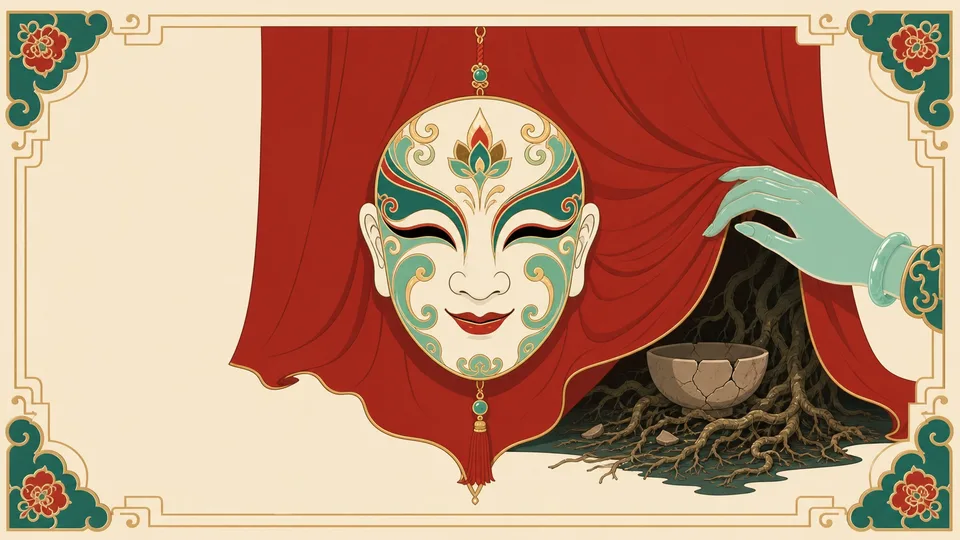
Kitsch is sentimentality with the dirty parts removed. It is not just cheesy taste, porcelain angels, inspirational sunsets, or mass-produced emotional décor. It is the aesthetic technology by which a person, movement, nation, relationship, or cause protects its sacred self-image from reality.
Kitsch is the beautiful lie that says: only this clean emotion is allowed; do not look behind the curtain.
That is why Kundera’s version is sharper than the ordinary art-world insult. Bad taste is merely embarrassing. Kitsch is politically and spiritually dangerous because it edits reality until the viewer is morally blackmailed by beauty.
Simple Picture
ELI5: kitsch is a perfect family photo presented as the truth of family life while the screaming, bills, jealousy, poop, boredom, lust, resentment, illness, and confusion are shoved outside the frame.
The photo is not false because love is false. Love can be real. The lie is the frame’s demand that love remain clean enough to photograph.
The Mechanism
Kitsch works by subtractive purification. It takes a real feeling — grief, love, patriotism, tenderness, solidarity, sacrifice — and deletes everything that would complicate the feeling.
The patriotic montage removes cowardice, corruption, bad luck, boredom, profiteering, and the fact that many soldiers want to go home. The Instagram relationship removes negotiation, money stress, fatigue, resentment, sex weirdness, and the low-grade logistical labor that real intimacy runs on. The charity ad removes the recipient’s agency so the donor can experience himself as beautiful. The political poster removes hunger and fear, leaving only smiling workers under the flag.
The feeling is not invented. The purification is the lie.
This is the dark side of beauty as a truth-signal. Beauty can reveal hidden order, but coherence can also be manufactured by deletion. Kitsch is beauty after the audit trail has been shredded.
Emotional Totalitarianism
Kitsch becomes totalitarian when it makes refusal look like corruption.
A kitsch image says: look how pure this is. Look how noble. Look how sacred. Anyone who complicates this is cynical, impure, ungrateful, bourgeois, unpatriotic, unserious, or dead inside.
This is why kitsch belongs beside totalitarianism, not merely beside bad interior design. Totalitarian ideology does not only command belief. It engineers the emotional atmosphere in which disbelief feels obscene. The smiling worker, the radiant martyr, the noble motherland, the stainless activist, the perfect couple: each image narrows the permissible range of experience until reality itself becomes a kind of treason.
Kitsch does not say, “Believe this proposition.” It says, “Feel this pure feeling with us, or reveal yourself as the kind of person who cannot feel properly.”
That is more invasive than argument. Argument meets the mind. Kitsch occupies the conscience.
The Sacred Self-Image
The social function of kitsch is self-protection. It protects the viewer from contact with the parts of reality that would damage their preferred image of themselves.
The nationalist does not want to ask what his nation did to its enemies or its poor. The romantic does not want to admit that love includes bargaining and disgust. The humanitarian does not want the suffering person to become too complex, because complexity would interrupt the donor’s moral glow. The revolutionary does not want the workers to be cowardly, bored, horny, selfish, funny, or tired, because then the poster stops being an icon and becomes anthropology.
This is the same nervous-system move described in self-display under the Machine: the performance replaces the thing and then becomes more socially legible than the thing. A real relationship is messy. A posted relationship is coherent. A real cause is morally mixed. A poster cause is luminous. A real nation is historical sediment. A montage nation is sacred essence.
Kitsch is what happens when the image wins.
Kundera’s Sabina
In The Unbearable Lightness of Being, Sabina hates kitsch because she recognizes fake holiness. Communist propaganda is kitsch, but so is Western moral romanticism. The enemy is not one ideology. The enemy is unified moral prettiness.
Franz is kitschy because he wants noble causes and grand gestures to redeem life from ambiguity. He wants meaning to arrive wearing clean clothes. Sabina’s instinct is betrayal: whenever an image becomes too beautiful, too unified, too morally certain, she escapes. Betrayal is her anti-kitsch reflex — the refusal to let any image become a sacred cage.
This is not cynicism. Cynicism refuses to be moved because being moved is risky. Sabina refuses the fraudulent demand that being moved requires surrendering perception. She is defending the right to feel and still see.
Sentiment Is Not the Enemy
The important distinction: sentiment is not kitsch.
Love, grief, beauty, tenderness, patriotism, religious devotion, and collective joy can be real. The anti-kitsch move is not to sneer at emotion. Sneering is just another defense against contact.
The question is whether the emotion permits reality to remain present.
Real grief allows anger, stupidity, logistics, numbness, inappropriate jokes, and relief. Kitsch grief permits only noble tears. Real patriotism can love a place while seeing its crimes. Kitsch patriotism makes sight itself betrayal. Real love includes embarrassment, bodily oddness, unmetabolized family scripts, and money. Kitsch love requires the sunset to mean the resentment is not there.
Sentiment becomes kitsch when it demands immunity from contradiction.
Dimwit / Midwit / Better Take
The dimwit take is “kitsch means cheesy tacky stuff.”
The midwit take is “kitsch means sentimental art that manipulates emotion.”
The better take is that kitsch is social technology for protecting sacred self-image from reality. It does not merely manipulate emotion. It polices which emotions may exist in public, which complications may be named, and which observers are morally allowed to interrupt the scene.
The worse-is-better reality: kitsch works because people need clean images. A movement, brand, family, religion, or nation that shows all its ambiguity at once becomes uninhabitable for ordinary nervous systems. Compressed symbols coordinate because they simplify. Kitsch is the pathological version of that coordination: simplification promoted from usability to truth.
Main Payoff
The mature move is not anti-sentiment. It is audited sentiment.
Feel the beauty, then ask what it had to exclude in order to feel complete. Feel the patriotism, then ask who disappeared from the montage. Feel the romance, then ask what labor keeps the scene lit. Feel the moral glow, then ask whose complexity was sacrificed so you could feel clean.
Kitsch is anti-truth prettiness. Its opposite is not ugliness. Its opposite is beauty that survives the return of the mess.
References:
- Milan Kundera, The Unbearable Lightness of Being