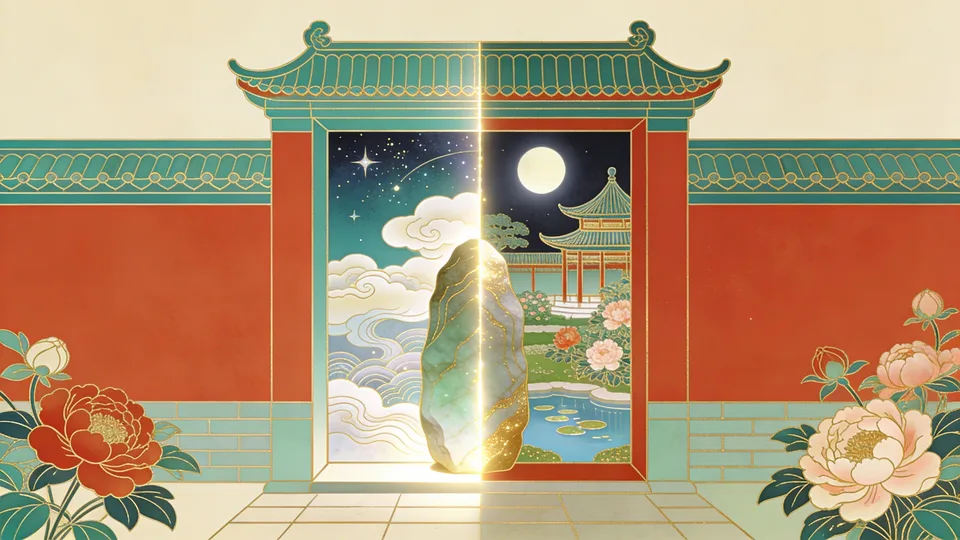
A stone was warned that everything it loved would be taken away, and asked to go anyway.
Cao Xueqin’s novel begins with a stone. When the goddess Nüwa repaired the broken sky, she smelted blocks of stone for the work and used every one but a single piece, which she left lying at the foot of a mountain. The leftover stone is conscious, and aware of its uselessness. When a Buddhist monk and a Daoist priest pass by talking about the splendors of the human world, the stone begs them to take it there, so that it can experience desire, beauty, and loss. They warn it that the pleasures of the red dust (红尘) do not last and end in sorrow. It insists. Its wish is granted, and it enters the world as Jia Baoyu, a boy born with a piece of jade in his mouth into one of the wealthiest families in the empire. The garden that family later builds, 大观园, the Grand Prospect Garden, is where most of the story unfolds.
Readers who come to Dream of the Red Mansion without that frame tend to read it either as a love story about a rich boy who could not marry the right girl, or as an allegory of feudal decline. Both readings are true as far as they go, and neither explains why the book opens in heaven with a stone that knows in advance how things will end and asks to go anyway. The novel’s other title, 石头记, The Story of the Stone, insists on that frame. So the question worth asking is why anyone, stone or reader, would choose a beauty they already know will be taken away.
The stone’s bargain
Before its descent the stone exists outside of time and can see everything but experience nothing. Its deal is to enter a beautiful world and love it, knowing everything it loves will be taken away and it will return with nothing but the memory. Read this way, the stone’s journey is the idea of Consciousness as Ground told as fable: awareness without shape or time chooses to enter a world of shape and time. The setting is Buddhist, but the parable does not argue that illusion is bad. It shows illusion to be irresistible. The stone has been told the red dust is suffering and goes anyway, because eternity without experience is its own kind of poverty.
The garden is the container for that bargain. It is built for a single occasion, the visit home of the family’s eldest daughter, who has become an Imperial Consort, and the family pours its fortune into pavilions, lakes, and bamboo groves that say we are worthy, we will last, while debt and corruption hollow it out from behind. But after the visit, Baoyu and his young cousins move in. They fall in love there, form a poetry club, and quarrel, and a fiction built to conceal the family’s condition creates a life more vivid than anything that condition could have supported. It is a beautiful world entered knowingly, for a while, on borrowed money and borrowed time.
Daiyu buries the flowers
The novel’s most famous scene shows what it means to live in such a place with open eyes. Lin Daiyu, Baoyu’s cousin and the love of his life, sweeps up fallen petals in a silk bag, carries them to a mound in the garden, and buries them while singing an elegy:
花谢花飞花满天,红消香断有谁怜? Blossoms fade and fly across the sky — who pities the red that fades, the fragrance that dies?
It could be read as melodrama, but the novel treats it as its thesis. Impermanence does not diminish the beauty of the flowers. The beauty is impermanence perceived by a consciousness that cares. A flower that never wilted would not be more beautiful. It would be plastic, and nobody would sing to it. Daiyu buries the petals because she knows, as the stone knew, that she belongs to the same season they do.
The alternative is the heart C.S. Lewis described in The Four Loves, locked in a casket where it will not break but will become unbreakable, impenetrable, irredeemable. Daiyu is its opposite: a heart held completely open, which knows it will be destroyed and chooses to feel everything anyway. The garden teaches that the only thing worse than losing what you love is never having loved it — and that these two options are the only ones available.
The bargain comes due in her. In the 120-chapter version most readers know, whose last forty chapters were completed after Cao’s death, the elders arrange for Baoyu to marry the sensible Xue Baochai by deceiving him into thinking his bride is Daiyu, and Daiyu dies while the wedding is under way. Baoyu eventually vanishes with the monk and the priest. By the end the garden is empty. The pavilions stand and the paths remain, but the people who made it alive are scattered, dead, or diminished past recognition.
Who keeps choosing it
The stone is not the only one who makes the bargain. Cao Xueqin wrote from ruin. His family fell from imperial favor in his childhood, its property confiscated, and he spent his adult life in poverty, reconstructing in prose a paradise he had to lose before he could write it. The reader makes the same choice. You know the garden will empty, Daiyu will die, and the family will fall. You open the book anyway, and for several hundred pages the love is real and the loss has not happened yet.
So the love story and the history of decline are both inside the book, but the frame holds them together. The garden is a metaphor for consciousness entering form. Stone, author, and reader each choose to care about something impermanent, which is the only kind of thing there is to care about. Its final argument is that the willingness to be destroyed by beauty is what makes consciousness worth having.
大观 means “grand view,” the ability to see everything at once. The garden promises a vantage point, and the novel’s deepest joke is that the view is not of paradise. It is of paradise disappearing. When the story ends the stone goes back to the foot of the mountain carrying exactly what it was promised: nothing but the memory that it mattered.
References:
- 曹雪芹 (Cao Xueqin), 《红楼梦》(Dream of the Red Mansion / The Story of the Stone)