Being able to explain exactly why you’re stuck can be the most comfortable way to stay stuck.
The really great thing about being smart and self-aware is that instead of falling into the common traps everyone falls into, you invent entirely new ways of being mentally ill that are way harder to identify and fix.
The joke cuts against a reasonable belief. Intelligence should help: someone who can notice their own patterns, name them and read about them ought to get unstuck faster than someone who can’t. A therapist once put the objection this way: strong swimmers are more likely to drown than people who stay out of the ocean because they can’t swim.
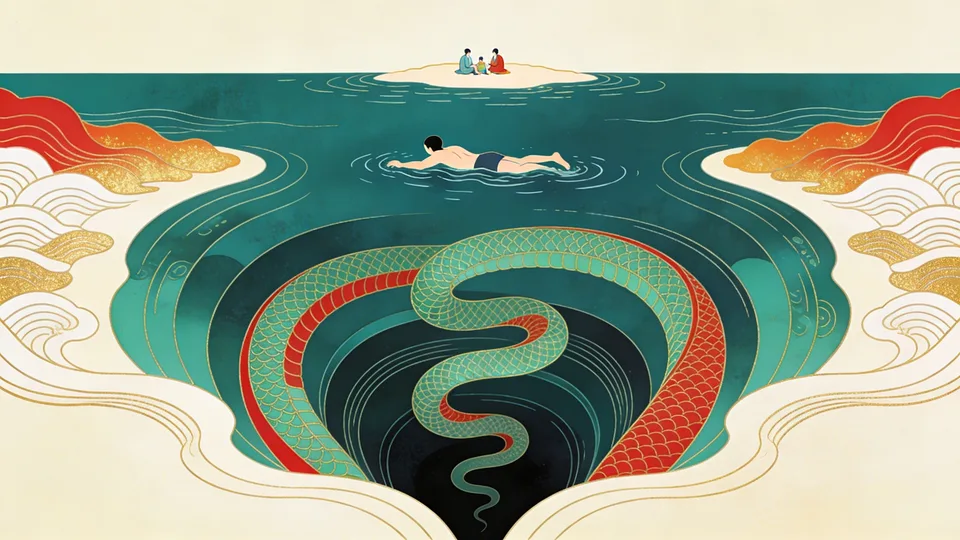
Picture a lake. Non-swimmers stay on the shore, where the problems are sunburn and boredom. Strong swimmers head for the deep end, where the currents are complex and the bottom is invisible. The standard mental-health playbook is a lifeguard manual for the shallows. It covers denial, projection, blame and avoidance, the drowning patterns of people who fell in by accident. It says little about someone who swam out on purpose and got pulled under by a current that only exists at that depth.
Intelligence does not protect you from psychological dysfunction. It gives you access to more sophisticated versions of it.
The map becomes the trap
Take someone who has repeated the same pattern for years, say, pulling away from every relationship just as it gets close. A person with little self-awareness repeats it and doesn’t notice. The strong swimmer notices. They can trace the pattern to its developmental origins, name the attachment style, cite the literature, and predict the next repetition before it happens. And none of this moves them an inch.
The reason is that the explanation has become the defense. Each layer of insight adds another surface for the pattern to hide behind, and because the explanation is accurate, it feels like progress. This is the diagnosed life: clinical vocabulary arranged into an elegant catalogue of your dysfunction that feels like understanding but works as a more sophisticated avoidance. You have not processed anything. You have catalogued it.
What makes this vicious is that the tool you would use to find the problem is the problem. Self-awareness that built the trap cannot, unchanged, detect it, just as a compiler cannot find its own bugs when every error looks correct from inside the compiler. So the deeper water fills with traps that look like insight and then traps that look like the cure: self-criticism dressed as accountability, Self-Acceptance attempted through the machinery of self-rejection, a defense so tailored that no clinical manual names it, because a mind smart enough to evade every category built it.
Why help struggles to reach them
The swimmer is also hard to help, and not out of stubbornness. The DSM catalogues common patterns and CBT restructures common distortions. Someone who has already anticipated each intervention, with the same pattern recognition that makes them good at everything else, can absorb it into the model. The therapist names the avoidance, the swimmer agrees and adds a footnote, and the footnote becomes part of the wall. The safety trap is the emotional version: a heart so intelligent about risk that its defenses against closeness look exactly like wisdom, until you notice they produce the same result as cowardice.
None of this means smart people are worse off overall. Higher intelligence correlates with better life outcomes, and the strong swimmer really does avoid the obvious traps. The claim is narrower. Intelligence shifts the distribution of problems rather than shrinking the total: fewer common problems, more exotic ones. The aggregate statistics look good because they count shore-level outcomes. They don’t count the currents that only exist at depth.
Getting out
The exit is not less intelligence. It is intelligence that has learned to distrust itself, that assumes its blind spots grow with its acuity. For the person pulling away from every relationship, that may mean treating the next brilliant explanation as a symptom rather than a breakthrough. The strong swimmer who survives open water is not the one who swims hardest. It is the one who knows the ocean is bigger than she is, that there are currents she cannot see, and that the most dangerous moment is when she feels most confident in the water.