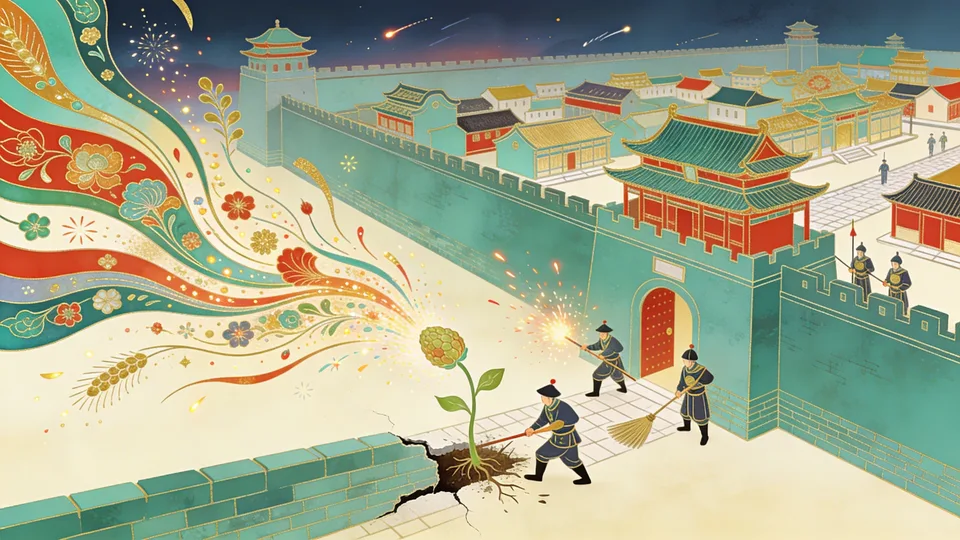
A village strict enough to stop every crank will also stop its next prophet.
In Lila, Robert Pirsig tells of a brujo in Zuñi who had learned to value some of the ways of his new neighbors. Looking back, Pirsig sees him as the precursor of deep cultural change. The war priests of his own tribe probably saw something else: an egotist trying to tear down tribal authority. From inside the tribe, there was no obvious way to tell which he was. A man who breaks the rules because he has seen something better looks, talks and acts much like a man who breaks them because he is bad.
Most of us assume that a healthy culture can tell the difference, rewarding its innovators and punishing its criminals. Pirsig’s sequel to Zen and the Art of Motorcycle Maintenance argues that it structurally cannot, and that this is not simply a flaw to be fixed.
Two kinds of quality
Pirsig’s frame is a split between two kinds of Quality. Although Dynamic Quality — the Quality of freedom — creates this world in which we live, the patterns of static quality — the Quality of order — preserve it. Neither works without the other. The brujo was Dynamic Quality arriving; the war priests were static quality defending what already worked.
When something new and Dynamic wants to enter the world, it often looks like hell. So the culture responds with what Pirsig calls the cultural immune system. Just as the biological immune system will destroy a life-saving skin graft with the same vigor it fights pneumonia, the cultural immune system fights off beneficial new understanding with the same vigor it uses to destroy crime. It cannot distinguish between them. The trade cuts both ways: the freedoms that save the saviors also save the degenerates. The restrictions that stop the degenerates also stop the creative Dynamic forces of evolution.
New York is Pirsig’s picture of the trade made in favor of freedom. Its strength is its looseness. The freedom to be so awful is what gives it the freedom to be so good. Pass static laws to cut out the worst, and the best goes with it; what’s left is suburban blandness. What keeps the good from drowning in the bad is a rare kind of person who can look at something new and say “Hey, wait a second! That’s good!” without looking over their shoulder to see whether anyone else is saying it. That is the cat quality: judging the thing itself rather than its social certification. The brujo needed someone like that, and the priests weren’t it.
Why order still matters
It would be easy to conclude that the priests were simply wrong. Pirsig doesn’t. He ranks static patterns in levels, inorganic, biological, social and intellectual, and a higher organism feeds upon a lower one and accomplishes more by doing so than the lower organism can accomplish alone. On that ranking, it is more moral for an idea to kill a society than for a society to kill an idea. But social patterns are also what keep biological chaos at bay. You cannot talk crime to death. The instrument of conversation between society and biology has always been a policeman and his gun.
So the danger runs in both directions, and Pirsig is sharpest about the side that believes itself safe from it: a ruthless, doctrinaire avoidance of degeneracy is a degeneracy of another sort — that is the degeneracy fanatics are made of. Purity, identified, ceases to be purity. The old social codes should not be followed blindly, but they should not be attacked blindly either. They should be re-examined to see what they were trying to accomplish. A society that cannot affirm its strong gods invites catastrophe, no less than one that cannot question them.
That leaves the brujo’s question open for every community that has ever had one. The priests were doing their job, and their job was to keep the tribe safe from people who looked exactly like him. Nothing disturbs a bishop quite so much as the presence of a saint in the parish.
References:
- Robert M. Pirsig, Lila: An Inquiry Into Morals