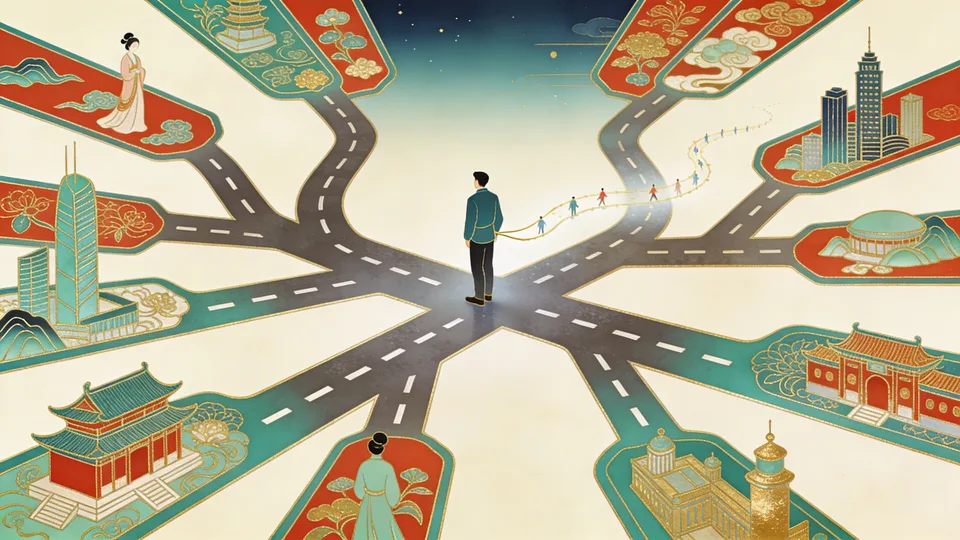
He’d rather sleep in the rain than carry a rucksack. A rucksack means he’s going somewhere.
Some men always have a “but”. The woman is nice as a girlfriend, but. The job is interesting, but. There is always a hair in the soup. Often they are the most interesting people in the room: quick, unconventional, drawn to deep questions. So why does someone so gifted keep refusing to land?
Jung and Marie-Louise von Franz used an old name for this figure: the puer aeternus, the eternal boy. His defining trait is the provisional life: the strange attitude that one is not yet in real life. For the time being he is doing this or that, but whether it is a woman or a job, it is not yet what is really wanted. There is always the fantasy that sometime in the future the real thing will come about.
Why weight feels like death
Picture a man who will not carry a rucksack. He trains himself to sleep in the rain, eat nothing, need nothing. This is not toughness for its own sake. Weight represents commitment, and commitment represents the death of infinite possibility, so he would rather endure any hardship than accept the limits of a specific life.
The one thing this type dreads throughout is being bound to anything whatever. Behind that dread is a terrific fear of being the singular human being one is. Choosing one woman, one city or one career means losing all the others, and the puer experiences that loss as a kind of death. So he hovers. He often travels compulsively, moving not to explore but to avoid the commitment that staying would require.
The provisional life usually comes with a justification. The secret thought is that one day he will save the world: the last word in philosophy or art or politics will be found, and his time has not yet come. Whether mild grandiosity or megalomania, it makes refusing the present look like waiting for the future.
The mother behind the fantasy
Jung traced the pattern to an outstanding mother complex, and one of its typical forms is Don Juanism. The image of the perfect woman, the mother goddess who will give everything, is projected onto each new partner. Each time he is fascinated, he eventually discovers she is an ordinary human being; the fascination vanishes and he turns away, disappointed, to project the image onto the next. No real person can compete with a maternal woman who would satisfy every need.
This is the rucksack again, in romantic form. A real woman is weight. She has limits, moods and a life of her own, and choosing her closes off the fantasy of the one who would have had none. That is why the puer’s infatuations burn so bright and end so abruptly: as Desire vs Love puts it, he is chasing the wound, and the crash comes at the moment the real person becomes visible.
The charm is real
It would be easy to say he just needs to grow up and get a job. That misses what is genuinely there. The puer often has a certain spirituality that comes from close contact with the unconscious. He is agreeable to talk with, invigorating, unconventional, and he goes straight for the truth. He has the charm of youth and the quality of champagne.
The opposite mistake is to call him more evolved for refusing to sell out. His freedom is real but incomplete. He has access to something the conventional person has lost, but he has not done the work of bringing that gift into form. The man who won’t carry a rucksack has real endurance; he has simply spent it on avoiding weight rather than carrying it. And the same immediacy that makes him sparkling in conversation makes him unreliable as a partner or friend, because his “yes” means “maybe, if I feel good the day-of.”
David Foster Wallace described the kind of freedom the puer is running from:
The really important kind of freedom involves attention and awareness and discipline, and being able truly to care about other people and to sacrifice for them over and over in myriad petty, unsexy ways every day. — David Foster Wallace
The puer hears “petty, unsexy ways every day” and recoils. His core illusion is that commitment is the death of possibility. Every door left open, though, is a door he has not walked through. The provisional life feels like it preserves options, but it prevents the one thing he most wants, the real thing, which can only arrive when he stops holding out for it and picks up the weight.
References:
- Marie-Louise von Franz, The Problem of the Puer Aeternus
- C.G. Jung on the mother complex