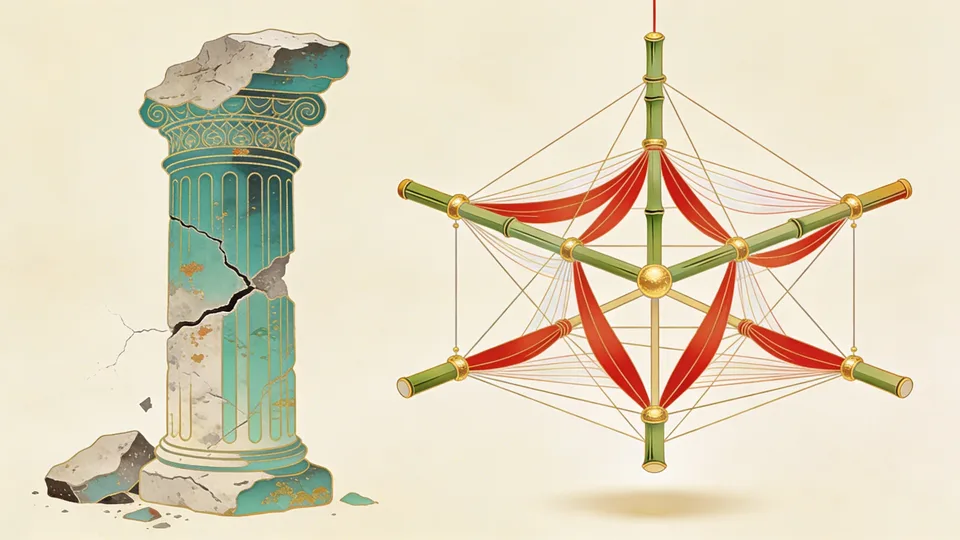
The taller your stack of titles, the less it takes to knock it over.
Ask someone who they are and you usually get a stack: a job title, a belief or two, a virtue they hold themselves to. “I’m an engineer, a runner, the reliable one.” Each label rests on the ones below it, and the stack gets taller and more impressive with every promotion and achievement. Then something removes one brick. The job ends, a belief stops making sense, or the reliable one lets someone down badly. For some people that loss is painful but local. For others the whole structure seems to go, and they can no longer say who they are. What makes the difference?
Columns and bridges
Buckminster Fuller distinguished two ways of holding up weight. A stone column bears it through compression: each stone pushes down on the one below, and past a certain height the column buckles under its own weight. A suspension bridge bears it through tension: cables pull the deck up while gravity pulls it down, and the integrity of the structure lives in the balance between opposing forces. Fuller’s name for the general principle was tensegrity, rigid struts that never touch each other, floating in a continuous web of tension that holds them in relationship.
Most identities are columns. Each label is a brick, and when one is removed, everything stacked on it has nothing to stand on. That is why losing a job can feel like losing a self: the job was carrying everything built on top of it.
Compression is the locally optimal way to build an identity. You pick the traits that worked, suppress the ones that didn’t, and stack the winners. In the environment that shaped it, this works beautifully, because the tower earns esteem and gives other people legible coordinates. But it has three structural problems.
It can’t absorb shocks. When a key brick goes, the column doesn’t flex. It cracks.
It grows heavier with success. Each credential and each new “I am this kind of person” adds weight, until the mask, the social persona built brick by brick to earn esteem, weighs more than the daemon underneath it can support. The most successful people can hit this earliest, because they stack fastest.
It excludes by design. A column works by deciding which bricks belong, so everything that doesn’t fit gets suppressed, denied or projected onto other people. The engineer who is “the reliable one” has nowhere to put the part of him that is tired of being relied on. A compression identity ends up at war with its own rejected material, spending on suppression the energy it could spend on integration.
Holding the contradiction
A tensegrity identity treats the contradictions as the cables. You are ambitious and lazy, kind and capable of cruelty, certain about some things and bewildered by others. The tension between wanting intimacy and needing solitude is the pull that keeps the bridge across the gorge, and resolving it would cut a cable. Roles, beliefs and commitments are the struts. They don’t need to form a coherent stack, because they aren’t stacked. They float, held in relationship by the tensions between them.
That changes what losing a brick means. When the engineer’s job ends, a strut is gone, so the structure sags and has to rebalance. But the other struts were never resting on it. The pull between his ambition and his wish to rest, between being relied on and wanting to be looked after, is still there, and it holds his shape while he finds out what replaces the missing piece.
It also explains why Self-Acceptance can’t be one more brick. “I accept all my parts equally,” stacked on top of the existing tower, is still compression. Structurally, acceptance means seeing that the tensions between your parts are the structure. The daemon isn’t the enemy of the mask. It is the opposing cable without which the mask collapses into a pile of disconnected bricks.
The opposite failure
The obvious objection is that this sounds like permission to be nothing in particular: you contain multitudes, so commit to none of them. But a tensegrity structure still needs struts, and a web of cables with nothing rigid in it has no shape at all. The person who tries to be nothing, all fluidity and no commitments, has no structure, which is the provisional life of the Puer Aeternus. The person who tries to be one thing, all rigidity and no contradictions, has a structure that can’t survive contact with reality.
So identity requires both rigid elements and the tensions between them, and the integrity is in the tension, not the rigidity. It needs to be committed enough to have a shape and flexible enough to absorb shocks, held together by the balance of its pulls rather than the weight of its bricks. You are not a building. You are an architecture — and the architecture persists when every brick has been replaced.
Which leaves the question a column never has to face. If every brick can be replaced, what were you protecting by stacking them so carefully?