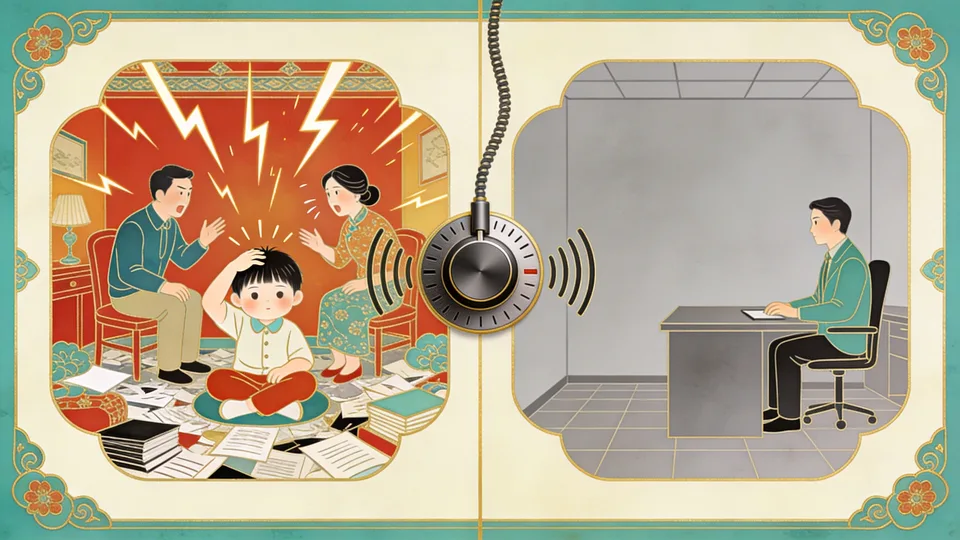
The adult who can’t start the report may still be saying no to a parent.
You reach the bottom of a page and realize you took in none of it. Most explanations of attention deficit disorder treat this as a failure of the machinery, whether of discipline or of brain chemistry. Gabor Maté, a physician who was himself diagnosed with ADD as an adult, starts from the experience instead. The hallmark of ADD is an automatic, unwilled “tuning out,” a frustrating non-presence of mind. And he asks what that tuning out was originally for.
His answer is that it isn’t a defect in the hardware. It is an automatic brain activity that originated during rapid brain development in infancy when there was emotional hurt combined with helplessness.
A defense that outlived its danger
Picture an unusually sensitive infant in a home full of emotional static: a stressed parent, a strained marriage, nothing dramatic. The baby can’t leave, can’t fix it and can’t even name it. The one thing a developing brain can do is turn the volume down. In Maté’s account, people with ADD are hypersensitive by temperament, and ADD usually comes from the environment’s impact on such infants. The tuning out that protected the infant becomes the tuning out that sabotages the adult, because the volume knob is now stuck.
The same sensitivity explains the second hallmark. Any pressure, however well meant, lands on such a child at magnified strength and provokes counterwill: an automatic resistance arising from the fear of being controlled. The toddler builds a wall of “no’s,” and behind it she can slowly learn what she likes without being flattened by the far stronger will of the parent. Counterwill is the small fence placed around a young, tender shoot to protect it from being eaten. The fence is only needed because a strong sense of self hasn’t yet grown. In the ADD adult, procrastination and automatic resistance are often the fence still standing around a shoot that needed it at age three.
The adult behind the fence
That history leaves the grown child with a specific problem. The unsolved problem is how to be oneself in contact with other people. The person craves closeness, dreads rejection and doesn’t know the difference between refusal and rejection, so every “no” feels like the universe denying his right to exist. The usual solution is to stop saying no. The adult with ADD is buried under a mound of yes’s, many of which are not true yes’s at all — only no’s he dared not say. She tones down her intensity, feigns interest in what bores her and works hard at seeming normal.
The suppressed self doesn’t disappear. The more the core self is suppressed, the more compulsive are the attempts to compensate by satisfying superficial, infantile, instant-gratification impulses. Buying sprees and binge eating look like failures of discipline, but on Maté’s account they are attempts to feel something through the numbness. And when such a person finally starts to say real no’s, guilt arrives, because guilt was the original enforcer of the yes’s. Maté treats it kindly: Guilt cannot grasp that its services are no longer required. It just hangs around, making us feel uncomfortable.
A wound and a gift
Maté’s model, also distilled in the garden’s ADHD note, is not the mainstream one. Twin studies find ADHD highly heritable, and most clinicians treat it as a neurodevelopmental condition for which medication often helps. Maté locates the inherited part in sensitivity and puts his weight on early environment, which is his reading rather than settled science. What his model offers is a way to see the condition whole: sensitivity + inadequate emotional attunement in infancy produces the neurological pattern we call ADD, and the pattern is simultaneously a wound and a gift. The sensitivity that makes a boring meeting unbearable is the same sensitivity that makes the person see what others miss. Maté sees it as the common root of both ADD and creativity.
So the work is not to suppress the sensitivity but to provide, finally, the conditions that were missing when the brain was learning how to attend. It can’t be done by escaping the old hurt, because Pain cannot be killed; it needs to be listened to. There is no path toward oneself that leads away from the pain.
That leaves the static in the infant’s home. Maté traces it to parents caught in the same pattern, without condemning them: We cannot endure seeing the needs of other people, least of all those of our children, when we are preoccupied with serving our own false needs.
References:
- Gabor Maté, Scattered Minds: The Origins and Healing of Attention Deficit Disorder