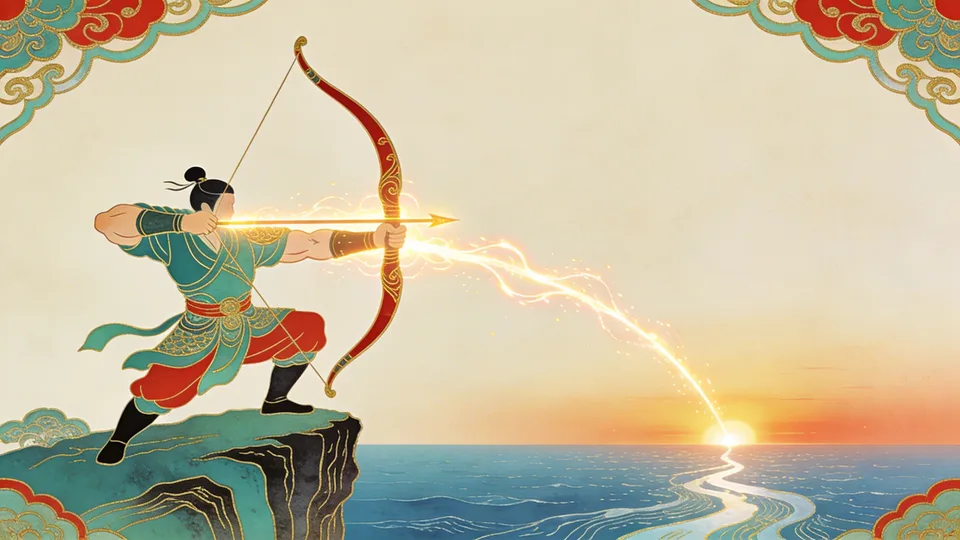
An unstrung bow is perfectly at peace, and it will never hit anything.
We usually picture the Prime Mover as a cosmic domino-flicker: a distant entity that set the universe in motion and stepped back to watch. In that picture God, or the Universe, is an architect of the past, separated from us by the march of time, with little to do with what happens in a life right now.
But what if the Prime Mover is not a push from behind but a pull from ahead? Then it is not an event that happened but a structural reality that is happening, beneath the surface of everything. When mystics equated ultimate reality with “Love,” they were not talking about romance. They were describing that pull. Love, in this ultimate sense, is the gravitational pull of the universe trying to put itself back together.
The draw and the release
To see what that means in a single life, picture drawing back a heavy recurve bow and holding it at full anchor. The tension is immense. That tension is the ego, and it is useful: it gives you an identity, a boundary, a way to act on the world. But try to hold it forever and your muscles shake, your joints ache, and eventually you collapse. Suffering is the exhaustion of trying to maintain separation from the whole.
Love is the release of the string. It is not an action you perform but a yielding. An archer who releases doesn’t push the string forward; they relax their grip and let the bow do what it naturally wants to do, which is return to its resting geometry. That is why getting out of the car can’t be a technique: it is the cessation of the thing you were effortfully doing.
The body knows this before the mind does. Strength and balance come not from rigid, isolated muscle tension but from aligning the skeleton so that gravity flows through you rather than against you. Moments of deep compassion, of being lost in beauty, or of serving something larger work the same way. You are not generating an emotion so much as letting the universe’s pull pass through you, before the intellect chops the moment into “you” and “me.” That is why love feels like coming home: for a moment you have dropped the exhausting project of absolute independence.
Why draw the bow at all?
If the release is the return, why does the draw exist? Why not stay integrated?
Because a bow resting unstrung is perfectly integrated, perfectly at peace and entirely useless. The universe does not seem content to remain an unconscious, undifferentiated soup. It wants to know itself, and to do that it has to split into subject and object. Imagine an eye floating in a void. It can see perfectly, but it can’t see itself, because it has no mirror. To see itself it must split into two eyes, step back and look across the gap. Drawing the string is stepping away from the whole to make that gap, and the tension you feel is the distance between “me” and “not-me.” Hegel described the same movement as alienation: Spirit separating from itself to create the friction that self-awareness needs.
Archery adds a precise detail. Because of the archer’s paradox, the arrow must bend around the riser to fly straight, and the archer clears the paradox not by going slack but by applying specific, localized torque at the moment of release (khatra), which lets the bow spin naturally (yugaeri). Individuation — building a sharp, highly competent, uniquely tuned ego — is the torque. You build the self so that when you finally surrender, the release has the force to alter something rather than collapsing limply. A person who has never played their edge, never drawn the bow to full tension, has nothing to release. An undrawn bow is not enlightened. It is inert.
Isn’t this just biology?
The strongest objection is that none of this needs a Prime Mover. Individuation is what a mammalian nervous system does to survive: the drive is dopamine, the tension is cortisol, and the whole arc falls out of evolutionary game theory. That account is good at mechanism. What it leaves out is direction, the way strong selves so often end up spent on something larger than themselves. The reading here is that the draw is aimed. You individuate not to stay isolated but to acquire the precise mass and informational density needed for a higher-order, conscious reintegration — the omega point. That is a teleological claim rather than a finding, and it is offered as one.
The familiar advice to secure your own oxygen mask first is not wrong either: you have to build an ego before you can transcend it. The mistake is to get stuck at either end. Refusing to draw at all, out of fear of tension, is spiritual bypassing. Holding the draw until the frame shatters is narcissistic hyper-individuation. The person organized around pain holds the draw indefinitely, because the tension justifies itself. The person organized around aliveness draws, aims and releases.
The foundational rule of reality is not chaos, indifference, or competition. The foundational rule is convergence. If that is right, the Prime Mover is not waiting at the end of time. It is the pull you feel whenever the boundary between self and world thins: in genuine connection, in surrendered service, in the instant the fingers open on the string. Which leaves the question every archer faces at full anchor: how do you know the draw is long enough?