Hold your breath to study breathing and you’ve stopped the thing you came to see.
Ask what animates the universe and the answers come back as nouns: God, consciousness, energy, love. Each tradition names a substance seated behind everything and argues with the others about which substance it is. The garden has its own candidates, consciousness as the ground and love as the Prime Mover. But every noun runs into the same trouble. God without creation has nothing to do. Consciousness without matter is a flashlight in an empty room. Love without separation has nothing to pull together. Each answer names one end of a process and leaves out the other end.
The alternative is that the soul of the universe is not a noun but a verb. It is neither consciousness, a ground, nor love, a force, but the movement between them: consciousness fragmenting to know itself and love pulling the fragments back toward unity, both at once.
Breathing
The simplest picture is breathing. You inhale and you exhale, and these are two halves of one rhythm; you cannot have either alone. Breathing is neither the inhale nor the exhale but the fact that the system moves between them.
Imagine a universe that only inhaled, only individuating and separating. It would freeze at maximum tension, consciousness so committed to separation that it seals every vent and runs on the dwindling heat of its own self-regard. A universe that only exhaled, only converging, would dissolve into undifferentiated unity: perfectly at peace, with no one left to experience anything. The soul is neither state. It is the oscillation between them.
Why at the same time
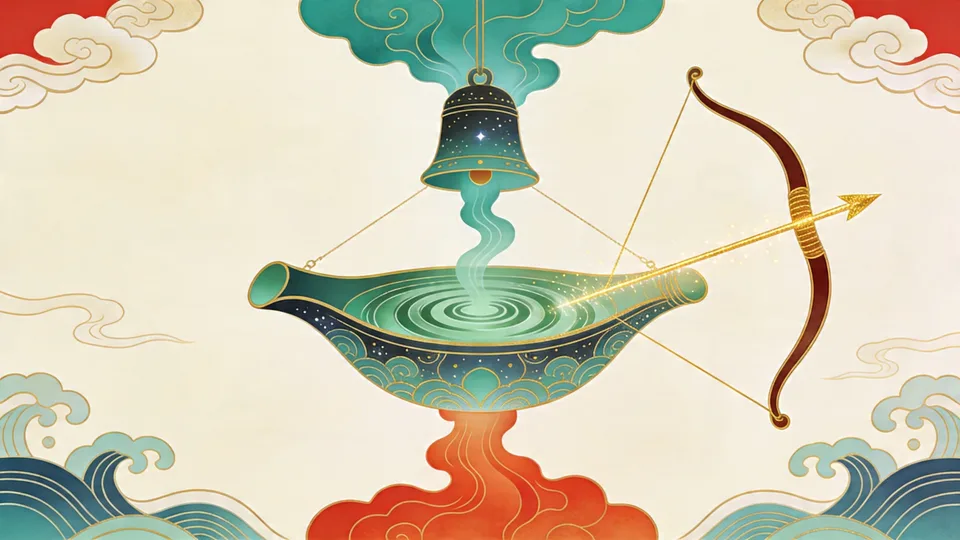
Love as Prime Mover describes individuation and reintegration as phases, like drawing a bow and then releasing it. The stronger claim is that they happen together, and pattern integrity shows how. You are not a thing but a persistent organization, like a whirlpool. Old material leaves and new material arrives in the same moment, so the pattern does not first lose cells and then gain them. It is the losing-and-gaining as one continuous verb, and the whirlpool is what that exchange looks like from outside.
The mind works the same way. In the three puzzles, the self is a simulation the brain maintains at metabolic cost, and it is tempting to treat the suffering as a side effect of that upkeep. But the cost cannot be peeled off the thing it pays for. The simulation is the suffering is the consciousness is the cost. As with a breath, there is no part that happens first.
The bellows
Laozi gives the purest image: 天地之间,其犹橐龠乎 — between heaven and earth, is it not like a bellows? A bellows is entirely empty and endlessly productive. It does not so much push or pull as alternate, and its emptiness is what makes it work.
Nor does it breathe for a reason. There is no First Mover who decided to start pumping. Ask why the universe oscillates and you are asking for a reason behind the thing reasons are made of: the oscillation trying to see itself and finding only more oscillation. Human longing has the same shape. The goals that pull a life forward work only while they stay out of reach, because arriving would stop the breathing. A life, like the universe, does not want arrival. It wants to keep oscillating.
The strongest objection is that there is no soul here at all. Consciousness is emergent, love is neurochemistry, and a breathing universe is a projection onto matter and energy obeying physical law. That account is faithful to the parts, but it still owes an explanation of the part doing the accounting, and the hard problem does not go away by being set aside. Neither view can be settled by evidence. What the oscillation view offers is a refusal to pretend that any one noun, matter included, contains the others.
This is why contemplative traditions keep landing on paradox. The soul cannot be found, because finding it would freeze the breath at one end. You do not transcend the oscillation; you realize you are it, and the realization does not stop the breathing. The foundational rule of reality is not convergence alone. It is convergence-and-divergence as a single, unsplittable act. The Prime Mover does not wait at the end or push from the beginning. It is the between, like the empty space inside the bellows. What remains open is what changes in a life that stops looking for its soul as a thing and starts treating it as a rhythm.
References:
- 老子 (Laozi), 《道德经》(Tao Te Ching)
- R. Buckminster Fuller, Critical Path
- 曹雪芹 (Cao Xueqin), 《红楼梦》(Dream of the Red Mansion)
- Alan Watts, The Book: On the Taboo Against Knowing Who You Are