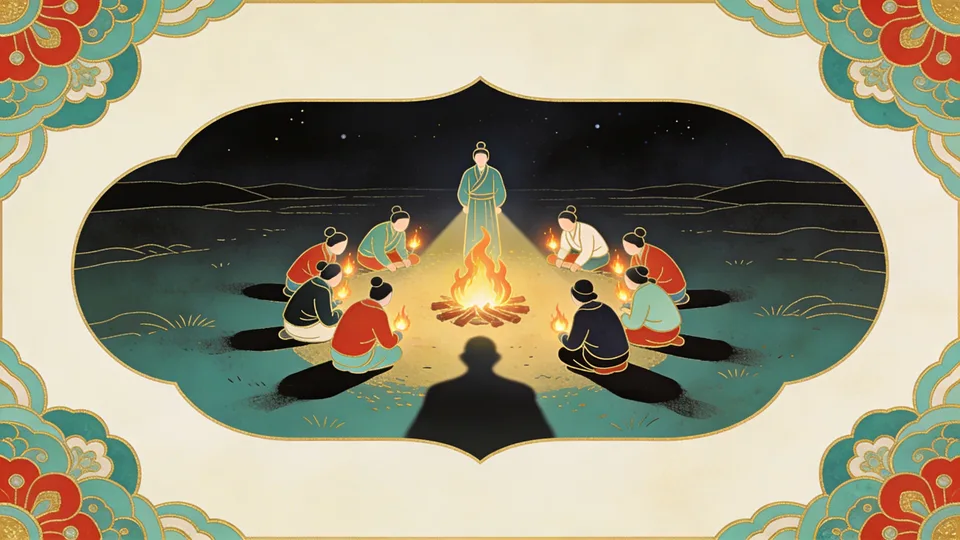
Whether your mistake gets forgiven depends less on the mistake than on the story your team is in.
An engineer ships a change that takes a service down for an afternoon. On one team, colleagues pile in to fix it, someone jokes about it at the retrospective, and she comes out of the week more trusted than she went in. On another team, the same outage becomes the thing everyone remembers about her, and within a year she is gone. The mistake, the skill and the process were the same. What was different?
The usual answer is culture or process, and the usual fix is a policy, such as blameless postmortems. But both teams can adopt the policy, and only one will get the forgiveness. Venkatesh Rao names what the policy can’t supply: If you put people in the right story, all hard problems become easy. If you put them in the wrong story, all easy problems become hard.
What a story does
A story here means the group’s shared sense of what it is trying to do and what part each person plays in it. A “straight” story is one in which all the characters can cut loose and act with relatively uninhibited energy, trusting that consequences will be net good. They can play their roles without second-guessing themselves too much, and absorb the impact of the unknown with forgiveness and deepening relationships.
On the first team, the outage was an event inside a story everyone believed: we are building something hard, and hard things break. Forgiveness came cheap because the mistake had an obvious meaning that wasn’t about her. The second team had no such story, so the outage could only be read as a fact about the person who caused it.
That difference compounds, because social luck dominates our fortunes under modern conditions. Whether a career rises or falls depends less on the quality of each action than on how other people respond to its mistakes, accidents and transgressions. A shared story is what makes them respond generously. Without one, every error is a solo error.
Why you can’t mandate it
If story matters this much, why not install one? Because the thing a story produces, mutual recognition, can’t be ordered into existence. Recognition must be voluntarily given and received by people exercising independent agency within a shared story. Power, rules and norms can’t compel it, and ceremony can only garnish it. On the second team, the blameless-postmortem policy produces the forms of forgiveness with none of the substance.
The same holds for every lever a manager reaches for. An incentive inside a story people believe produces effort; the same incentive inside a story nobody trusts produces gaming. A process inside a shared narrative produces coordination; in a vacuum it produces bureaucracy. So story is the precondition that makes incentives and processes work. Without a story, people feel their efforts are futile, and making those efforts more efficient only fuels nihilism. That is why the first order of business is getting the right people in and the wrong people out, chosen less for skill than for meaningful potential for mutual recognition.
When the story holds too tight
A strong story has its own failure mode. In any community, those who prioritize primal belongingness will eventually wrest control from those who prioritize primal curiosity. As a group grows, cohesion starts to outrank exploration, and the isolation that protects the consensus also prevents its correction. Frozen unity breeds groupthink.
So a leader can’t keep the story healthy by keeping everyone in it. Managing high-autonomy creative people is not about keeping them engaged. It is about managing entries and exits. About ninety percent of the time, the solution to an impossible interpersonal problem is for somebody to leave. The deepest commitment a shared story can offer is the promise to grow together, even if it means growing apart, and an organization keeps that promise by treating departure as a valid move within the story rather than a betrayal of it.
That leaves the engineer on the second team. She did leave, but not as a move within any story. The exit interview will record a better offer, and the headcount report will record attrition. Nobody will record what happened: the team had no story in which her mistake could mean anything other than her, and nobody noticed it was missing until she was gone.
References:
- Venkatesh Rao, Breaking Smart, Season 1
- Tom DeMarco & Timothy Lister, Peopleware: Productive Projects and Teams