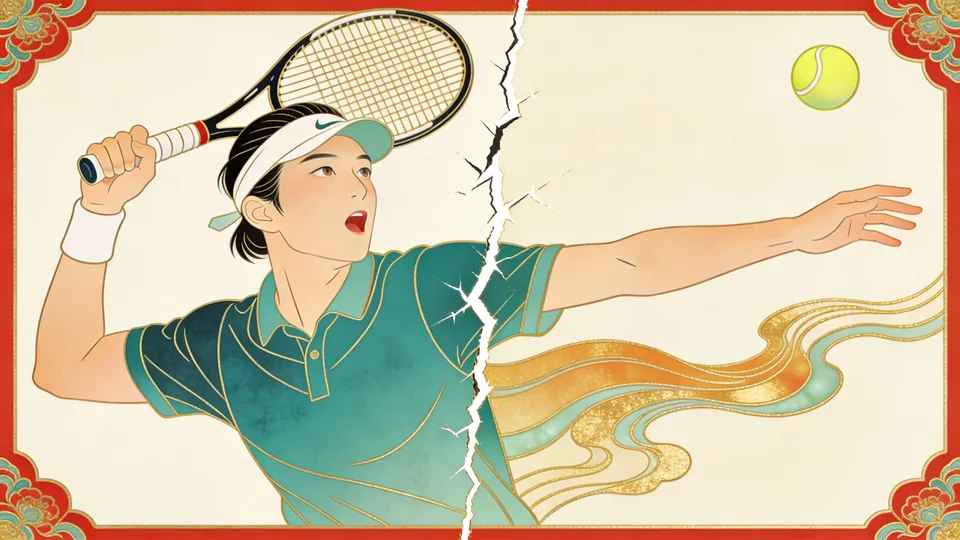
The serve falls apart the moment you start explaining to yourself why it worked.
“It’s not that I don’t know what to do, it’s that I don’t do what I know!” A player hits three clean serves in a row, starts thinking about how he did it, and puts the fourth into the net. The natural response is to concentrate harder. Timothy Gallwey’s The Inner Game of Tennis argues that the harder concentration is the problem, and that the player of the inner game discovers the secret to winning lies in not trying too hard. He values relaxed concentration above all other skills.
Two selves on the court
Gallwey’s model is that every player contains two selves. Self 1 is the voice that gives instructions, judges, tries hard and wants credit. Self 2 is the body and mind that actually knows how to play. Self 1 does not trust Self 2, even though Self 2 embodies all the potential you have developed up to that moment, and is far more competent to control the muscle system than Self 1.
Go back to the three good serves. While Self 2 was in control, the player was focused without trying to concentrate, with an inner assurance that the action would come. When it did, he didn’t feel like taking credit; he felt fortunate, “graced.” Then Self 1 started wondering how it happened and tried to get the body to repeat it by issuing instructions: toss higher, snap the wrist. The instructions interfere with a body that already knew, and the magic disappears.
Why players go back to trying
Effort is the opposite of power. Gallwey watched students learn to let Self 2 play and improve visibly, then revert the next day to trying hard, and play worse. Why would anyone go back to the method that clearly worked less well?
Because when you try hard and succeed, you get ego satisfaction. You feel in control, master of the situation. When you simply allow the serve to serve itself, it doesn’t seem as if you deserve the credit. If a person is on the court mainly to satisfy the desires and doubts of ego, they will choose Self 1 despite the lesser results.
The trap tightens once a player learns this. The moment you try to apply the “secret,” Self 1 is back in the picture under the subtle guise of “trying to let go.” That is pressing the “let go” button on the dashboard while still driving. But the only way to get there is to leave Self 1 behind. Grab for it and it squirts away like a slippery bar of soap; take it for granted and you lose it. It is not a gift you can demand of yourself, but one you can ask for.
Learning without judgment
If instructions interfere, how does anyone improve? Gallwey noticed that errors he saw but didn’t mention were correcting themselves without the student ever knowing they had been made, and that his verbal instructions sometimes decreased the chance of correction. So his method replaces instruction with attention: observe what the body is doing without judging it, picture the result you want, let it happen, and observe the result calmly. Instead of telling yourself “bend your knees more,” you notice how your knees feel during the stroke, and the body finds what works.
Praise has to go too. “My compliments are criticisms in disguise. I use both to manipulate behavior.” Praise and blame are both Self 1’s tools for staying in control.
The opponent as the big wave
The obvious objection is that this sounds like an argument against competing at all. Gallwey says the reverse. A surfer waits for the big wave because he values the challenge it presents: only against it must he use all his skill, courage and concentration. So your opponent is your friend to the extent that he does his best to make things difficult for you.
What corrupts competition is need. As Gallwey puts it, “Only to the extent that one is unsure about who and what he is does he need to prove himself to himself or to others.” Some players escape that need by seeking failure: “I may have lost, but it doesn’t count because I really didn’t try.” The desire to fail is the mirror of the desire to win — both are ego plays. The alternative is the egoless desire to win, the determination that isn’t a trip of “see, I’m better than you.”
Underneath all of this is one claim: Self 2 needs no improvement from birth to death. A child doesn’t dig his way out of the habit of crawling; he simply leaves it as he finds walking an easier way to get around. That natural learning works unless Self 1 turns it into a moral project. The inner game finally reverses its own premise: instead of learning focus to improve your tennis, you practice tennis to improve your focus. Which raises the question of where else Self 1 is talking you out of three good serves.
References:
- W. Timothy Gallwey, The Inner Game of Tennis: The Classic Guide to the Mental Side of Peak Performance