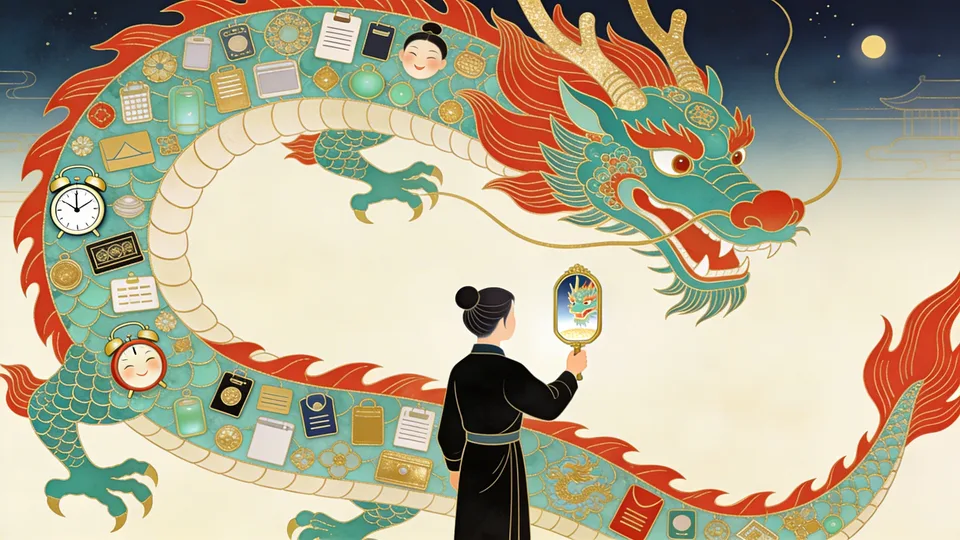
The dragon is the life everyone around you is comfortable with you living.
Nobody you know has fought a dragon, and anyone who calls their own life heroic sounds faintly ridiculous. Carol Pearson’s The Hero Within argues that the joke is the trap. The dragon to be slain is precisely the monster of the status quo, and the hero’s task has always been to bring new life to an ailing culture. People may ridicule you for thinking of yourself as a hero, and that discouragement is how the dragon wins. We are defeated not dramatically but by any number of small acts of self-betrayal masquerading as virtue that add up, over time, to an inauthentic life.
The virtues doing the masquerading are familiar: keeping the peace, being reasonable, putting others first. Pearson’s question is how a person stops losing that slow fight.
Six tasks, not six types
Pearson maps the journey through six archetypes, each with its own task: the Orphan survives difficulty, the Wanderer finds herself, the Warrior proves her worth, the Altruist shows generosity, the Innocent achieves happiness, and the Magician transforms her life. Read quickly, this looks like a personality quiz. That reading misses the book: the archetypes are not personality types but developmental tasks, and the danger is not identifying with the wrong one but getting stuck in any one. Each archetype is Locally Optimal: it solves a real problem, which is exactly why people stay in it after its work is done. The Orphan who never wanders stays a victim. The Wanderer who never fights stays homeless. The Warrior who never gives stays burned out.
Each stage learns to allow something
What moves a person from one task to the next? Pearson’s answer is that each stage requires letting in a feeling the previous strategy was built to keep out. The Orphan learns to allow pain, the Wanderer loneliness, the Warrior fear, and the Innocent faith, love and joy.
The Orphan shows why this is harder than it sounds. Saying “I am in pain and I do not know what to do” takes more courage than bluffing or taking disappointment out on others, and Orphans need to understand they have a right to their own pain, even if it has not been as great as that of others.
The Wanderer’s allowance is loneliness. Her first job is to declare that the cage is a cage and the captor is a villain, and then to accept that whatever the cost in isolation, she will be herself. That looks like the opposite of love, but Pearson argues it is love’s precondition: making an absolute choice for yourself and your own integrity, even if it means being alone, is the prerequisite for heroism and ultimately for being able to love other people.
The opening’s self-betrayals are refusals of exactly this kind. Virtue often is used to camouflage cowardice, and sacrifice cannot be redemptive if it is required. And the refusals cost more than they save, because if you shut out pain, you shut out everything. The Innocent learns that allowing pain, not avoiding it, is what opens the channel to joy.
Naming the dragon
The Magician’s task is not to slay the dragon but to name it. To face the dragon is to recognize it as dangerous, to ourselves as well as others. But then to transform the monster by affirming it and acknowledging it as our own. Pearson’s example is an alcoholic who sobered up, faced the full horror of his life, and discovered he had an equally immense capacity for goodness, love, and care. Internal Family Systems makes the same move clinically: the part you refuse to love turns hostile.
The obvious objection is that this is fairy-tale psychology. That is fair if the archetypes are read as a theory of personality. Read as a list of what a life may ask you to allow, they make a smaller claim, one you can test against your own history: where did you get stuck, and what feeling were you refusing?
It’s not that we go anywhere, but that we fill out, becoming substantial enough to hold pain and joy, solitude and connection. Which leaves the dragon’s question: which of your virtues is doing its work?
References:
- Carol S. Pearson, The Hero Within: Six Archetypes We Live By