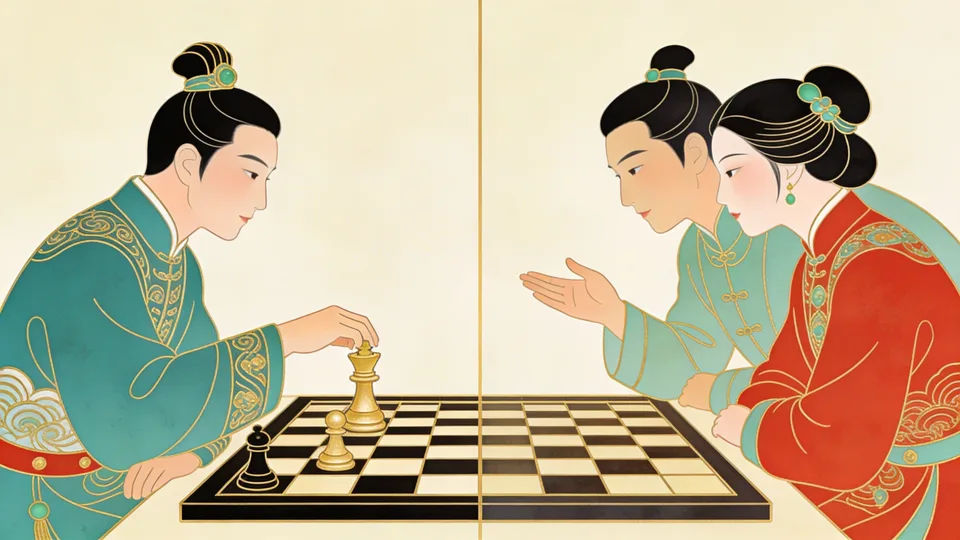
Chess ends at checkmate. A good conversation is the game nobody is trying to win.
There is an old story that Alexander the Great wept when he realized there were no more enemies to conquer. It sounds like vanity, but in James Carse’s terms it is a structural problem. Alexander had played to win, and winning is the move that ends a game. Once the last opponent fell, there was nothing left that could make him Alexander.
The distinction explains the tears. A finite game has known players, fixed rules and an agreed endpoint, and you play it to win. A chess match is one. An infinite game has no fixed endpoint and no final winners, and its only purpose is to keep playing. A conversation is one: the point is to keep it going, and the best ones change both people. Most of life can be played either way, and the trouble starts when we play everything as the first kind.
Surprise
Surprise causes finite play to end; it is the reason for infinite play to continue.
A finite player trains to prevent surprise. The ideal is to play as though the game were already in the past, following a script whose every detail is known. That has a cost: finite players must appear to be something other than what they are. Everything about their appearance must be concealing, because any honest signal is information an opponent could use. A general cannot show his doubts.
The infinite player prepares for surprise instead, which means exposing a self that is still growing. The infinite player does not expect only to be amused by surprise, but to be transformed by it. Carse turns this into a distinction between two kinds of preparation:
To be prepared against surprise is to be trained. To be prepared for surprise is to be educated.
Training regards the past as finished and the future as to be finished. Education sees what is unfinished in the past and continues it into the future.
Power looks backward
Why would a winner want more enemies rather than fewer? Because of what winning produces. To see power is to look backward in time. One does not win by being powerful; one wins to be powerful, and that power can only come from contests already finished. We display the success of what we have done by not having to do anything. What the winners of finite games achieve is not continuing existence but continuing recognition of their titles, and a title means nothing without an audience that remembers the game.
The same logic scales up to states. Since there can be no prizes without a society, no society without opponents, patriots must create enemies before we can require protection from them. So war presents itself as necessary for self-protection, when in fact it is necessary for self-identification. Decisive victory can be as destructive as defeat, because when the boundary with the enemy blurs, the state loses its definition. That is Alexander’s grief at the scale of a nation, and why a war fought to end all wars only breeds universal warfare.
The trouble is restriction
None of this makes finite games bad. Chess, elections and careers are fine. Carse’s target is narrower:
Evil is not the inclusion of finite games in an infinite game, but the restriction of all play to one or another finite game.
The problem is treating every relationship as a contest and every moment as a step toward a fixed result, until, as Life Is Not a Race puts it, presence starts to feel like falling behind. Carse is careful about the response, because infinite players do not try to eliminate evil in others: to do so is the very impulse of evil itself. The contrast he offers is between seriousness and play:
To be serious is to press for a specified conclusion. To be playful is to allow for possibility whatever the cost to oneself.
Playfulness here is not triviality. When we are playful with each other, the relationship stays open to surprise, and everything that happens is of consequence. An infinite player can still play finite games inside the infinite one, as long as he remembers that the larger game has no end and no winners. Only that which can change can continue.
The outcome of a finite game is the past waiting to happen, so whoever plays toward a certain outcome wants a particular past. Alexander got his, and it had no future in it. If we cannot tell a story about what happened to us, nothing has happened to us. But the story has to stay unfinished. The moment we close it with a winner, a final meaning or a completed self, the game is over, and a game that is over cannot surprise us anymore.
References:
- James P. Carse, Finite and Infinite Games: A Vision of Life as Play and Possibility