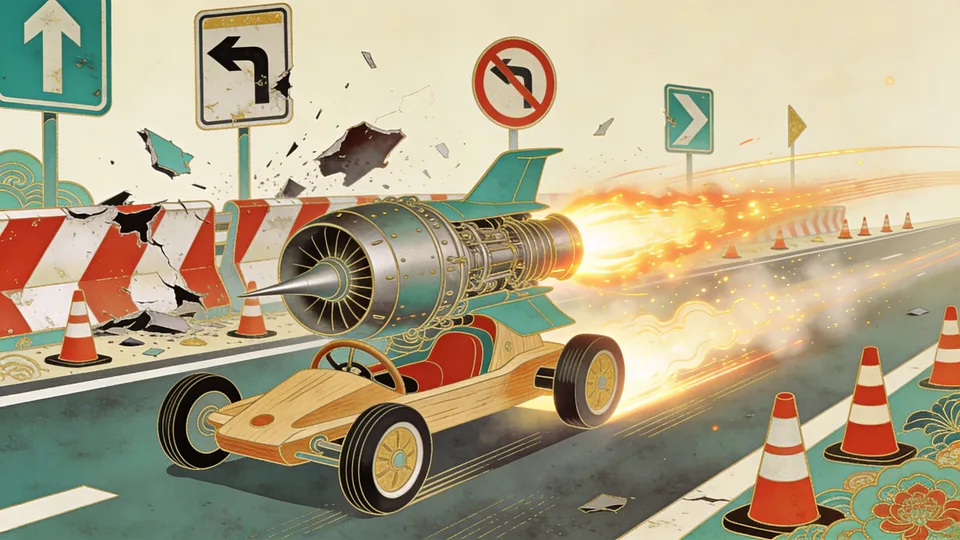
The engine that gets someone past everyone else doesn’t know which red lights you wanted it to run.
John Boyd thought about flying planes in a way that used a different part of his brain than other pilots. The same personality made him naturally indifferent to established customs. His superiors would rave about his contributions in the same performance report where they tried to block his promotion. They wanted the output without the person who produced it.
That wish feels reasonable. Surely someone can be original and also cooperative, brilliant and also easy to manage. Morgan Housel’s answer is that the wish rests on a mistake: thinking someone is brilliantly different but not well-behaved, when in fact they are not well-behaved because they are brilliantly different.
One trait, every domain
What Boyd’s superiors saw as two features, a gift and a flaw, was one: an unusually weak respect for “the way things are done.” Applied to air combat, it produced new ideas. Applied to the chain of command, it produced friction. The trait has no switch that limits it to the domains you approve of. A person who believes normal constraints don’t apply, not as ego but in their bones, will violate every constraint, including the ones you think are reasonable.
One way to see why is as variance. A mind with more degrees of freedom and weaker default canalization ranges further in every direction, as in Autism and Dimensionality. The unusual insights and the unusual dysfunction come from the same expanded search space, so you can’t narrow it where the person is difficult without narrowing it where they are brilliant.
Organizations get this wrong in a predictable way. They hire the maverick, celebrate the early wins, then spend years sanding off the edges that produced those wins. Inside the selected group, genius and abrasiveness look correlated, a version of Berkson’s paradox: not because being smart causes rudeness, but because the filter that let them through selected for a disposition that doesn’t recognize conventional boundaries.
Where the package stops
Two limits keep this from becoming an excuse. The first is that the trait misleads its owner too. Housel calls it intelligence creep: assuming talent in one area signals skill in all others. Technical founders who design brilliant products make catastrophic HR decisions, and the higher your competence in the first domain, the harder it is to accept that it does not transfer. The second is survivorship. Study successful business people and you find confident, decisive, aggressive risk-takers, but those are variance-increasing traits. They bought a chance at big success along with a chance at spectacular failure, and we mostly see the survivors. Breaking every rule guarantees nothing.
So the useful question about someone like Boyd is not “why can’t he behave?” but “do I want what comes with this package?” The answer can be no. What it can’t be is the version his superiors wanted, the ideas without the man who wouldn’t defer. If the output is extraordinary, expect the person to be extraordinary in every direction, including the inconvenient ones.
References:
- Natural Maniacs — Morgan Housel / Collaborative Fund