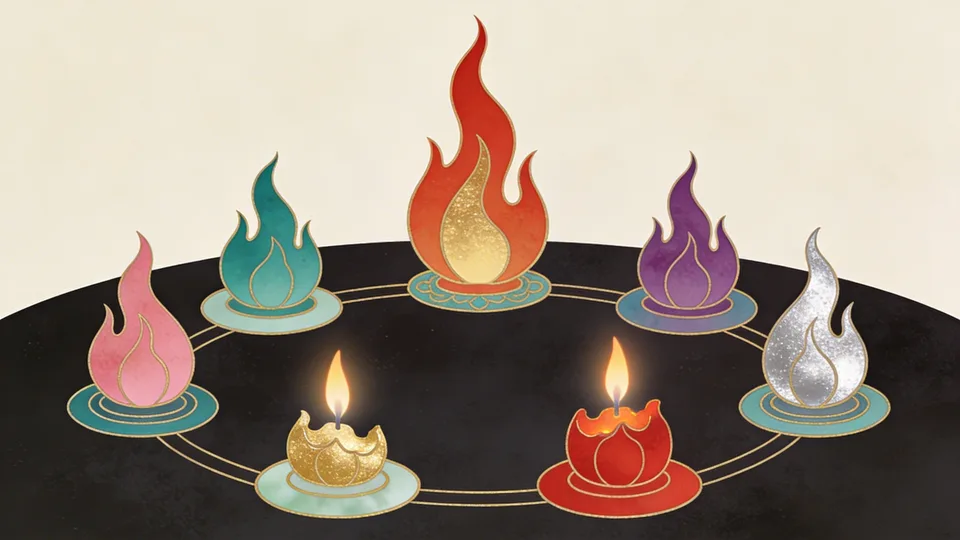
Emotions are arguments. They compete for energy, and the arguments that win are emphasized while those that lose atrophy. This is the premise of the eristics framework — a personality typology that organizes six base emotions into three dualities, maps their healthy and disordered sequences, and predicts what happens when someone becomes addicted to a particular emotional argument.
The Three Dualities
Self: Love and Disgust
Love and disgust enforce the boundaries of the self through inclusion and exclusion. Love expands the self to incorporate people, objects, and ideas. Disgust ejects things that feel like they should not be part of the self.
Together they answer: what is me, and what is not me?
World: Fear and Anger
Fear argues to alter the internal model of the world. Anger argues to alter the world itself. Fear builds the map; anger acts on it.
Fear sets up a model for anger to act upon. Without fear, anger has no target. Without anger, fear has no resolution.
Society: Guilt and Pride
Guilt argues for participation in society — contributing, fitting in, playing your part. Pride argues to set a model for society — leading, defining standards, shaping the group.
Day-to-day guilt revolves around contribution, not atonement. Only the extreme form reaches atonement.
Emotional Ordering
Which emotion fires first matters enormously. The same two emotions in different orders produce health or dysfunction:
-
Love → Fear (in-order): balanced preparation. Caring enough to consider risks. Packing appropriate gear for a trip.
-
Fear → Love (disordered): overcompensation from anxiety. Overpacking “just in case.” This is unhealthy attachment — fear driving the need to include.
-
Love → Anger (in-order): righteous indignation. Anger at injustice affecting loved ones.
-
Anger → Love (disordered): the cycle of abuse. Alternating between rage and affection.
-
Pride → Love (disordered): narcissistic affection. Loving others only as extensions of yourself — a parent who loves their child only for achievements that reflect on them.
The pattern: when a lower-energy emotion properly precedes a higher-energy one, the result is proportionate and grounded. When the order inverts, the higher-energy emotion hijacks the process and produces dysfunction.
Emotional Addiction
Addiction to an emotion looks like one argument consistently overruling the other two dualities regardless of context. The emotion stops being a means to an end and becomes the end itself.
Each addiction maps onto a recognizable clinical pattern:
Love addiction → Codependency. The need to grow the extended self through others. The codependent spends all energy on relationships. Losing an intimate relationship feels like losing the self, producing desperation that damages the very relationships it tries to preserve. This is the same architecture described in neediness — the self has no internal ground, so it outsources its identity to whoever is closest.
Fear addiction → Depression / Anxiety. Fear addicts avoid intimate and societal relationships in favor of modeling the world. Counter-intuitively, they show low capacity for the reactions traditionally associated with fear — they have developed resistance to their own drug, producing blunted affect. This maps onto depression: the system that chose numbness as its locally-optimal strategy.
Disgust addiction → Narcissism. The narcissist is obsessed with finding and ejecting things that do not meet their standards. They need to own the best, be the best, judge the others. The cycle of I’m-this and this-is-better-than-that leads inevitably to delusion. The disgust addict needs their target to express love back for the fullest reward — which is exactly the dynamic in narcissistic-personality-disorder, where admiration is demanded but cannot be reciprocated.
Anger addiction → Borderline patterns. The telltale sign is loved ones walking on eggshells. Anger demands action without productive results. The strongest hit comes when the target shows fear. Rage allows anger to go free without the bounds of self, reality, or society. This maps onto the core loop in borderline-personality-disorder — explosive reactivity driven by threat detection that fires too fast.
Guilt addiction → Histrionic patterns. The guilt addict validates through others via society rather than the extended self. They perform self-sacrifice and express guilt-feeling narratives to elicit pride from others — wanting to be seen as the one who gives everything.
Pride addiction → Antisocial patterns. The most addicted pride seekers work within their own imagined social hierarchy, effectively ignoring actual society. They seek status within a warped structure of their own design.
Energy Economics
Emotions are too expensive to be unnecessary. They are about getting, protecting, saving, and securing energy.
Fear is roughly 5x as expensive as love. Guilt is roughly 5x as expensive as fear. This inverts in the number of relationships each duality maintains: a person can sustain about 5 love/disgust relationships (intimate), 25 fear/anger relationships (professional/competitive), and 125 guilt/pride relationships (acquaintances).
Love relationships require the most energy per relationship but the fewest relationships. Guilt/pride relationships require the least energy per relationship but the most relationships. Total energy across dualities is roughly equal.
This explains why changing the world (anger’s demand) is so exhausting, why deep intimacy is scarce, and why most social relationships are shallow by necessity rather than by choice.
The Blind Spots
No amount of emotional competency overcomes a duality’s blind spot:
Self-disgust is always self-defeating. Disgust argues to eject from the self — when turned inward, it produces self-destruction. A narcissist with no external targets turns the disgust on themselves.
Unwinnable anger demands action against things that cannot be changed. Incorrect anger responses are a failure of fear, not a conquering of it — anger without fear’s reality-checking produces psychosis. Everything becomes fight, flight, freeze, or fawn. No resting state.
Unattainable pride seeks validation that society cannot provide in the amount demanded. The telltale sign is a dramatic life narrative — the actor who will be discovered any day, the temporarily embarrassed millionaire.
Happiness vs Meaning
A sharp distinction: happiness is the ability to feel emotion without actual survival demands. Fear evoked by a horror movie, in a safe theater, is pleasant. The same fear running from a real threat is not.
Meaning is the near-opposite. Meaning requires actual stakes — the real emotion in the real environment. This is why a life optimized purely for happiness can feel meaningless, and a meaningful life is rarely comfortable.
Common Misread
The dimwit take is “some emotions are good and some are bad.”
The midwit take is “all emotions are equally valid and should be expressed freely.”
The better take is that emotions are arguments with energy costs, and the order and proportion in which they fire determines whether the result is adaptive or pathological. No emotion is inherently destructive. Any emotion becomes destructive when it wins every argument regardless of context — when it stops being a tool and becomes an identity.
Main Payoff
The eristics framework’s deepest contribution is the insight that personality disorders are emotional addictions — not fixed states but runaway feedback loops where one argument has colonized the entire system. This reframes treatment as re-balancing rather than fixing, and prediction as identifying which argument is winning too often rather than categorizing a person into a box.
References: