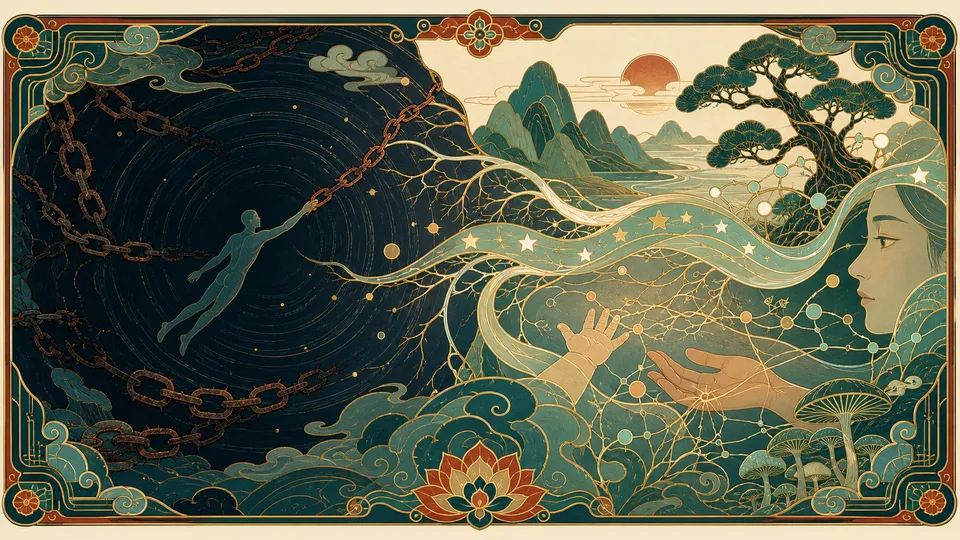
The psyche does not only defend against pain. It defends against the deeper terror that pain protects it from: absolute disconnection. A hostile world is still a world. A painful relationship is still a relationship. A crisis is still contact. The ego would often rather be dragged through reality by a barbed wire than float untouched in a vacuum.
Pain often functions as a crude tether: a hostile proof that the self is still connected to an Other. A miracle is the opposite proof - a direct taste that connection does not require hostility.
Simple Picture
Imagine drifting in a black ocean with no stars, no shore, no sound, no one calling back. Then your hand catches a rusty chain. It cuts your palm. It hurts. But the pain is also proof: something is there. The chain is connected to a world.
You should not worship the chain. You should not call the cut holy. But the system gripping it is not stupid. From inside the panic of total drift, the painful chain is better than the empty water.
This is why some people cling to misery with a force that looks irrational from outside. The misery is not only misery. It is the last felt evidence that the world is still touching them.
The Terror Under the Symptom
The ego is a boundary-maintenance system. It draws a line between me and not-me, then spends its life monitoring that line for threats. Too much intrusion feels like violation. Too much distance feels like annihilation.
The obvious fear is pain, rejection, failure, humiliation, abandonment. The deeper fear is stranger: what if nothing is connected to me at all? What if I am an air-gapped node, sealed off from the living fabric, floating in an ontological vacuum?
This is the hidden terror underneath many symptoms. The symptom hurts, but it also locates the self. Anxiety says there is danger. Resentment says there is an enemy. Conflict says there is someone across from me. Bodily tension says the world is pressing back. Even loneliness, when narrativized, becomes a relation to the absent other.
No symptom is fun. But a symptom is still a signal. The void has no signal.
Pain Works
Pain is the densest tether because it is local, intense, predictable, and hard to doubt. Joy can be questioned. Peace can feel unreal. Love can disappear. But a clenched jaw, a stomach knot, a familiar panic loop, a recurring fight, a wound that reliably reopens - these produce high-fidelity evidence that something is happening.
This reframes some self-sabotage. The system is not always failing to heal. Sometimes it is preserving contact by manufacturing friction. Remove the painful attachment without addressing the terror underneath it, and the ego panics. It generates a new problem, a new enemy, a new ache, a new emergency. The content changes. The tether function remains.
This is the personal version of heavy-stones: the friction is not incidental. It is what proves the structure exists. A grievance that never moves may be less interested in justice than in maintaining a line of contact with reality. The carrier is not simply suffering from the resentment. They are also using it to avoid the terror of having nothing to press against.
Pain Is Not Sacred
This can easily be misread as romanticizing pain. That is the trap.
holy-suffering keeps the distinction clean. Pain is information. Suffering is pain refused, narrativized, and installed as identity. The pain tether is not an argument that pain is spiritually superior. It is an explanation of why unnecessary suffering can still feel load-bearing.
If suffering has become the proof that you exist, then healing can feel like disappearance. Relief does not feel like relief. It feels like losing the last rope. This is why “just let go” often lands as violence. The person is not only holding pain. They are holding reality through pain. The exile equation is what happens when this tether breaks under shame: the mind reads the loss of felt belonging as evidence that the self should leave entirely. The fear behind fears names the prior condition: pain becomes necessary when ordinary aloneness has been encoded as uncontained helplessness.
The work is not to rip the tether away. The work is to build forms of contact that are less jagged.
What a Miracle Does
A miracle, in this frame, is not primarily a violation of physical law. It is an event that proves connection without requiring pain.
The Milky Way overhead. A mountain range at dawn. A newborn’s hand closing around your finger. The unfragmented gaze of someone who is not trying to get anything from you. A master whose presence exposes your defenses without attacking them. A moment in music where the boundary between listener and sound stops being the point.
These moments collapse the ego’s local boundary without creating panic. They give an experiential proof that the space between things is not empty. It is structure. The self is not a sealed object trying to reach the world from outside. The self is a local fold of the world.
That is why miracles can feel both consoling and dangerous. They do not merely comfort the isolated individual. They threaten the premise that the individual was ever isolated in the first place.
Why the Miracle Cannot Stay
The partition won the evolutionary tournament for a reason.
Total union is not a viable operating system for a mammalian body. If you are one with the tiger, you still need to run from the tiger. If you are one with hunger, you still need to eat. If you are one with the person who wants to exploit you, you still need boundaries.
This is where love-as-prime-mover needs its darker complement. The universe may be drawn toward convergence, but biological life persists through local preference. The body survives by caring more about this vessel than about all vessels equally. The ego is not a mistake. It is the survival interface.
The miraculous state is therefore not the permanent abolition of boundary. Sustained zero-separation would dissolve the very friction that lets a local life prioritize, choose, flee, build, and protect. The point is not to live boundaryless. The point is to stop mistaking the boundary for absolute exile.
The Worse-Is-Better Reality
Painful separation is biologically robust. It keeps the organism local. It makes threats vivid. It creates a center of action. It gives the self a border and a reason to defend it.
Union is truer at the deepest level, but separation is more adaptive at the everyday level. This is the worse-is-better bargain: the partition is metaphysically false and operationally necessary.
The mature spiritual posture is not “destroy the ego.” It is “make the ego porous enough to receive union and solid enough to handle tigers.” The local vessel must remain local. The tragedy begins when the vessel uses pain as its only proof that it has not been abandoned by reality.
Dimwit / Midwit / Highwit
The dimwit take is: miracles are beautiful moments where God or the universe gives lonely people a hug, and trauma is just when people are mean.
The midwit take is: “miracles” are neurochemical aesthetic events that regulate allostatic load and promote attachment; fear of isolation is mammalian survival circuitry; painful patterns are maladaptive prediction loops.
The highwit take is: the ego is a sensory partition. It uses structural suffering as friction to define where “I” ends and “world” begins. A miracle is a temporary collapse of the partition, proving that separation is a local interface and union is the deeper topology.
The better take is that all three see part of the elephant. Miracles do soothe. They do have biological correlates. They do expose the illusory absoluteness of the ego. But the operational question is what happens after the miracle: does the self return with a gentler tether, or does it try to abolish the boundary it still needs to live?
The Straussian Reading
Surface text: miracles are rare gifts that remind isolated people they are loved and connected.
Hidden subtext: miracles are threats to the social fiction of the self-contained individual.
Institutions domesticate miracles by placing them inside authorized containers: temples, ceremonies, pilgrimage sites, scriptures, retreats, approved peak experiences. This is partly control, and partly mercy. Unquarantined union destabilizes the motives that ordinary society depends on: accumulation, competition, status anxiety, self-protection, the entire machinery of “me against the world.”
If a workforce internalized absolute union, much of the competitive drive that keeps institutions running would evaporate. But if everyone internalized absolute union badly, so would rent payments, childcare schedules, and tiger avoidance. Society quarantines miracles because miracles are dangerous. It also quarantines them because ordinary life cannot run on full cosmic voltage.
Main Payoff
When pain returns after a supposed healing, ask what tether it was providing.
What contact did the crisis prove? What role did the symptom give you? What world did the enemy keep you connected to? What would you have to feel if the friction stopped? What form of non-hostile contact could replace the barbed line?
The goal is not to become painless. The goal is to stop needing pain as proof of connection.
Miracles matter because they show the possibility of another tether: awe, friendship, service, craft, breath, beauty, disciplined love, intimacy with the ordinary. These are not as dense as pain at first. They do not grip as violently. That is why they must be practiced.
The old tether says: I hurt, therefore I am connected.
The miracle says: you were connected before the hurt.
The practice says: learn to feel that without needing the wound to announce it.