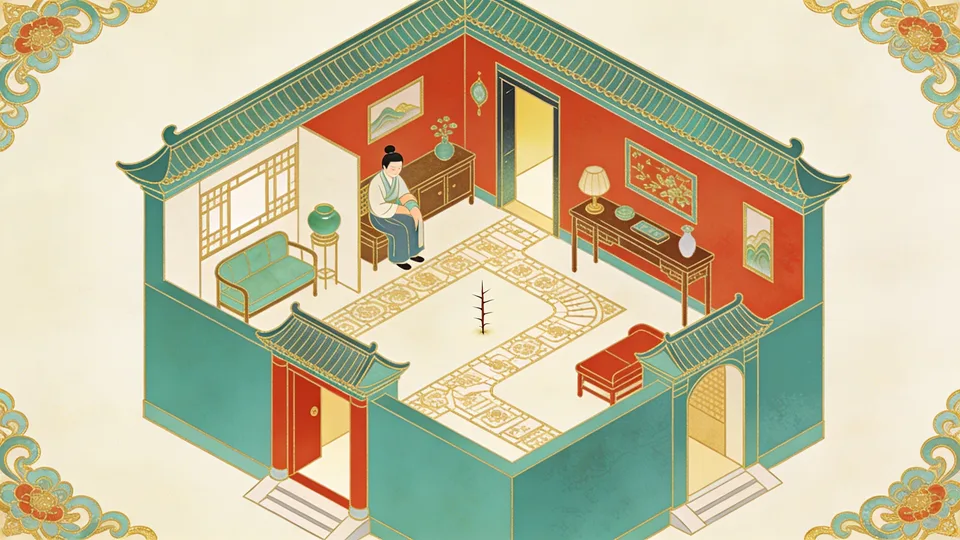
Much of what you call your life is furniture arranged around a thorn.
You said to your mind: “I want everyone to like me. I don’t want anyone to speak badly of me. I want everything I say and do to be acceptable and pleasing to everyone. I don’t want anyone to hurt me. I don’t want anything to happen that I don’t like. And I want everything to happen that I do like.”
Then you said: “Now, mind, figure out how to make every one of these things a reality, even if you have to think about it day and night.”
And of course your mind said: “I’m on the job. I will work on it constantly.”
Michael Singer uses this contract in The Untethered Soul to change the usual question. We tend to treat the endless inner chatter as a malfunction, something to silence through discipline or fix through therapy. Singer’s point is that the mind is doing exactly what it was asked to do. You gave it an impossible task, and you broke it, just as you would break a body by overloading it.
The one who hears the voice
Who gave the order? Not the voice itself. The voice inside your head does not care which side it takes, as long as it gets to keep talking. You are not the voice of the mind; you are the one who hears it.
It talks for the same reason a tea kettle whistles: energy has built up inside. The narration’s main purpose is comfort. When you say “it’s cold,” your body already knows, but once the feeling is in words, the mind can answer it with “don’t worry, we’ll be there soon,” and you feel more secure. So true growth is a growing comfort with silence and a reduced need for this kind of protection. The mind does not have to be quiet. You be quiet.
The thorn and the cage
Why does the protection feel so necessary? Singer’s image is a thorn in your arm that touches a nerve. Instead of removing it, you build your life around never bumping that spot: you choose your friends, your job, your house and your routines to avoid it. Then you announce to the world that you have solved your problem. But the thorn completely runs your life.
The human heart has many thorns, sensitivities about loneliness, rejection, appearance or intelligence, and each one generates a cage of avoidance that looks like a life. Take loneliness. When you feel lonely, you usually aren’t asking how to get rid of the problem, only how to avoid feeling it, so the mind fills the days with “did I say the right thing” and “what can I do so they don’t leave me.” If you then find the perfect person to love and adore you, you have actually failed. You did not solve your problem; you just involved that person in it, and now both of you must step carefully around the thorn.
Decorating the cage with beautiful experiences does not make it less of a cage, and in most societies you are well rewarded for how well you can build and cling. This is also why the walls are hard to give up: each one really does block a specific pain, so removing it means feeling the pain it was built to keep out. Yet if you stop supporting the wall, it breaks down by itself.
What the fear is really about
The cage seems to protect you from the unknown, but Singer says that gets the fear backwards. You do not fear the unknown. You cannot fear something you do not know. What you really fear is the loss of the known. The lonely person does not fear some unimaginable future; he fears losing the arrangement that keeps the thorn from being touched.
That explains why the mind never runs out of work. There is always a specific problem absorbing attention, the job, the money, the health scare, and when one resolves the next appears at once, because the cage requires a reason to exist.
Is this just bypassing?
The strongest objection is that this is spiritual bypassing dressed up as wisdom: you cannot ignore real problems by declaring that you are not your thoughts. But Singer is not asking anyone to ignore anything. The mind is innocent. It is a tool, and you are the one who told it to conjure up outer solutions to inner problems. Stop expecting the mind to fix what is wrong inside of you. The thorn still has to be felt; what changes is that you stop building cages so you never have to feel it.
The greatest freedom is not rearranging the cage. It is realizing that the bars were never locked, and that you were just too afraid to push. Which thorn has your mind been working around for so long that you have stopped noticing the furniture?
References:
- Michael A. Singer, The Untethered Soul: The Journey Beyond Yourself