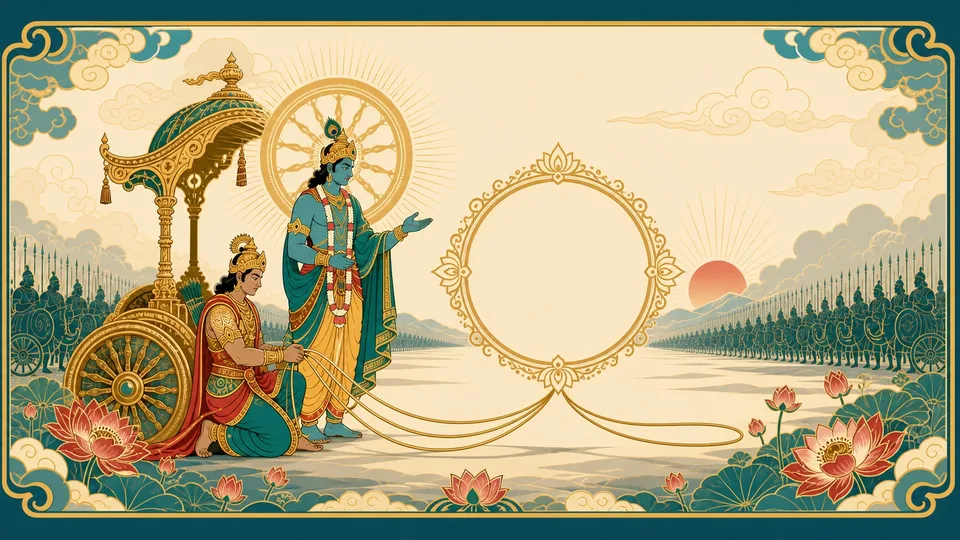
The Bhagavad Gita is a battlefield text, not a self-help text. Its opening crisis is not “Arjuna needs motivation.” It is “Arjuna sees that every available action destroys part of the world that made him who he is.”
The teaching begins where moral cleanliness fails. Arjuna cannot remain innocent by fighting, because the people across from him are kin, teachers, and friends. He cannot remain innocent by refusing to fight, because refusal is also an action with consequences. The fantasy of a pure exit collapses.
Simple Picture
Arjuna is an actor who suddenly sees the stage, the script, the audience, and the costume at once. He does not merely forget his lines. He sees that every line preserves the play. His body fails because the identity that was supposed to act has become internally contradictory.
Krishna’s answer is not comfort. It is a cut: act, but stop claiming the action as yours. Do what the situation requires without turning the outcome into proof of self.
Arjuna’s Collapse
Arjuna falls because the battlefield makes identity impossible. He is warrior, student, relative, moral agent, public man, and embodied person. Each role issues a command. The commands conflict. No role can adjudicate the conflict because each role is part of the conflict.
This is why the Gita is deeper than “do your duty.” Duty is one layer. The harder insight is that the self trying to choose from among roles is itself another role. The chooser is not outside the battlefield. The chooser is on it.
This maps directly to the recursive observer puzzle. The “I” that wants to find the correct action is another mental object in the field. It cannot secure final innocence because it is not outside causality. It can only keep generating one more courtroom inside the previous courtroom.
Krishna’s Cut
Krishna does not solve Arjuna’s dilemma by finding a painless option. He dissolves the possessive structure underneath it.
The famous instruction is action without attachment to the fruits of action. The dense version: act without appropriation. Do not make the result yours. Do not make virtue yours. Do not make failure yours. Do not make the role yours. Action remains, but the owner-claim is removed.
This is not passivity. Passivity is often ego in retreat: “I will not act because action would threaten my self-image.” Krishna’s move is the opposite. Action becomes cleaner when the self-image loses veto power.
In the car parable, Arjuna wants the dashboard button that gets him out: fight nobly, refuse nobly, grieve nobly, spiritualize nobly. Krishna points to the deeper move: the driver-claim is the car. You do not need a better button. You need the collapse of the one who thinks buttons are the only category of action.
McKenna’s Arjuna
McKenna uses Arjuna as the image of fear followed to its source. Arjuna does not fall because he sees enemies. He falls because he sees attachment, kinship, obligation, compassion, violence, and selfhood fused into one organism.
Fear cannot be slain because the desire to slay fear is fear wearing armor. Fear has to be entered. At the bottom of fear is not an object but no-self: the loss of the one who wanted safety, moral certainty, and continuity.
Arjuna gets back up only after the doer has been cut down. The person who rises is not the same as the person who collapsed. This is the bridge between negation and action: enlightenment language burns the claimant; the Gita shows that action can continue after the claimant is gone.
The Practical Distinction
Human Adulthood: act responsibly without making every action a referendum on your identity.
Enlightenment: action happens, but the owner has lost its metaphysical claim.
Most people want the first and call it the second. That is not a failure. Human Adulthood is already rare. But confusing the two creates spiritual inflation: ordinary maturity gets marketed as ultimate realization, and the ego survives by becoming the narrator of its own transcendence.
Common Misread
The dimwit take is “the Gita justifies violence.”
The midwit take is “the Gita teaches detached duty.”
The better take is that the Gita asks whether action can happen after the self stops owning action. The battlefield matters because it removes all clean exits. You cannot preserve innocence by acting, and you cannot preserve innocence by refusing to act. The only remaining freedom is to cut ownership at the root.
Main Payoff
The question is not only “what should I do?” It is “who is the one demanding that action preserve a self?”
Once that claimant relaxes, action becomes less neurotic. You still choose, speak, fight, love, refuse, build, and grieve. But the action no longer has to manufacture a person in the middle of itself.
Surrender is not collapse. Surrender removes the extra owner from the event.
References:
- Bhagavad Gita
- Spiritually Incorrect Enlightenment