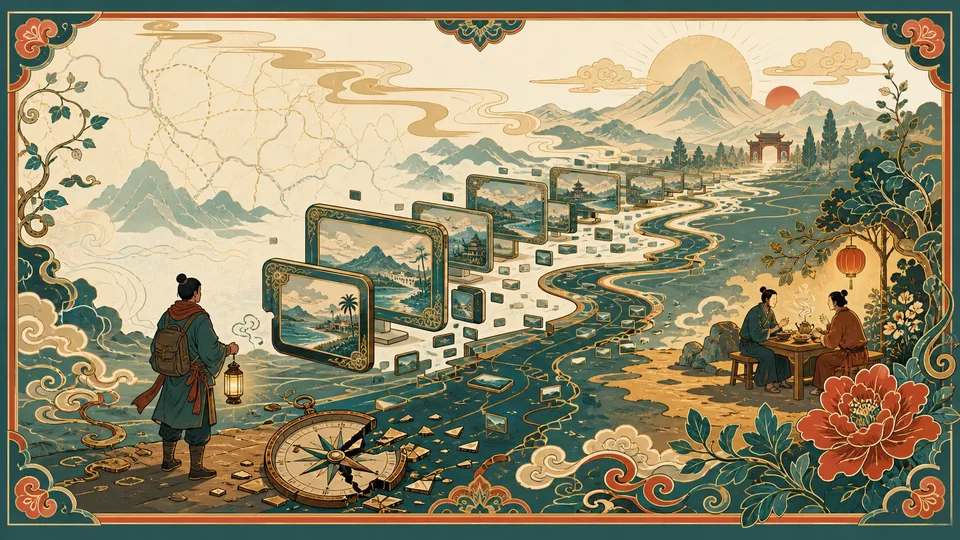
Redemptive distance was the modern belief that moral and spiritual renewal lived somewhere far away. The local world was compromised by modernity; the distant world still contained reality. If you could cross enough water, language, poverty, danger, or strangeness, you might come back less hollow.
The death of redemptive distance is the collapse of the belief that elsewhere can save you. Travel still exists. Difference still exists. Strangers still exist. What is dying is the old Western contract in which distance itself carried transformative authority.
Simple Picture
Imagine a person living in a gray house. Everyone in the house feels restless, overcivilized, managed, and fake. For centuries, the house has told itself a story: somewhere outside there is a forest where people are still real.
Every generation goes looking for the forest. One calls it nature. One calls it the sublime. One calls it Tahiti, India, Morocco, Bali, the backpacker trail, the village, the street-food stall, the unmediated human encounter. Each generation discovers that the previous forest has become a theme park, so it walks farther.
Now the house contains screens showing every tree in advance. It contains lectures explaining why the forest fantasy was built on empire. It contains artificial forests good enough to absorb the longing. The young no longer argue about how to find the real forest. They suspect the forest story was damaged from the start.
The tragedy is that the story was damaged. But walking outside still mattered.
The Old Religion of Elsewhere
The lineage runs through Rousseau, the Romantics, modernist primitivism, the Beats, the hippies, backpackers, voluntourists, and the late cosmopolitan food-and-travel shows. Each version repeats the same move:
Modernity alienates. Therefore salvation must live where modernity has not yet arrived.
Rousseau placed authenticity in nature against society. The Romantics placed it in wild landscape against industrial life. Modernists projected it onto colonized places. Hippies spiritualized it through the East. Backpackers turned it into the search for the “real” neighborhood beyond the tourist district. Voluntourists moralized it by making self-discovery look like help. Anthony Bourdain refined the fantasy to its last defensible form: go somewhere unfamiliar, sit humbly with strangers, eat what they give you, listen, and let the encounter change you.
The pattern is elsewhere as salvation technology. The destination changes, but the structure stays stable: here is dead; there is alive.
This was never innocent. It required passports that opened doors, currencies that stretched far, empires that had already mapped the routes, and locals who had to remain “authentic” so the visitor could experience transformation. The traveler got to be the seeker. The local got cast as the cure.
Why Distance No Longer Redeems
Three collapses arrived at once.
The map is exhausted. There is no longer a psychologically convincing off-map. Google Maps, Instagram, TikTok, YouTube, Netflix, travel vlogs, geotags, and recommendation systems have pre-digested the planet. A place can still surprise the body, but it rarely arrives as pure unknown to the imagination. The traveler often goes to confirm an image already consumed.
The desire is pre-critiqued. Older generations could feel the romance of travel first and the critique later. Younger people inherit the critique before the romance gets to form. Colonialism, carbon guilt, white-savior anxiety, extraction, cringe, and the suspicion that one’s presence may be harmful all arrive at the threshold. The result is not moral rebellion against travel. It is a quieter loss of appetite.
Synthetic elsewhere now competes with real elsewhere. Modernity sells escapes from modernity: open-world games, Discord servers, fandom worlds, TikTok feeds, AI companions, VR spaces, algorithmic dreamscapes. These do not replace travel completely, but they absorb enough longing to keep the body home. The cure has become one of the apparatus’s products. The Machine no longer merely mediates the world. It manufactures replacement worlds.
This is the difference between travel ending as an industry and redemptive distance ending as a myth. Planes will keep flying. Influencers will keep filming. The spiritual charge has leaked out.
Bourdain as the Last Priest
Bourdain mattered because he made the old contract feel honorable at the moment when it was becoming indefensible. He did not sell paradise. He sold attention.
The gesture was simple: an unrelated Western stranger enters a place, does not pretend to own it, eats what is offered, lets ordinary people speak, and translates the encounter back to an audience without fully domesticating it. The meal was never just food. It was a ritual of asymmetry made temporarily human.
After Bourdain, the genre splinters. Influencers travel without translation. Heritage shows translate through ancestry. Comfort-food shows preserve joy by dodging the political burden. The old Bourdain move — stranger, distance, humility, danger, food, moral witness — no longer feels culturally permitted at mass scale. The position was too compromised to continue and too valuable to replace cleanly.
That is why his symbolic weight exceeds the television genre. He was the last mass-cultural priest of redemptive distance: the figure who could still make Western viewers believe that going outward, if done with enough humility, might enlarge the soul.
The Ethical Trap
The easy take is to celebrate the end of the fantasy. It was colonial, extractive, carbon-heavy, class-coded, cringe, and full of self-mythology. Good riddance.
The harder take is that the critique is correct and incomplete. The structure was compromised. The encounters were still real.
Taxi drivers helped lost travelers. Shopkeepers negotiated across laughter and bad grammar. Strangers gave directions, tea, warnings, stories, hospitality, scams, tenderness, and glimpses of lives arranged around different assumptions. The visitor often misunderstood. The local often performed. Money and passport privilege shaped the interaction. But reality still leaked through.
This is the load-bearing illusion problem. The cosmopolitan travel fantasy was false, but it preserved a real aspiration: that distant strangers were worth attending to, that a life could be enlarged by encounter, that the world outside one’s own moral weather mattered. Destroying the illusion without preserving the aspiration produces a cleaner person and a smaller world.
Dimwit / Midwit / Better Take
The dimwit take is “travel is fun; go see cool places.”
The midwit take is “travel is colonial, extractive, carbon-intensive consumption dressed up as self-discovery.”
The better take is that a civilization that stops training its people to attend to distant strangers becomes morally smaller, even if its critique of the old training method is accurate. The old cosmopolitanism was hypocritical, but hypocrisy can preserve an aspiration. The replacement may be more ethical in language while producing less curiosity, less risk, less encounter, and less obligation.
The Straussian Read
The surface topic is travel. The real topic is the collapse of liberal cosmopolitan selfhood.
“Global citizen” was not just a leisure identity. It was the moral personality of the American-led unipolar era: mobile, curious, tolerant, secular, lightly guilty, aesthetically omnivorous, and convinced that exposure to difference made people better. Travel was the sacrament of that personality. Bourdain was its most convincing preacher because he made the sacrament look less like consumption and more like humility.
When the geopolitical order weakens, the personality type it produced starts to look fragile. The new moral personality is not the global citizen but the screen-mediated local: ethically alert, risk-averse, suspicious of extraction, saturated with images of elsewhere, and increasingly capable of feeling responsible for distant harm without feeling drawn toward distant people.
This is not pure decline. Some innocence deserved to die. But the replacement has its own pathology: purified non-encounter. The new subject avoids doing harm by avoiding contact, then mistakes the absence of contact for virtue.
Main Payoff
The danger is not that people will stop traveling. The danger is that they will stop believing encounter can obligate them.
The old system said: go outward, even badly. The new system says: stay inward, but feel morally superior about not doing harm. Worse-is-better reality: a flawed, asymmetrical, cringe travel culture may produce more real cross-cultural attention than a perfectly critiqued, screen-mediated localism that never leaves the room.
The voluntary loneliness machine makes the endpoint visible. A person can now consume endless images of distant suffering, distant food, distant festivals, distant war, distant beauty, and distant ordinary life without ever entering the vulnerability of being hosted, confused, cheated, helped, corrected, or changed. The world becomes content. The stranger becomes an ethical object rather than a person who might interrupt you.
The task is not to resurrect the old fantasy. Redemptive distance is dead for good reasons. The task is to build a post-redemptive cosmopolitanism: one that does not need the faraway to be pure, primitive, therapeutic, or morally available, but still preserves the basic human act of letting strangers change the size of your world.
References:
- Fugitive Margins, The End of Elsewhere