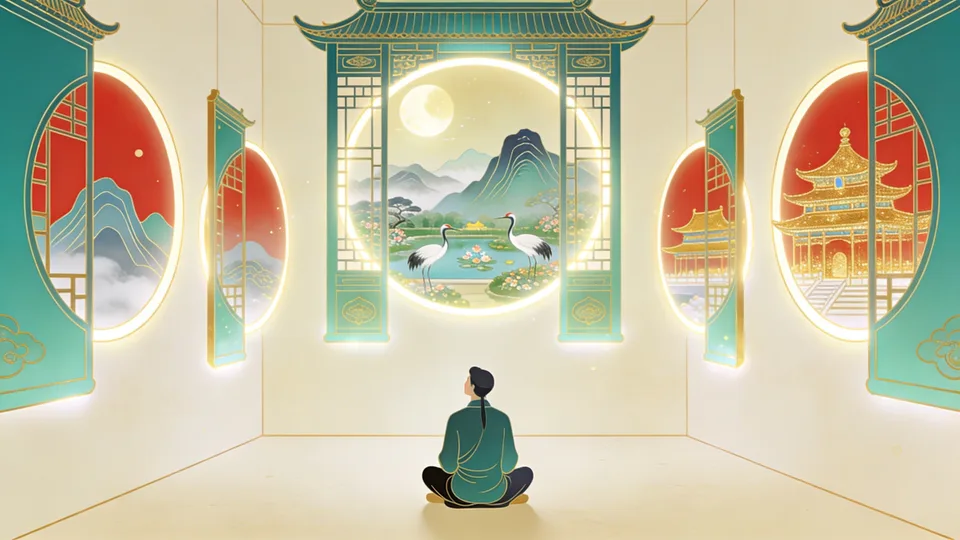
A wound that drives one person produces a person who cannot sit still. A wound that drives a population produces a culture full of places to go that are not here. The list of those places, taken together, is a diagnosis of what the population finds unbearable about the present.
Simple Picture
If a single person finds their inner life intolerable, they may keep moving — new partners, new cities, new projects — anything that does not require sitting. If a hundred million people find their inner lives intolerable at once, they cannot all keep moving in the same way. The world is not big enough. They need a culture that manufactures elsewheres at industrial scale.
The most popular escape directions in any era are roughly the shape of what the era cannot bear. Tell me what your civilization is most fixated on building, and I will tell you what it most cannot face.
What This Era Builds
Three categories deserve naming, because the same structure runs through all of them.
Virtual worlds. Hyper-detailed games and immersive online environments are not, primarily, entertainment. They are containment zones for a population that finds the physical present hard to inhabit. They scale to whatever fidelity the technology can produce, because the demand is essentially infinite — anyone for whom here feels uninhabitable will pay, in time and money, for somewhere else that does not. The richer the here in raw materials, the more elaborate the somewhere else has to be to compete with it.
Radical life extension. The serious effort now flowing into bio-hacking, longevity, and cellular reprogramming is sometimes pitched as a love of life. Up close, much of it reads more like a horror of mortality. The thing being fled is the present’s most unavoidable feature — that it ends. Life extension is not, for many of its loudest patrons, an embrace of being alive. It is the project of postponing the moment when the present becomes inescapable because there is no longer any future to defer to.
Perpetual relocation. The aesthetic of the sovereign individual, the digital nomad, the optimized passport portfolio — each is sold as freedom, and each, on closer reading, encodes a claim that the next country will resolve something the current one could not. The internal void is not solved by changing the external coordinates, but the geography of the modern world makes it possible to test the proposition again and again. The frequency of the relocation tracks the depth of the dissatisfaction with the self that does the relocating.
Redemptive distance is the older, more romantic version of this pattern: the belief that a far enough place could morally remake the traveler. Hyper-elsewhere is what remains when that romance is exhausted but the inability to inhabit here remains.
These categories share a structure: each is an industrial-scale expansion of the personal escape engine described in ambition as flight. None is unique to this era — every era has its escapes — but the scale, fidelity, and resource intensity are unprecedented, because the underlying ache is unprecedented in its breadth.
The Mirror Algorithm
What pushed the personal pattern into a civilizational pattern was the arrival of feeds that constantly mirror the deficient present against a hyper-curated elsewhere. Every scroll is a comparison: your kitchen vs. someone else’s, your trip vs. someone else’s, your body vs. someone else’s, your relationship vs. someone else’s. The algorithm has no opinion about this; it optimizes for engagement, and engagement is highest where the gap between the user’s present and the visible alternative is widest.
The result is that the here feels worse than it used to, not because it actually got worse, but because the comparison surface increased a thousandfold. The personal feeling of “I am in the wrong life” used to be assembled slowly through specific encounters; it is now delivered to most people, every day, in a continuous stream. The race is the temporal version of the same mirror: someone else’s timeline becomes evidence against your own. This is why the escape industries do so well even when the actual conditions of life — material comfort, longevity, safety — are by historical standards extraordinary. The dissatisfaction is not about the conditions. It is about the comparison.
The Lotus-Eating Mode
Most of these escape industries occupy the lotus-eating half of the civilizational bargain — they offer not the engine of more ambition but the off-switch for ambition. The user does not climb anything; they recline into a continuous low-grade pleasure that requires nothing of them. The world-eating wound builds; the lotus-eating wound consumes. Both refuse to inhabit the present. The escape industries are profitable specifically because they sell containment to the half of the population whose engine has stalled — and as the comparison surface widens, the stalled half grows.
This is what makes the era’s affect so distinctive. Earlier ages produced runners who could not stop; this age produces, alongside the runners, a much larger population who cannot start, and who consume the runners’ output as content. Long-horizon civic work — fixing a city, rebuilding an institution, planting trees you will not see grow — depends on a population willing to inhabit the present long enough to invest in it. A population running from the present has neither the patience nor the affection; a population reclining into containment has neither the energy nor the appetite. Projects that promise escape from the present — rapid technological transcendence, exit communities, bunker-and-island futurism, total digital relocation — find willing patrons and willing populations even when their probability of working is low. The willingness is not an evaluation of the probability. It is an evaluation of how unbearable the alternative feels.
Dimwit / Midwit / Better Take
The dimwit take is kids these days are addicted to screens, they need to log off and touch grass.
The midwit take is technology is reshaping attention and we need to regulate it. This is true at the policy level and useless at the diagnostic level — it tells you what to do, not what is actually being fled.
The better take is that the escape industries are real, growing, and profitable because the population they serve has a real, distributed wound that the present cannot soothe. Take away the escape industries and the wound does not disappear; it surfaces in worse forms with worse outlets. The serious project is not to eliminate the escape — that is unrealistic and probably harmful — but to gradually rebuild the conditions under which the present is inhabitable. That work is local, slow, relational, and unglamorous, which is why it competes badly against industries that promise instant elsewhere.
Main Payoff
The personal pattern of running outward because inward is unbearable does not stay personal once a hundred million people share it. It becomes a culture. The culture builds, sells, and consumes the products that make the running feasible at scale. The shape of those products is the most accurate map available of what the culture cannot face.
The diagnostic value of this lens is high. When the next decade’s biggest investments cluster around places that are not here — virtual, biological, geographical — the lens predicts which industries will compound, why their consumers will not be persuaded by criticism, and what the political tone of an era becomes when its dominant affect is the present is not where I want to be. The serious response is not to scold the running. It is to ask, in each life and in the aggregate, what the here would have to become before it stopped being a place people pay to leave.