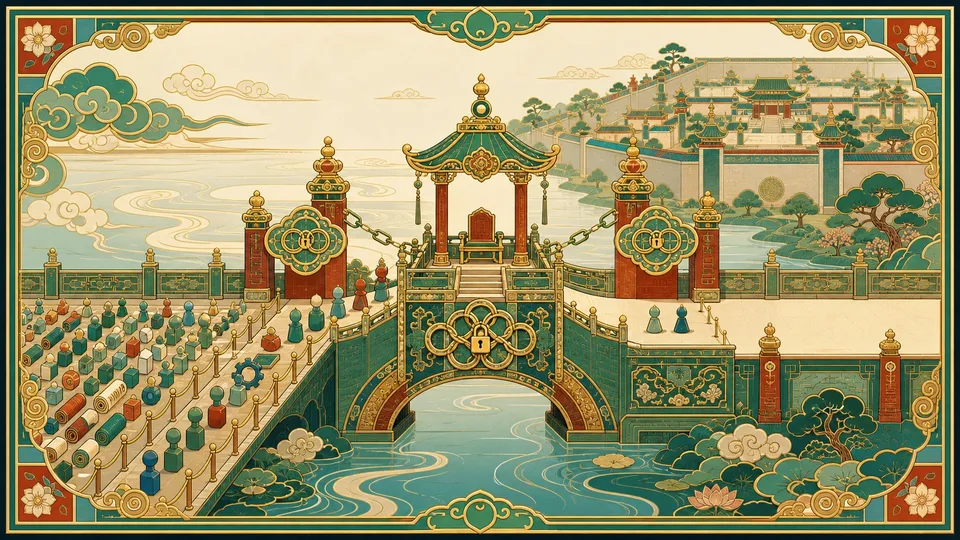
Constraints are not only operational facts. They are political prizes. The point that controls flow also controls credit, blame, hiring, promotion, access, and survival. The bottleneck becomes a throne the moment people need it for protection more than the organization needs it for throughput.
Simple Picture
Imagine a narrow bridge into a city. At first the bridge exists to move food, tools, and people across the river. Then a famine arrives. Whoever controls the bridge controls who eats. The bridge stops being infrastructure and becomes a fortress.
Organizations have the same bridges: review gates, hiring loops, roadmap committees, migration approvals, platform teams, promotion panels, budget owners, compliance desks, architectural councils. Each begins as a way to coordinate work. Under pressure, each becomes a chokepoint worth capturing.
The Core Mechanism
A healthy chokepoint is a quality filter. It says no because the work demands it. An unhealthy chokepoint is a survival asset. It says no because saying no preserves the operator’s position. This is also why meritocratic alpha is not power: the excellent producer still petitions the filter, while the chokepoint owner decides which excellence becomes consequential.
The distinction is invisible from the outside. Both versions produce delays, standards, explanations, escalations, and requests for more evidence. Gatekeeping is so durable because the same behavior can be read as diligence or domination. The reviewer who blocks a bad design and the reviewer who protects a private fiefdom both say, “I have architectural concerns.”
This is why chokepoint politics is darker than ordinary bureaucracy. Bureaucracy slows things down because process has replaced judgment. Chokepoint capture slows things down because judgment has been subordinated to survival. The captured chokepoint still thinks. It is just thinking for itself.
Legibility makes the capture defensible. The operator translates private interest into public language: risk, consistency, maintainability, fairness, alignment, security, process. The language may be true. That is what makes it useful. A captured chokepoint does not need to lie. It only needs to select the true reason that preserves control.
Survival Coalitions
People do not capture chokepoints only because they are greedy. They capture them because the environment makes exposure intolerable.
If employment, immigration status, social standing, retirement security, family obligation, or professional identity depends on staying inside the machine, then control over a chokepoint becomes insurance. A precarious person cannot afford a pure meritocracy. A pure meritocracy means the floor can disappear tomorrow. The rational response is to build a coalition that makes disappearance less likely.
This is the organizational version of bad equilibrium. Everyone can see that the captured chokepoint damages the product, but nobody can defect safely. The operator cannot loosen control without losing protection. Allies cannot criticize the operator without losing shelter. Outsiders cannot bypass the chokepoint without being marked as hostile. Management cannot dismantle it without paying the political cost all at once. The equilibrium is ugly and stable.
The Gervais Principle supplies the roles. The Sociopath sees the chokepoint as leverage. The Clueless operates it as sacred procedure. The Loser shelters inside it because the outside bargain is worse. None of this requires cartoon villainy. It only requires a system where survival is scarce enough that people rationally prefer a worse product to a less secure position.
The Three Cruelty Patterns
Chokepoint capture changes shape depending on where the cruelty lives.
Upstream cruelty produces the cartel pattern. The harshness comes from the state, the labor market, the credentialing system, or some other force outside the firm. Workers respond collectively, forming protective blocs around hiring, review, platform ownership, or managerial approval. The product decays through gridlock and rent-seeking. Everyone can explain every delay. Nobody can explain why nothing gets better.
Distributed cruelty produces the tournament pattern. The harshness lives peer-to-peer: status comparison, overtime signaling, stack ranking, social punishment for under-commitment. Workers respond individually by over-optimizing local signals. The product decays through burnout and Goodharting: more work, more metrics, more visible sacrifice, less judgment.
Ritual cruelty produces the legacy pattern. The harshness lives in inherited procedure. The organization submits to ceremonies that no longer serve reality because violation feels more dangerous than failure. The product decays through frozen process: forms, approvals, meetings, handoffs, compatibility vows, “how we do things here.” This is simple sabotage performed as institutional piety.
The map is not regional sociology. Any company can contain all three. A startup can have upstream cruelty in fundraising, distributed cruelty in engineering, and ritual cruelty in finance. The useful question is not “which culture is toxic?” The useful question is: where is the pain located, and what survival strategy does that pain select for?
Straussian Reading
Surface text: products get worse because companies grow, politics accumulates, and talented people leave.
Hidden text: product quality is often a lagging indicator of survival architecture. The people inside the system are not optimizing directly for software, users, truth, or beauty. They are optimizing for continued membership in the system that lets them keep food, status, legality, identity, and face.
This is not cynicism. It is an explanation for why intelligent people sincerely produce stupid outcomes. Once the chokepoint becomes someone’s shelter, attacking the dysfunction feels to them like attacking their right to exist. The would-be reformer thinks they are improving throughput. The operator experiences the reform as eviction.
Enshittification is what product quality looks like after every chokepoint has been repurposed into somebody’s survival bunker.
Worse-Is-Better Reality
Captured systems are not broken. They are working for a different beneficiary.
The approval gate works for the approver. The hiring loop works for the coalition that knows how to pass it. The platform migration works for the team funded to manage it. The compliance process works for the people protected by the paper trail. The ticket machine works for managers who need visibility more than engineers need autonomy.
The user experiences degradation because the user is not the real client of the captured chokepoint. The real client is the operator’s future self: still employed, still credentialed, still respectable, still legally present, still hard to remove.
This is why appeals to craftsmanship fail. Craftsmanship competes with survival. Survival wins.
Dimwit / Midwit / Better Take
The dimwit take is “the wrong people captured the organization; replace them with better people.”
The midwit take is “misaligned incentives and late-stage capitalism produce bureaucratic decay.”
The better take is that chokepoints are survival assets before they are process assets. Any point that controls flow will be captured unless the surrounding system makes capture less valuable than quality. This requires more than values. It requires low enough precarity, high enough trust, clear enough ownership, and strong enough standards that the operator can afford to serve the work instead of sheltering behind the gate.
Main Payoff
When diagnosing decay, do not begin with culture. Begin with the chokepoints.
Ask:
- What point controls flow?
- Who benefits when flow slows?
- Who becomes exposed if the gate opens?
- What public language justifies the private protection?
- What cruelty upstream makes capture rational?
The deepest mistake is treating the captured chokepoint as a local defect. It is usually an adaptation to an external threat. Remove the operator without removing the threat and another operator will capture the same bridge. There is no culture change in this sense: the culture is the memory of what people had to do to survive.
A healthy organization does not eliminate chokepoints. It keeps them aligned with reality. The bridge must still exist. The food still has to cross. The question is whether the person guarding the bridge is protecting the city or protecting the toll booth.