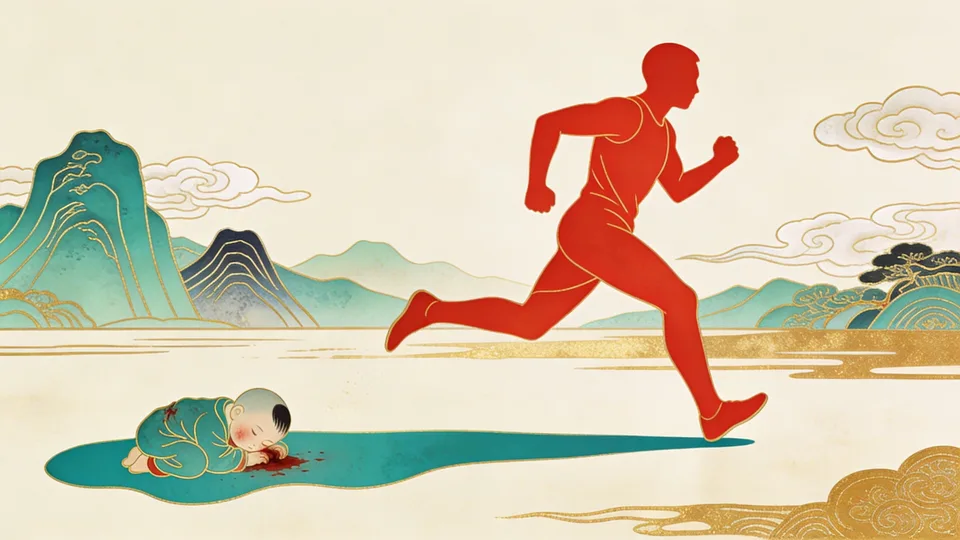
Two people on the same trajectory can be running on opposite engines. One is pulled forward by what they want. The other is pushed forward by what they cannot bear to look at. The vector is identical. The fuel is opposite.
Simple Picture
Imagine two runners crossing the same finish line at the same pace. The first ran because she loves the race. The second ran because something behind her was on fire and the running was the only way to not feel the heat.
To anyone watching, they ran the same race. To the runners, they ran in different worlds. The first one can stop at the finish line, breathe, and go home. The second one needs another race immediately — because the moment her feet stop moving, the heat catches up. She does not love running. She loves the not-being-still.
The Wound Travels
The story most ambition tells about itself is that arrival will fix something. The next promotion, the next city, the next partner, the next house, the next fitness goal. Each is sold as a destination, and the running is in service of arriving.
But for a certain kind of person, arrival never works. They get the thing. The thing is, briefly, what they thought it would be. Then they look around and notice they are still inside the same self they were trying to escape. The new circumstances do not change the texture of the hours. The hours feel the way they always felt. The wound traveled in the suitcase.
So they pick a new destination. The pattern repeats: vivid pursuit, brief arrival, instant deflation, fresh pursuit. Anyone who has run this loop knows it from the inside. The destinations are interchangeable. What is constant is the running.
This is the Ask hidden inside ambition: the explicit target keeps changing because the implicit command underneath has not been seen, bounded, or allowed to complete.
Why Arrival Cannot Land
The reason arrival does not land is structural, not motivational. The pursuit is not optimizing for a destination at all. It is optimizing for distance from the current position. The current position is the self, and the self is the thing the engine is trying to put behind it. As soon as you arrive somewhere, that somewhere becomes the new here — and here is precisely the thing the engine is built to flee.
This is why geographical change rarely works as deeply as the person hoped. It is why the new partner stops feeling new after the honeymoon ends. It is why the lavishly redecorated life still feels claustrophobic after a few months. The decor changed. The observer did not. Velocity gets mistaken for healing. The motion feels like progress because something is happening, but the something is just the constant relocation of the same unbearable self.
This is the Lacanian structure of desire seen from the inside: the object the engine pursues was never really the object. It was an excuse to keep the pursuit alive. The moment the object is acquired, it must be devalued and replaced, or the engine fails — and the failure of the engine is the thing the system was built to prevent.
The Engine Is Productive
The cruel twist is that this engine is highly effective. The person who cannot sit still produces a great deal of output. They take risks others would refuse, ship work others would defer, build things others would never start. From outside, they appear driven in the most flattering sense — focused, hungry, decisive. From inside, the driving is closer to a flinch.
This is one reason the wound is so rarely treated. The behavior it produces is often rewarded. Promotions, money, status, partners — the things the world hands out for sustained motion are handed out at exactly the rate the engine produces them. A great deal of what is admired as ambition is panic that found a productive direction. Success stories then rewrite the rewarded motion as a recipe, making the striver’s fear look like a transferable virtue and the reader’s identification feel like a forecast. The uncompletable game describes the structural mismatch when this engine enters an arena that refuses to terminate; the stage trap describes what happens once the climber is too high to step down.
Life Is Not a Race names the cultural layer that makes this engine feel normal. The private wound says “do not stop.” The public scoreboard says “you are falling behind.” Together they convert panic into virtue and stillness into shame.
Why the Engine Cannot Be Asked to Stop
The obvious question is why not just sit down and feel what is underneath. The answer is that the running was built, originally, because what is underneath was unbearable. Sometimes the wound was a child whose interior was not allowed to exist. Sometimes it was grandiosity covering an early absence of mirroring. Sometimes it was a joy that was systematically invalidated until the wanting-organ went silent. The structure is consistent: there is a place inside the person that registers as intolerable on contact, and the entire architecture of motion was built to avoid contact.
Asking such a person to stop is asking them to walk back into the room they spent decades fleeing. The nervous system reads the request as a threat to survival. Mindfulness, presence, just sit with it — these instructions are correct in the limit and read, to the underlying system, as go die. The flinch is not laziness or stubbornness. It is the engine doing the job it was built for.
The exit is not a heroic act of will — the will is what built the running in the first place. The work is not to stop the engine. The work is to make the place underneath it a little less unbearable, one degree at a time, until the running stops being load-bearing. Focusing, neural-annealing, nervous system regulation, the slow patient relationships that do not punish stillness — these are the materials. None of them work fast. The engine consents only when it is no longer the only thing standing between the person and the room.
Dimwit / Midwit / Better Take
The dimwit take is that person just has FOMO and needs to chill out.
The midwit take is they are overcompensating for childhood trauma — they need to do the inner work, heal the inner child, learn mindfulness. This is correct in shape and unhelpful in delivery. The instructions assume a person whose system is not actively flinching from the room those instructions point at.
The better take is that ambition and panic share a vector. The chase and the flight produce identical motion. Watching the motion tells you nothing about the engine. The work of distinguishing them — first in oneself, then in others — is one of the few tools that consistently keeps a person from spending decades sprinting in the wrong direction for reasons they will only understand much later.
Main Payoff
A great deal of what looks like drive is panic with a polished surface. This is not a moral judgment of the panicked striver — they are usually a person who learned, very young, that motion was the only safe state. It is a diagnostic distinction. When you cannot tell whether your own pursuit is pulled or pushed, the test is simple: ask what would happen if you arrived. If arrival sounds like rest, you are pulled. If arrival sounds like terror, you are pushed.
The cost of mistaking one for the other is years. The benefit of naming the difference is that the next destination becomes a question rather than a foregone conclusion.