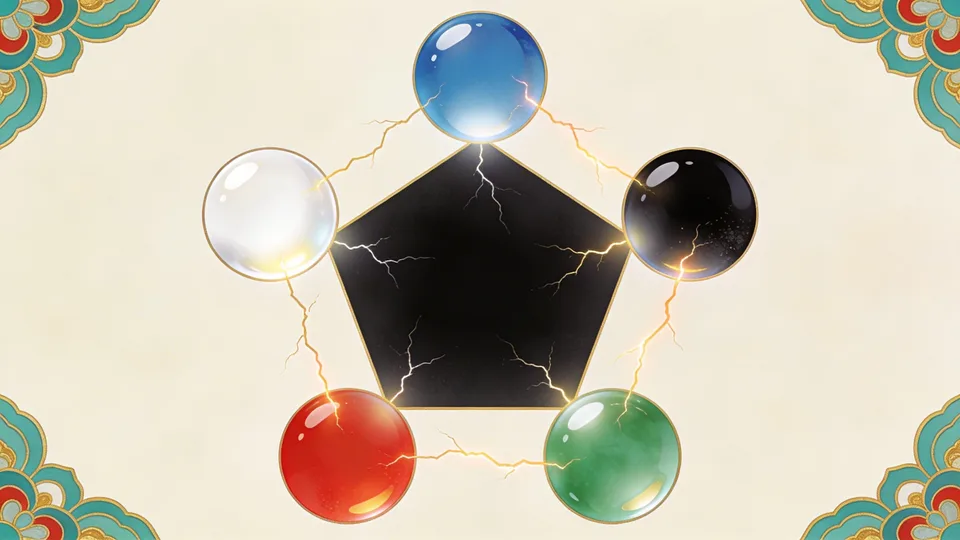
The five colors of Magic: the Gathering form a surprisingly useful typology — not of personality traits but of fundamental value orientations. Each color has a core goal, a strategy for achieving it, a characteristic failure mode, and a distinctive phenomenology of victory. The conflicts and alliances between colors map real philosophical tensions that show up in politics, relationships, and institutional design.
The Five Colors
White — Peace Through Order
White seeks coordination, cooperation, and rules. It believes that the good of the group is the highest good, and that structure is what makes goodness possible.
Entities: Churches, civic institutions, authoritarian regimes (at the dystopian extreme). Big Five mapping: High conscientiousness, high agreeableness, low openness, low neuroticism. Victory feels like: brightness, purity, exaltation.
Blue — Perfection Through Knowledge
Blue seeks understanding and the application of truth. It believes that everything is improvable and that the path to improvement is knowing more and thinking better.
Entities: Universities, research labs, engineering culture. Big Five mapping: High openness, high conscientiousness, moderate agreeableness and extraversion, low neuroticism. Victory feels like: clarity, revelation, actualization.
Black — Satisfaction Through Ruthlessness
Black seeks power and self-interest. It does not pretend to altruism. It believes that the world is a competitive landscape and that the honest move is to play to win rather than pretend otherwise.
Entities: Hedge funds, totalitarian dictatorships (at the extreme). Big Five mapping: Moderate openness and extraversion, low agreeableness, low conscientiousness. Victory feels like: hefty, exultant, satisfying.
Red — Freedom Through Action
Red seeks spontaneity, passion, and authentic expression. It believes that aliveness is the point and that anything that constrains genuine experience is the enemy.
Entities: Art studios, anarchic movements (at the extreme). Big Five mapping: High openness, high extraversion, high agreeableness. Victory feels like: fiery, beautiful, magnificent.
Green — Harmony Through Acceptance
Green seeks natural order and wisdom. It believes the system is already subtle and interconnected, and that the correct move is acceptance of natural roles rather than intervention.
Entities: Hippie communes, rigid traditional societies (at the extreme). Big Five mapping: High agreeableness, high conscientiousness, low openness, low neuroticism. Victory feels like: peaceful, fertile, balanced.
Conflicts
The color wheel is arranged so that each color’s two enemies are the colors on either side of its opposite. These conflicts are not arbitrary — they represent genuinely irreconcilable value tensions.
White vs Black — the good of the group versus the good of the individual. White sees evil; Black sees codependency. Neither is entirely wrong.
Blue vs Red — reason versus emotion. Blue sees Red as impulsive and rash. Red sees Blue as repressed and unfeeling. Blue builds systems; Red lives in moments.
Green vs Blue — nature versus intervention. Green believes the system is subtle and interconnected. Blue believes you need to science harder. Green says accept; Blue says optimize.
Each of these conflicts is an instance of reference-point-bias: each color calibrates “reasonable” to its own position and reads the opposing color as defective rather than differently oriented. The Blue agent cannot understand why Red will not think more carefully. The Red agent cannot understand why Blue will not feel more freely. Both are right about what the other is missing and wrong about what the other has.
Alliances
Adjacent colors share a common enemy and a common value:
- White + Blue: Structure and intentionality. Enemy: Red (chaos).
- Blue + Black: Growth mindset, belief in self-improvement beyond tradition. Enemy: Green (acceptance).
- Black + Red: Independence and self-reliance. Enemy: White (conformity).
- Red + Green: Authenticity and immediacy. Enemy: Blue (abstraction).
- Green + White: Community and collective good. Enemy: Black (selfishness).
Why This Framework Is Useful
Most personality typologies sort people by traits — MBTI sorts by cognitive defaults, Big Five by behavioral tendencies. The color wheel sorts by values — what you think the point of life is and what strategy you believe serves it. This makes it useful for understanding conflicts that feel irreconcilable not because of personality friction but because of genuine philosophical disagreement about what matters.
It also explains why people who share a color bond instantly (shared values produce immediate trust) while people on opposing colors talk past each other permanently. The conflict is not about facts. It is about which facts count — which is the same dynamic described in paradigm lock-in.
Common Misread
The dimwit take is “I’m obviously Blue/Red and that makes me superior.”
The midwit take is “all colors are equally valid, so there is no real conflict.”
The better take is that each color captures something genuinely important that the others miss, and each color’s dystopia is real. White becomes authoritarian. Blue becomes heartless. Black becomes predatory. Red becomes chaotic. Green becomes stagnant. The full picture requires holding all five in tension — which is uncomfortable, because your own color will always feel like the obvious default.
Main Payoff
The color wheel’s deepest value is as a conflict diagnostic. When two people or two institutions are locked in a fight that neither can resolve, check whether they are on opposing colors. If so, the disagreement is not about evidence — it is about values. No amount of argument will resolve it, because each side is using a different scoring function to evaluate the same world.
References:
- The MTG Color Wheel — Homo Sabiens