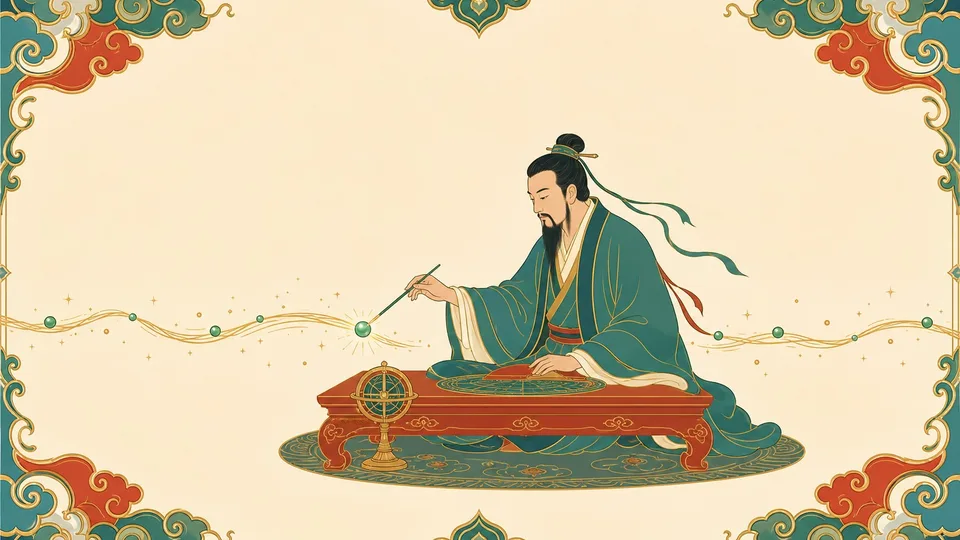
“Everything Everywhere All at Once” is not just a movie title. It is the condition that overloads the mind: every object, every mind, every alternate path, every failed branch, every future, every past, every version of the observer who could have looked. The nervous system cannot hold that. Language cannot hold that. So consciousness does what it always does when reality exceeds its working memory: it creates a handle.
For one civilization the handle was God. For another it was Dao. For another it was Brahman, the One, Suchness, the field, the pleroma, 天. These words are not primarily explanations. They are pointers. They let a finite mind gesture toward the total object without pretending to contain it.
God and Dao are what everything everywhere all at once looks like after the human mind compresses it into a usable pointer.
But a pointer is not a steering wheel. This is the missing half of the thought. In Venkatesh Rao’s “Touching Time”, the important distinction is not nature versus abstraction, but agency versus presence. Some scales of reality invite action. Others only allow attendance. The stars, deep geology, memory, history, and the past are not improved by our compulsive need to do something about them. They demand a different posture: presence without agency.
That is why this note is not only about sacred names as pointer technology. It is about how to hold the pointer without mistaking it for control.
The Handle
Imagine a film strip.
One frame shows a woman looking at a stone. Another frame shows her looking away. Another shows her as a child. Another shows her as an old woman. If you hold one frame up to the light, you get a complete little world: colors, bodies, positions, relationships. That is a temporal slice.
Now imagine the entire strip at once: every frame laid out, every transition visible, the whole arc from first movement to final stillness. That is a world-line.
Now imagine not one strip but all possible strips: the version where she speaks, the version where she stays silent, the version where she never met the stone, the version where there is no stone, the version where the word “stone” never existed. That is the multiversal block, the unbearable object behind the phrase everything everywhere all at once.
“God” and “Dao” are handles for this level of totality. Not because an old man with preferences lives outside the projector. Because the whole film-strip-and-all-its-variations is not available as an ordinary object inside any single frame.
The Tao Te Ching begins by protecting this distinction: the Dao that can be named is not the constant Dao. That is not anti-language. It is language hygiene. The name is useful only while it remembers it is a pointer.
The same hygiene applies to God. God is not another entity inside the universe. God is a way of addressing the whole when the whole needs personhood-language: intimacy, answerability, gratitude, terror, moral weight. Dao is what the whole looks like when the whole needs process-language: movement before naming, order without central command, way-making without forcing.
Both are handles. Neither is the thing held.
The Slice and the Block
The first meaning of “all at once” is phenomenological. Every remembered past occurs now. Every imagined future occurs now. Regret, planning, anticipation, nostalgia, fear of death, childhood memory, spiritual longing: all appear as present events in awareness. The mind represents time, but the representing happens in the immediate field.
This is the flashlight problem in temporal form. Awareness cannot step outside itself to inspect awareness as an object. It can only illuminate appearances. The past is a present image tagged “past.” The future is a present image tagged “future.” The self is a present pattern tagged “me.” All of it is happening in the one place experience ever happens.
The second meaning is colder: the world-line-block.
A person is not only the current felt instant. A person is infancy, shame, accident, luck, habit, love, decline, death, and every causal dependency that made the trajectory possible. pattern-integrity already makes the local version of this claim: you are not a fixed object but a persistent architecture sliding through matter. The block view says the architecture is not only the current whirlpool. It is the whole path the whirlpool traces through the river.
This is where Spinoza becomes useful. Freedom is not exemption from causality. Freedom is understanding necessity. The block view is not a prison unless you smuggle in a tiny sovereign self who was supposed to hover outside the causal field issuing edits. Once that fantasy is removed, necessity stops meaning coercion. It means belonging to the whole fabric.
The temporal-slice version says: all time appears now.
The world-line-block version says: every now is one cross-section of the whole path.
Do not collapse these into each other. They rhyme, but they answer different questions. The first asks about the structure of experience. The second asks about the structure of the whole pattern if no local frame is privileged.
Touching Time
Rao’s useful move is to notice that “touching grass” is often a fake escape from scale. Literal grass, especially the manicured lawn imagined by the phrase, is not primordial nature. It is a tiny high-maintenance regime, a pleasant surface produced by an endless campaign against weeds, meadow, forest, insects, weather, and entropy. To touch that kind of grass is to touch the product of somebody’s agency, often somebody else’s labor.
So the opposite of abstraction is not grass. The opposite of abstraction is temporal depth.
To touch time is to encounter a place, object, memory, or scene whose time constants run deeper than the current human project. A gorge exposes glaciers. A stamp carries a miniature history. A ruin lets empire become texture. A night sky turns looking into delayed contact with light-years. The point is not information. A geology textbook can tell you what happened. The felt thing is different: time becomes thick enough to touch.
This matters because many of the most important scales of reality offer almost no agency. The heavens are the cleanest example. You can ignore them, or you can watch them. You cannot meaningfully negotiate with them. Even the grandest civilizational fantasies of space colonization barely register against the cosmic scale. The available posture is not mastery but attention.
The past has the same structure. We can revisit memories, reinterpret archives, contest narratives, and repair our relationship to what happened. We cannot alter the event itself. The phenomenology that made the memory is gone. Presence remains possible; agency does not.
This is intolerable to the agency-anxious. So they invent ways to convert the past back into a project. They turn history into progress, destiny, proof, vindication. They author hoped-for futures partly to validate preferred pasts. They do not merely revise history; they try to make history retroactively win.
That is the pathology of the map-maker. But the grass-toucher has the opposite pathology. Faced with huge unsteerable processes, he retreats into the local, concrete, and tactile until the larger maneuvering disappears from view. One person mistakes comforting contact for truth. The other mistakes comforting abstraction for steering authority.
Touching time bridges them. It lets you feel your way into the amount of agency you actually have without needing to deny the vast regions where you have none.
The Sacred Pointer as Presence
This is where the old sacred words become clearer.
The mistake is to treat God, Dao, or the block universe as a total-control map. Once the mind has a word for the whole, it wants the word to grant leverage over the whole. Theology becomes command-and-control. Metaphysics becomes cosmic management. Big History becomes self-soothing epic. Spirituality becomes a claim to have found the master key.
But the better use of the pointer is not control. It is presence at the right scale.
God: the whole addressed as Thou.
Dao: the whole moving before naming.
Block: the whole seen without local privilege.
Slice: the whole appearing here.
Time: the whole felt through depth, memory, strata, starlight, and consequence.
Each word helps consciousness stay in contact with something larger than its current frame. Each becomes false when it inflates contact into sovereignty.
This is also why the movie title is emotionally exact. Totality does not merely exceed comprehension. It threatens local meaning. If every path exists, why care about this one? If every choice branches, why honor this branch? If the whole contains every wound and every repair, what makes this conversation matter?
The answer is not that this slice is the only slice.
The answer is that this slice is how the whole becomes intimate with itself here.
The hand on the table, the ordinary apology, the small kindness, the ridiculous bill, the eye contact that should not matter and does: these are not made less real by totality. They are the only places totality touches itself at human scale.
Dimwit / Midwit / Better Take
The dimwit take is “God is a big supernatural person who made everything and watches you.” Crude, but emotionally functional: it preserves address, gratitude, fear, accountability, and a felt relation to the whole.
The midwit take is “God is fake, Dao is poetry, and the universe is just particles plus laws.” Often correct against bad theology, useless against the deeper problem. It deletes the primitive picture and then has no replacement handle for totality, value, consciousness, causality, time, and the felt demand of existence.
The agency-anxious take is “if the whole can be named, it can be steered.” This is the metaphysical version of making endless maps of the spaceship and then mistaking the map for command authority.
The avoidant take is “only the touchable local thing is real.” This is the spiritual version of staring at the grass because the stars are too much.
The better take is that sacred language is pointer technology for totalities the local mind cannot render directly, and touching time is the discipline that keeps the pointer from turning into a fantasy of control.
Main Payoff
Do not ask whether God or Dao “exists” as if the word named another object inside the furniture of the universe. Ask what scale of reality the word is trying to make contact with.
If the question is experience, the pointer aims at the temporal slice: the immediate field where past, future, self, and world appear now.
If the question is causality, the pointer aims at the world-line-block: the whole pattern across time, including every local instant as a cross-section of an extended curve.
If the question is agency, the pointer must be humbled by touching time: some of the whole can be acted within, much of it can only be attended to, and wisdom begins by learning which is which.
The sacred name is not the whole. It is the handle consciousness invented because the whole cannot fit through consciousness except as a handle. The mistake is worshipping the handle. The equal and opposite mistake is throwing away the handle and then pretending your hand is empty because there is nothing to hold.
Everything everywhere all at once needed a pointer. We called it God when we needed a face. We called it Dao when we needed a way. We call it time when the whole becomes tangible through memory, starlight, ruins, geology, and consequence.
The point is not to steer everything. The point is to remain present to everything, and to act only where the whole has actually placed a hand.