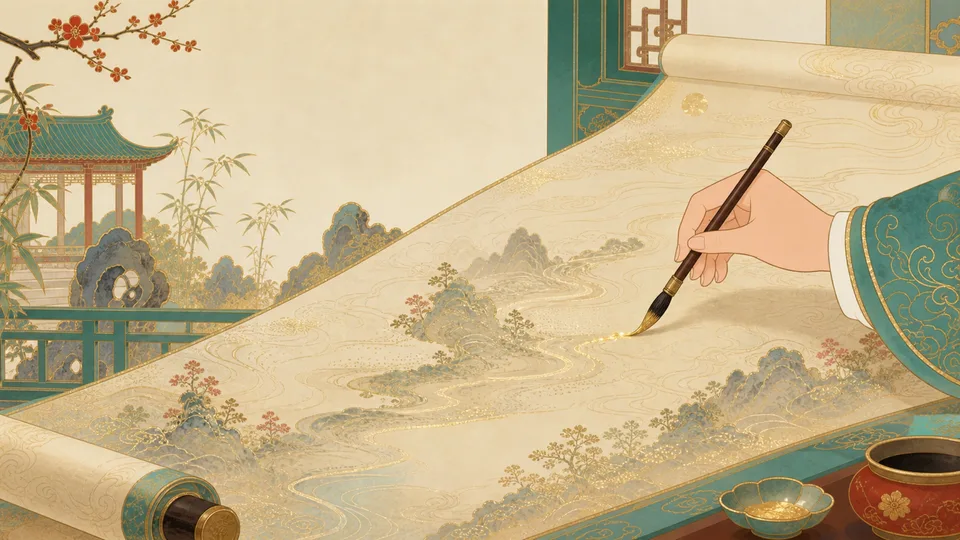
To accept that your life is one brushstroke in the grand tapestry can either liberate you or annihilate you. It liberates you when you can see the tapestry. It annihilates you when all you can see is the smallness of the stroke.
The crucial distinction: a brushstroke is tiny, but it is not trivial.
Its meaning does not come from being large. Its meaning comes from being placed. A single stroke on a blank canvas can feel absurd - too small to matter, too fragile to endure, too easily covered over. But a single stroke inside a larger composition can be sacred: the glint in an eye, the shadow under a hand, the almost invisible line that makes the whole figure breathe.
This note grows from the-creative-act, prospect-garden, intimacy-with-all-things, love-as-prime-mover, pattern-integrity, the-self-and-the-soul, helplessness-and-copes, and cynicism-as-counterfeit-judgment. The question it answers: what happens when ego death arrives without reverence? The claim: smallness only becomes freedom when perception of the whole is strong enough that the particular remains holy.
Simple Picture
Imagine a painter working on a vast scroll. One mark is barely visible. From six inches away, it looks like nothing: a thin curve of ink, a small darkening under a sleeve, a fleck of gold near the corner of an eye. If the mark were floating alone on blank paper, it might look ridiculous. Inside the painting, it is exact.
The immature eye sees only quantity: small mark, small value. The artist sees placement: this mark belongs here, and because it belongs here, the whole painting changes when it is missing.
Your life is like that. The danger is not realizing that you are small. The danger is realizing that you are small before you have learned how anything small belongs to anything large.
Ego Death Without Soul Death
A lot of people can kill the ego. Far fewer survive that killing with their capacity for reverence intact.
They realize they are not the protagonist of the universe and conclude that nothing matters. But this is only half an awakening. The fuller awakening is realizing that not being the protagonist is what allows you to participate cleanly. You stop trying to make the whole tapestry about you. Then, paradoxically, your brushstroke gets better.
This is the missing bridge between already-free and the-self-and-the-soul. The fruitional view releases the drama of the self. The soul view refuses to let that release become sterile. You are not the central problem to solve, not the central achievement to optimize, not the central wound the cosmos must organize around. But the thing left after that subtraction is not nothing. It is participation.
Ego death without soul death means the self stops demanding cosmic importance, while the soul keeps its ability to care.
Scale Without Beauty
Scale without beauty produces nihilism.
The cosmos is large. Civilization is old. Institutions are vast. Your individual action is usually not the lever your fantasy wants it to be. helplessness-and-copes names the ordinary reaction: if I cannot be visibly consequential, I need a surrogate activity that lets me feel like the kind of person who would be consequential. When that cope collapses, the clever mind often flips to the opposite error: nothing matters because I am small.
This is not realism. It is wounded scale perception.
The nihilist has seen that the self is not the painting, but has not seen the painting. So every act of care starts to look embarrassing. Excellence seems naive. Love seems biologically manipulative. Duty seems socially constructed. Beauty seems subjective. Sacrifice seems irrational. The person becomes too clever to participate.
That is the trap: seeing through everything until you can no longer see anything.
cynicism-as-counterfeit-judgment is the social form of this injury. The cynic borrows the authority of final judgment because participation would expose them to disappointment. But the metaphysical version is deeper: the person mistakes the absence of protagonist status for the absence of meaning. They killed the ego and accidentally killed the organ that could perceive the whole.
Beauty Without Scale
Beauty without scale produces narcissism.
This is the opposite failure. The person can feel the holiness of their particular mark, but cannot place it inside anything larger. Their suffering becomes uniquely profound. Their art becomes a referendum on their soul. Their romance becomes cosmic proof. Their sensitivity becomes identity. Every brushstroke must announce itself as the painting.
the-creative-act warns against this through the privacy of the soul: recognition does not complete the work, because the real instrument is the life doing the perceiving. But the artist without scale turns perception into self-importance. They do not serve beauty; they use beauty to certify themselves as special.
This is neediness at the sacred register: the mark demands an audience because it has not found its place in the composition. The painter wants applause for every stroke because the work itself is not yet enough.
Beauty without scale makes the particular too heavy. Scale without beauty makes it too light. Both destroy the mark.
Scale Plus Beauty
Scale plus beauty produces devotion.
Devotion is the word the idea wants. Not ambition, not optimism, not self-esteem. Devotion says: this stroke matters, not because I am important, but because the work is important.
The artist can hold two scales of reality at once:
- the immensity of the whole
- the holiness of the particular
This is not a compromise between cosmic significance and personal insignificance. It is a third posture. The brushstroke does not need to be large, and it does not need to be self-negating. It needs to be faithful.
intimacy-with-all-things gives the contemplative version: friendship is the path because contact is available at every scale. The breath, the grief, the stranger, the tree, the species - each is a corner of the same fabric. love-as-prime-mover gives the teleological version: the universe is not pushed from behind but drawn toward integration, and every act of real contact is a local register of that pull. Devotion is what this feels like when it enters the will.
It is the willingness to make the local mark as if the whole is real.
Placed, Not Large
Meaning is not proportional to size.
This is where the brushstroke metaphor becomes operational. A private act of discipline can matter. A clean room can matter. A sentence told truthfully can matter. A refusal to pass ugliness downstream can matter. A moment of mercy can matter. Not because any one of these becomes historically legible, but because reality is not made only of what history can see.
pattern-integrity names the structural reason: the most important effects of an action are often precessional, rippling at ninety degrees to the direct motion. You think you are merely doing the task in front of you. Someone else inherits the atmosphere. You think you are keeping one promise. A child learns what promises are. You think you are refusing one small ugliness. The room becomes slightly less hostile to beauty.
The direct stroke is small. The placement is not.
This is why the ability to care about every brushstroke is not sentimental. It is a discipline of perception. You cannot truly care about the brushstroke unless you believe, at least implicitly, that the whole is real. And you cannot truly serve the whole unless you honor the brushstroke in front of you.
The Artist’s Sanity
Artist energy is not about painting. It is the capacity to perceive both the whole and the mark without sacrificing either.
The non-artist of scale says: why care about one note when the symphony is too vast? The non-artist of beauty says: listen to my note, my note, my note. The artist hears the symphony and still tunes the note. This is sanity. The note is not the symphony. There is no symphony without notes.
prospect-garden is the garden’s strongest version of this. The stone enters form knowing the garden will empty. The author writes the garden knowing it is already gone. The reader opens the book knowing the loss is coming. The point is not that impermanence makes beauty futile. The point is that beauty is impermanence perceived by a consciousness that cares. The brushstroke will not last. That is not an argument against the stroke. It is the condition that makes fidelity matter.
The artist’s sanity is the ability to know that one stroke is not the painting, while also knowing there is no painting without the stroke.
What Faithfulness Looks Like
Once the protagonist burden drops, life becomes less theatrical and more exact.
You do not have to be history. You do not have to be God. You do not have to redeem the species, solve the age, justify existence, or become globally legible. You have to add your mark.
Do the work well. Love the person in front of you. Keep the room beautiful. Tell the truth. Make the thing. Carry the tradition one inch forward. Refuse ugliness where you can. Let the small act be small without letting it become careless.
This is not resignation. It is the release from performing magnitude. finite-and-infinite-games clarifies the shift: the finite player needs the title, the proof, the recognized victory. The infinite player keeps the play alive. The faithful brushstroke is infinite play at the level of daily action. It does not ask whether the mark wins. It asks whether the mark continues the painting.
Common Misread
The dimwit take is “I am just one person, so nothing matters.”
The midwit take is “meaning is an illusion, but we can manufacture local preferences.”
The better take is that meaning is not proportional to size. A thing can be small and still be exact, necessary, and sacred. The task is not to inflate the self back into cosmic importance after ego death. The task is to perceive the whole strongly enough that smallness becomes beautiful rather than humiliating.
Scale without beauty produces nihilism. Beauty without scale produces narcissism. Scale plus beauty produces devotion.
Main Payoff
Your life is not less meaningful because it is small. It is meaningful because it is placed.
The brushstroke is insignificant only to those who cannot see the painting. But the painting is not an excuse to neglect the brushstroke. The whole arrives through the particular or it does not arrive at all.
That is ego death without soul death: no longer needing the canvas to be about you, and still caring completely about the mark your hand is making.