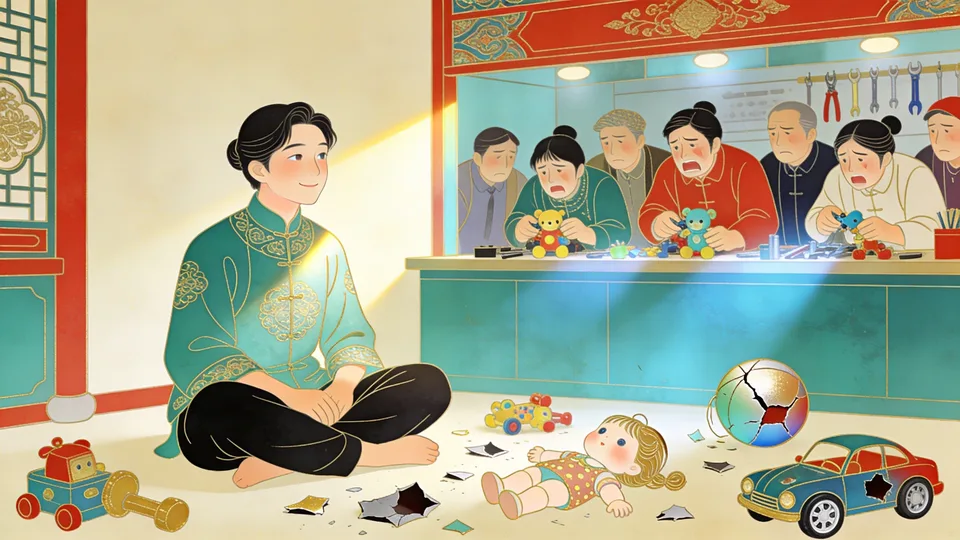
When someone lets you down, what actually failed was your judgment about them.
Anthony De Mello, a Jesuit priest who spent his life leading retreats, warns against believing people who say they want to wake up. They tell you they want to get out of kindergarten, but all they really want is for you to mend their broken toys. “Give me back my wife. Give me back my job. Give me back my money. Give me back my reputation, my success.” They want their toys replaced. That is not waking up.
So what would waking up be, if not getting the wife or the job back? Awareness is his answer, and it starts by relocating the problem from the lost thing to the person who lost it.
The belief behind the toy
An attachment is a belief that without something you are not going to be happy. The trouble is the belief, not the wife or the job. You were taught to place your happiness in external conditions, so you are ready to be happy only provided you have this and that and the other thing. Naval Ravikant compresses it to one sentence: desire is a contract that you make with yourself to be unhappy until you get what you want. The contract gets signed so automatically that you never notice you are the one who wrote it.
Take the man asking for his wife back. He feels betrayed, and De Mello’s reply is the sharpest passage in the book:
You never trust anyone. You only trust your judgment about that person. So what are you complaining about? The fact is that you don’t like to say, “My judgment was lousy.” That’s not very flattering to you, is it? So you prefer to say, “How could you have let me down?”
Part of the pain of being let down, then, is a model of reality that turned out wrong, and an ego that would rather blame the other person for changing than own the error. His suffering is real, but much of it is about him.
Fear of the known
Why cling so hard to a picture that has already failed? Because the picture is familiar. It is not that we fear the unknown. You cannot fear something that you do not know. What you really fear is the loss of the known. The marriage that ended was at least a known world, and its absence feels like falling. De Mello goes further: there is only one evil, fear, and when you fear somebody you also stop seeing them, because the emotion blocks perception.
That is why he defines love so differently from the toy-mender:
To surrender is to let something be. To let something be is to love it.
Clinging love looks devoted, but often it is two people each loving the other at the cost of their own happiness, and so you get two unhappy people, but long live love! The alternative he offers is not detachment:
What I really enjoy is not you; it is something that is greater than both you and me. It is something that I discovered, a kind of symphony, a kind of orchestra that plays one melody in your presence, but when you depart, the orchestra doesn’t stop.
By this measure, De Mello argues, sorrow at a loss is mostly self-pity over not getting what you want. It sounds brutal. The test behind it is whether the orchestra stops when the person leaves. If it does, what you had depended on her, and desire was wearing love’s costume.
Seeing without judging
How do you get from clinging to letting be? Not by a technique, De Mello says, because the moment you pick up a method you are programmed again. Self-observation is the only one. What you are aware of you are in control of; what you are not aware of is in control of you. And what you judge you cannot understand, so the observation has to happen without verdicts. The same goes for verdicts from outside: if you let yourself feel good when people tell you that you are okay, you are preparing yourself to feel bad when they tell you that you are not. Focusing works the same way, by gentle attention rather than intervention: you sit with the felt sense until it shifts on its own.
The obvious objection is that this is spiritual bypassing, a way to stop caring about real losses. But De Mello is not asking you to stop caring. He is asking you to notice that most of what you call caring is attachment, the belief that your happiness depends on one outcome. Caring without attachment is not cold. It is the only kind that can actually see the other person, because it is not filtered through “what does this mean for me?”
Uncaused happiness
What’s left when the toys stop mattering? Happiness that doesn’t depend on them. Uninterrupted happiness is uncaused. Ask the awakened person, “Why are you happy?” and the awakened person replies, “Why not?” You are never so full of yourself as when you are in pain. You are never so centered on yourself as when you are depressed. You are never so ready to forget yourself as when you are happy.
Learning, where spirituality is concerned, is unlearning almost everything you have been taught. Every time you make sense out of reality, you bump into something that destroys the sense you made, so life only makes sense as mystery. The man still wants his wife back. De Mello’s wager is that the loss he is mourning may be the beginning of something he can’t yet see. The end of the world for a caterpillar is a butterfly for the master.
References:
- Anthony De Mello, Awareness: The Perils and Opportunities of Reality
- Anthony De Mello, Rediscovering Life