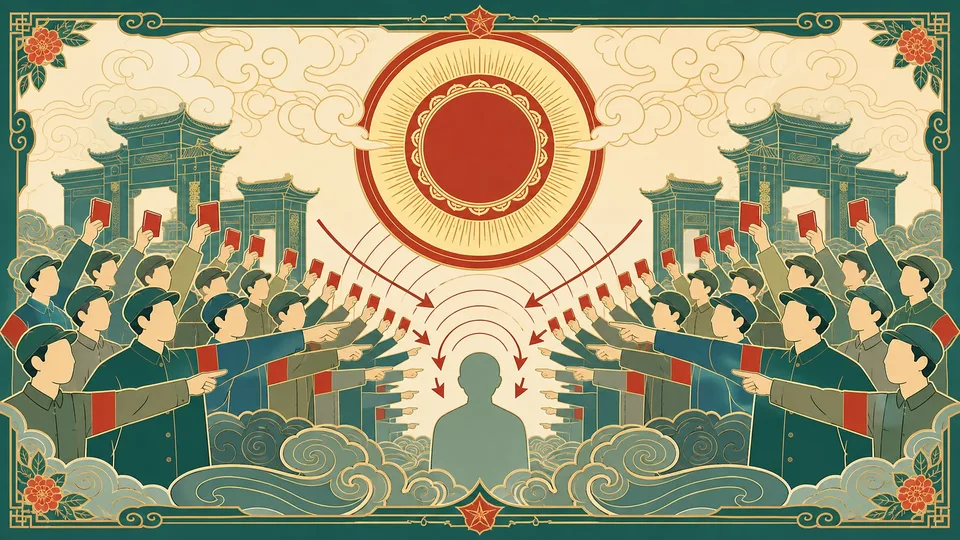
The Cultural Revolution was a state-unleashed mimetic purity tournament that became too decentralized for the state to control. Mao made revolutionary authenticity the supreme object of desire, but gave no stable external test for possessing it. In that vacuum, accusation became self-protection.
The modern Chinese state is designed around the opposite lesson. Not “no scapegoating,” but licensed scapegoating: accusation centralized, bureaucratized, censored, redirected, and prevented from becoming autonomous mob violence. The Party learned that the most dangerous crowd is not an anti-Party crowd. It is a crowd that believes it can interpret sacred legitimacy directly.
Simple Picture
Mao made everyone play a game called Who Is the Most Red?
The prize was safety, status, belonging, moral innocence, and proximity to the sacred model. The problem was that nobody knew the rules. If you accused first, you looked loyal. If you hesitated, maybe you were the hidden enemy. Soon students, workers, cadres, neighbors, and families were copying one another’s accusations. Then rival factions fought each other while all claiming to love Mao most.
Modern China tries to prevent the same game by changing one rule: only the state gets to say who the bad guy is.
The Mimetic Sequence
The Cultural Revolution’s Girardian sequence:
Mao as sacred model → redness as desired object → no one knows who is red enough → accusation becomes self-defense → factions mirror each other → society becomes all-against-all → order is restored through state repression and retrospective scapegoats
The usual explanations are true but incomplete: Mao’s power struggle, elite factional politics, youth mobilization, institutional collapse, class categories, and ideological extremism all mattered. The Girardian layer explains why the thing became contagious.
The object was not merely policy. The object was being red.
And “being red” is the perfect mimetic object: infinite, invisible, and zero-sum. You can always be more revolutionary, more loyal, more willing to denounce, more willing to sacrifice, more willing to detect hidden enemies. But if someone else appears more revolutionary than you, your own revolutionary status becomes suspect.
The scarce good was not food or land. It was revolutionary being.
Accusation as Immunity
In an ordinary conflict, accusation says: he did something wrong.
In a mimetic purity crisis, accusation says: I am safe because he is guilty.
That is the engine. Accusation is not only punitive. It is immunizing. The Cultural Revolution created a world where failing to accuse could itself look counterrevolutionary. The Red Guard does not merely attack the teacher because the teacher is hated. The Red Guard attacks because violence is proof of belonging.
The violent act says:
Look how far I am willing to go. Only a true revolutionary would do this.
This is why humiliation mattered. The struggle session was not just punishment. It was a ritual of visible guilt. The bowed head, placard, shaved hair, inked face, forced confession, beaten posture, or corpse gave the crowd a body on which to see its own righteousness.
A purity system without an external test will eventually use cruelty as the test.
Red vs Red
The rivals were not fighting because one side loved Mao and the other hated Mao. Often both sides claimed to be the truest Maoists.
That is why the conflict became unstable. It was not:
red vs anti-red
It was:
red vs red
More precisely: imitator vs imitator, each accusing the other of false imitation.
Faction A says: we are the real revolutionaries. Faction B says: no, we are the real revolutionaries. Each side borrows the same sacred vocabulary, Maoist symbols, victimhood claims, purge logic, and permission structure for righteous violence. The factions become doubles while insisting they are metaphysically opposite.
This is the nightmare form of orthodoxy: when everyone can perform the approved language, the only way to distinguish true belief from counterfeit belief is escalation.
Internal Foreigners
The Cultural Revolution did not need a foreign enemy. It manufactured internal foreigners.
The scapegoat was usually inside the social body but marked as alien: teacher but bourgeois, Party official but capitalist roader, Chinese citizen but class enemy, former revolutionary but renegade, student but wrong class background, neighbor but contaminated by old culture.
That is the perfect scapegoat type: close enough to blame, different enough to expel.
The point was to split society into:
the people vs the hidden enemy among the people
Because the enemy was hidden, anyone could be accused. Because anyone could be accused, accusation became the safest move. Because accusation became the safest move, the system selected for people willing to accuse faster, louder, and with less hesitation.
The Sacrificial Monopoly
Maoist mobilization generated too much mimetic energy. The Party unleashed mass accusation, then discovered that accusation could not be safely contained.
Once everyone can accuse everyone else of betrayal, the Party itself becomes vulnerable. Students, workers, local cadres, military units, and Red Guard factions all claim direct access to Maoist legitimacy. The hierarchy loses its monopoly on deciding who counts as legitimate.
That is intolerable for any state. A state can tolerate hatred. It cannot tolerate unauthorized priesthoods.
So the center restored order by demobilizing the forces it had empowered. Mass scapegoating from below became factional all-against-all; state scapegoating from above rebuilt order through repression. Walder’s research is crucial here: the larger share of casualties came not from rebel violence alone, but from organized repression used to restore political order.
The lesson was not “purity politics is bad.” The lesson was: purity politics must never become horizontally self-authorizing.
The Gang of Four
After Mao died, the post-Mao leadership needed to explain the catastrophe without destroying Mao’s sacred residue or the Party’s legitimacy. So the Cultural Revolution itself was scapegoated.
The Gang of Four became the vessel for the disaster. This is Girardian closure:
The system creates violence. The violence becomes unbearable. A few figures are made to carry the guilt. Their removal lets the system continue.
The point is not that the Gang of Four were innocent. The point is that they were made to carry more than their share of the whole system’s guilt.
Real fault + collective projection = scapegoat.
Modern China’s Anti-Mimetic Machinery
Modern China’s ruling strategy is built around one anti-Cultural-Revolution commandment:
Never allow uncontrolled mass mobilization to become more legitimate than the Party center.
The modern state does not eliminate mimetic dynamics. It monopolizes them.
Cultural Revolution China:
- decentralized accusation
- horizontal mob violence
- rival factions claiming sacred legitimacy
- ambiguous enemy categories
- local collapse of hierarchy
Modern China:
- centralized accusation
- bureaucratic discipline
- censorship and surveillance
- preemptive policing
- licensed nationalism
- controlled scapegoats
The post-Mao system rebuilt hierarchy. Xi’s system intensifies it. The 2021 historical resolution repeatedly stresses centralized Party authority and unity. The Patriotic Education Law fuses love of country, Party, and socialism into one object of loyalty. The stability-maintenance state tries to detect contention before it becomes self-amplifying. The internet is treated as a mimetic-contagion surface. Nationalism is permitted as long as the enemy remains licensed.
The modern command is:
You may imitate patriotic feeling. You may imitate loyalty. You may imitate outrage against approved enemies. But you may not decide the enemy yourself.
Safer Containers
Modern China redirects scapegoating into safer containers.
Bureaucratic internal scapegoats. Corrupt officials, disloyal cadres, local governments, tycoons, celebrities, cults, “black hands.” Corruption is real; the Girardian point is not that targets are innocent. The point is that selected targets absorb systemic anger while preserving the center’s legitimacy. Anti-corruption works because opposing it is indistinguishable from defending corruption.
Externalized nationalism. Japan, the United States, Western hostile forces, separatists, foreign NGOs, Taiwan independence, Hong Kong black hands. External enemies give domestic resentment an outside object while leaving the protected symbolic core intact.
Peripheral internal outsiders. Uyghurs, Tibetans, Hong Kong dissidents, underground religious groups, rights lawyers, and other groups can be placed outside the protected symbolic center while remaining inside the border. This is “elsewhere” in the Girardian sense: not necessarily outside the country, but outside the circle whose innocence the system must preserve.
Growth. The reform era also used a non-scapegoat solution: it reintroduced reality mediation. Instead of competing over revolutionary purity, people could compete over income, education, housing, migration, business opportunity, exams, consumption, and family advancement. These are still mimetic, but they are less explosively sacrificial than ideological purity contests. Growth commercialized status competition. Much safer.
Do not fight your teacher to prove revolutionary purity. Pass the exam. Move to Shenzhen. Start a business. Buy an apartment. Get your child into a better school.
The Fragile Part
When growth slows, property wealth stagnates, youth mobility declines, and local governments face fiscal pressure, more desires become zero-sum again. Then resentment needs a container.
Modern China’s answer is not Cultural Revolution 2.0. It is more discipline, more censorship, more nationalism, more security, more anti-corruption, more ideological unity. Freedom House’s China Dissent Monitor shows that protest still occurs regularly and across regions. The key difference is that the Party is extremely skilled at killing network effects early.
The simplest contrast:
Cultural Revolution China: the state said, find the enemy. Everyone started finding enemies. Then everyone became someone else’s enemy.
Modern China: the state says, we will tell you who the enemy is.
That is the difference between mimetic crisis and authoritarian stability.
Dimwit / Midwit / Better Take
The dimwit take is “the Cultural Revolution happened because Mao was crazy and people were brainwashed.”
The midwit take is “it happened because of elite power struggle, class politics, institutional collapse, youth mobilization, and ideological extremism.”
The better take is that the Cultural Revolution was a mimetic purity cascade: Mao became the sacred model, revolutionary authenticity became the desired object, everyone competed to prove redness by exposing impurity, accusation became self-defense, factions became doubles, and the state eventually restored order by re-monopolizing scapegoating.
Worse-is-better: modern China is stable not because it is morally healed, but because it is procedurally optimized against uncontrolled mimetic contagion.
Straussian Reading
The official post-Mao lesson is:
Do not repeat the chaos of the Cultural Revolution. Protect Party unity. Preserve stability. Modernize.
The deeper lesson is:
Never let the people believe they can interpret sacred legitimacy directly.
The Cultural Revolution’s hidden threat to the Party was not only violence. It was that ordinary people, students, workers, and local cadres started claiming direct access to revolutionary truth. Once that happens, the center is no longer the only priesthood.
Modern China is designed to prevent rival priesthoods. The Party must be the only institution that can say:
- this is patriotism
- this is betrayal
- this is corruption
- this is extremism
- this is history
- this is chaos
- this is order
Main Payoff
The Cultural Revolution was a mimetic crisis because Mao made revolutionary purity the supreme object of desire, people competed to imitate that purity by accusing others, accusation became self-protection, rival factions became indistinguishable doubles, and society slid toward all-against-all until the state restored order through repression and retrospective scapegoats.
Modern China avoids that form of violence by centralizing accusation, censoring contagion, preempting autonomous factions, and channeling resentment into growth, nationalism, anti-corruption, and controlled internal outsiders. Scapegoating still exists. The difference is that it is licensed by the state rather than improvised by the crowd.
The Cultural Revolution asked, “who is the most red?” Modern China answers, “the Party decides what red means.”
References:
- Encyclopaedia Britannica, Cultural Revolution
- Stanford SPICE, Introduction to the Cultural Revolution
- Andrew G. Walder, Rebellion and Repression in China, 1966-1971
- Andrew G. Walder, Agents of Disorder: Inside China’s Cultural Revolution
- State Council of the People’s Republic of China, Resolution of the CPC Central Committee on the Major Achievements and Historical Experience of the Party over the Past Century
- National People’s Congress, Patriotic Education Law of the People’s Republic of China
- Lynette H. Ong and Kevin W.E.I. Luo, Stability Maintenance, Preventive Repression, and Contentious Politics in China under Xi Jinping’s Rule
- Susan Trevaskes and Delia Lin, Integrating Stability Maintenance into Comprehensive Governance: The Burgeoning “Safe China” Behemoth
- Xinhua, Discipline inspection, supervision work yielded notable results in 2024
- Friso M.S. Stevens, Gripped by Fear: China’s Digital “Stability Maintenance” and Revanchist Emotional Nationalism
- World Bank, Lifting 800 Million People Out of Poverty
- Freedom House, China Dissent Monitor
- Freedom House, Protests Appear to Be Increasing in China
- Human Rights Watch, World Report 2025: China
- OHCHR, Assessment of human rights concerns in Xinjiang