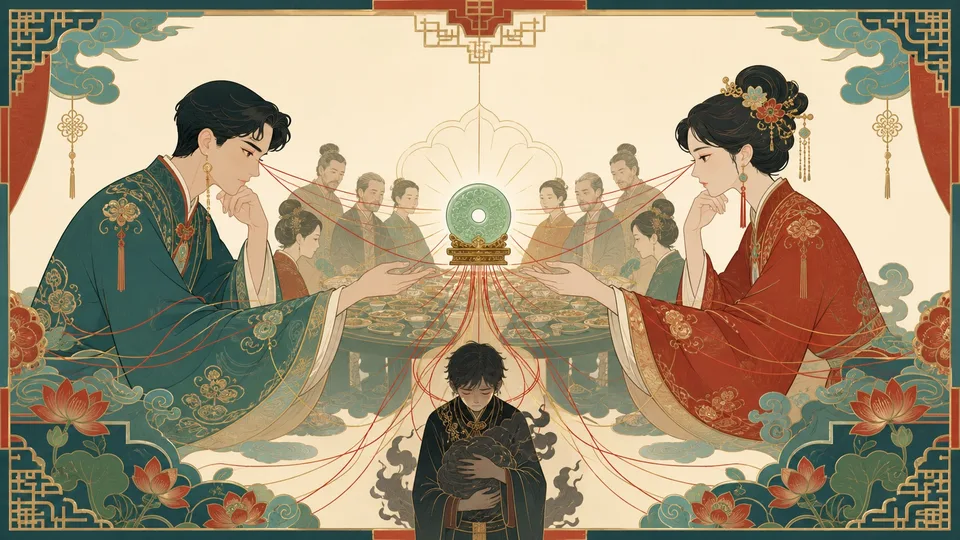
Girardian mimetic theory is a theory of borrowed wanting and exported violence. Its core claim is simple and devastating: human beings imitate not only behavior but desire itself. The object does not glow on its own. It glows because someone you use as a model appears to want it.
This is the anchor underneath mimetic markets, the mimetic gradient, desire as wound-recognition, the identified patient, trauma dragons, and productive bubbles. The same mechanism runs through romance, finance, elite competition, family systems, politics, religion, and mobs: desire converges, rivalry intensifies, difference collapses, and the system looks for a body to carry the pressure.
The spine:
model → desire → convergence → rivalry → reciprocal imitation → crisis → scapegoat → temporary peace
The cleanest formula: Girardian violence happens because the other person is both my teacher and my obstacle.
Simple Picture
Two children are in a room. One toy lies untouched. The first child picks it up. Suddenly the second child wants it more than anything in the world.
The toy did not change. The model changed. The first child’s wanting made the toy desirable. Now the two children are no longer just playing with an object. They are using the object to fight over whose desire gets to define reality.
Adult life is this scene with better vocabulary. The toy becomes an admissions slot, a startup idea, a lover, a house in the right neighborhood, a market trade, a political identity, a moral position, or a theory everyone in the room suddenly needs to have discovered first.
The Triangle
Girard’s basic unit is not a straight line from subject to object. It is a triangle:
- Subject: the person who wants
- Model: the person whose wanting teaches the subject what to want
- Object: the thing made desirable by the model’s desire
The subject usually experiences desire as autonomous: I want this because it is good. Girard says that is mostly retrospective narration. The truer sentence is: I want this because someone whose desire has authority for me has made it look good.
This does not mean desire is fake. It means desire is social before it is personal. Humans are born unfinished; we learn what matters by watching what other people treat as worth wanting. Mimesis is not a bug in cognition. It is how culture gets installed.
The danger begins when the model is close enough to become a rival.
Models Become Rivals
Girard distinguishes between distant models and proximate models. A distant model can inspire without directly blocking you: a saint, an artist, a dead philosopher, a grandparent from another era. They mediate desire from far enough away that admiration can remain admiration.
A proximate model stands in the same room, applying for the same school, dating in the same market, raising the same fund, chasing the same promotion, performing for the same audience. Their desire teaches you what to want while their existence blocks you from possessing it. The model becomes the obstacle. The obstacle becomes the obsession.
This is the model-obstacle. I imitate you because I admire you. Then I resent you because you stand between me and the thing your desire taught me to want.
This is why rivalry is often most vicious between near equals. Large differences can coexist peacefully because they do not mirror each other. Small differences become intolerable because they do. Siblings, cofounders, neighboring departments, elite colleges, adjacent status groups, and ideological splinters are mimetic pressure cookers. Dan Wang’s useful formulation is that the conflict is Shakespearean rather than Marxist: not class against class across a clean structural gap, but doubles locked in theatrical hatred because each sees too much of himself in the other.
The practical rule: if you want to create trouble, put similar people near each other and tell them to want the same thing.
Metaphysical Desire
The object is often only the first bait. What the subject wants through the object is being: the model’s aura, fullness, confidence, desirability, legitimacy, centrality, chosenness. You do not merely want the job. You want to be the kind of person for whom the job proves something. You do not merely want the lover. You want to be the one who was chosen. You do not merely want the house. You want the ontological relief of no longer being behind.
This is why more resources often fail to calm mimetic conflict. More bread solves a bread shortage. It does not solve “I want to be the chosen son.” Housing can be built. The humiliation of watching your rival become the person everyone treats as settled cannot be built away so easily.
Scarcity becomes metaphysical when the object turns into a token for rank, innocence, beauty, centrality, sovereignty, or proof that one’s life was not wasted. At that point, dividing the object does not divide the rivalry. You can give both children identical toys and still fail, because the desired thing was never plastic. It was mimetic electricity.
Rivalry Erases Difference
The strange feature of mimetic rivalry is that opponents become more alike as they fight. Each side watches the other obsessively, imitates the other’s tactics, mirrors the other’s accusations, and defines itself against the other’s movements. The fight begins over an object. Then the rival becomes the real object.
This is why enemies often know each other better than friends do. The rival becomes a model you claim to hate but cannot stop consulting. Every gesture is information. Every success is humiliation. Every insult is secretly accepted as a judgment from the one person whose judgment matters.
The violent flywheel is reciprocal imitation. A imitates B’s desire. B sees A wanting it and defends it harder. A copies B’s escalation. B copies A’s accusation. Both say, “They are the violent ones; we are only defending ourselves,” while mirroring the same emergency logic, purity tests, contempt, and permission to punish.
At scale, this turns crowds non-ergodic. The mimetic gradient describes the systemic version: as desire flows toward the visible winners, independent judgment disappears. The crowd looks stable because everyone is synchronized, but the stability is the fragility. When the gradient reverses, there are no independent shock absorbers left.
The Scapegoat Mechanism
Mimetic rivalry spreads because desire is contagious, and anger is contagious too. One rivalry becomes two, then ten, then a whole field of people watching each other for cues. Distinctions blur. The community loses the differences that normally keep conflict bounded: elder and younger, sacred and profane, ruler and subject, parent and child, insider and outsider, aggressor and victim.
When the system cannot metabolize the pressure, it discovers a miracle: unanimity can be restored by turning everyone against one target.
The scapegoat is usually not random. They are close enough to be blamed and marginal enough to be expelled. The family black sheep, the failed executive, the heretic, the foreigner, the contaminating minority, the disgraced celebrity, the “toxic” teammate, the child who acts out the parents’ shadow. The target becomes the place where the group’s diffuse violence can concentrate.
The group experiences this as truth: we found the problem. Structurally, it is relief: we found a body that can hold the problem for us. The Identified Patient is the family-scale version. Tiamat Dragons names the trauma version: the violence of slaying the dragon has to go somewhere, and the scapegoat route is the cheapest dump.
The scapegoat mechanism works because it converts many-against-many conflict into all-against-one consensus. It is not merely displaced hatred. It is coordination technology. The hidden bargain is: we will stop accusing each other if we can all accuse him. It is a peace treaty signed in someone else’s blood.
The target need not be innocent in every literal sense. This is what makes scapegoating persuasive. The scapegoat often has real flaws, real failures, real blameworthy actions. The lie is not always “they did nothing.” The lie is: if we remove them, our disorder is solved.
Real fault + collective projection = scapegoat.
Peace returns. The group feels purified. Later, myth explains why the victim must have been guilty, monstrous, sacred, or necessary. The cure retroactively proves the diagnosis. The story hides the mechanism that produced it.
This is the difference between mediation and scapegoating:
- Mediation resolves causes
- Scapegoating resolves tension
Mediation requires people to stay differentiated enough to say, “You did this, I did that, here is the misunderstanding, here is the constraint.” Mimetic crisis is precisely the condition where those distinctions collapse. Everyone is contaminated by the same envy, resentment, victimhood, and tactical escalation. Truth gets expensive. Discharge gets cheap.
Religion and Revelation
Girard’s most controversial move is that archaic religion is not a set of primitive explanations for weather. It is social technology for containing mimetic violence. Ritual sacrifice repeats the scapegoat event in controlled form so the community can discharge pressure before uncontrolled violence returns.
The victim is both poison and cure. They are blamed for the crisis, then credited with restoring peace. This is why sacrificial victims so often become sacred. The community does not understand that its own unanimity created the peace, so it attributes the peace to the victim’s strange power.
Girard’s Christian claim is sharper: the Biblical tradition progressively reveals the innocence of the victim, culminating in the Passion. Myth speaks from the perspective of the crowd. The Gospels speak from the perspective of the scapegoat.
That revelation destabilizes sacrifice. Once a culture has learned to see victims as potentially innocent, scapegoating becomes morally suspect. This is progress, but it also creates a new problem: the old sacrificial machinery is weakened, while mimetic rivalry remains. Modernity is therefore full of half-discredited scapegoating. Everyone denounces victimization, everyone competes to occupy victim status, and everyone still wants a culprit when pressure becomes unbearable.
Alternatives to Sacrifice
Girard is not saying scapegoating is the only possible release. He is saying it is the archaic, default, pre-reflective release: fast, emotionally satisfying, coordination-friendly, and requiring no self-knowledge.
The alternatives all do one of three things: slow the accusation down, symbolize the violence, or separate the rivals before sameness becomes contagious.
- Law slows scapegoating down with procedure, evidence, standards, and due process. It forces the crowd to stay differentiated long enough to ask what actually happened.
- Ritual discharges violence symbolically instead of literally. The community gets form, repetition, and release without needing a fresh victim every time pressure accumulates.
- Markets redirect rivalry into production. You can compete for customers, margins, and innovation instead of sacred status directly.
- Sports and games create bounded rivalry with rules, clocks, referees, and consent. The whole point is to let conflict intensify without becoming metaphysical.
- Religion reveals the innocence of the victim, forbids revenge, and installs a sacred brake on reciprocal violence.
- Comedy punctures mimetic seriousness. A joke can deflate the aura around the object before the object becomes sacred enough to kill for.
- Abundance reduces object-level competition. It does not solve metaphysical desire, but it can stop bread conflicts from becoming being conflicts.
- Exit lets rivals separate before the rival becomes the whole world. Distance converts internal mediation back into external mediation.
- Confession breaks reciprocal accusation by owning one’s part. It reintroduces asymmetry into a room where everyone is trying to be the pure victim.
- Forgiveness refuses to continue the revenge loop. It is not moral softness; it is the decision not to let the rival keep authoring your next move.
The mature alternative to sacrifice is not niceness. It is any structure that metabolizes mimetic pressure without requiring a body to carry the group’s disowned violence.
Straussian Reading
On the surface, Girard is giving a theory of violence: imitation produces rivalry, rivalry produces scapegoating.
Underneath, he is attacking the modern liberal myth of autonomous desire. The self-authored individual with private preferences is a comforting fiction. Desire is socially downloaded. The person is less a sovereign chooser than a node in a prestige-contagion network.
The deeper scandal is anthropological: civilization is not founded only on reason, contract, consent, or enlightenment. It is founded partly on sacralized violence that later gets laundered into myth, ritual, law, taboo, and institution. The murder becomes order. The order forgets the murder.
Where It Shows Up
Markets. A bubble is desire made visible in prices. You buy because admired people own it; their ownership attracts more imitators; the rising price becomes evidence that the desire was correct. The bust is the uncontrolled sacrifice that resets the system. Boom adds the productive version: the same mimetic cascade that demands a bust can also synchronize capital and talent around futures no rational actor would build alone.
Romance. Desire often arrives through a model you do not recognize. Sometimes the model is another person whose approval matters. Sometimes it is the wound itself, teaching you to want whoever reproduces the old pain with enough precision to feel like destiny. The beloved becomes less a person than a stage on which the wound can try to complete itself.
Families. The family that cannot face its own shadow routes it through one member and calls that person the problem. The scapegoat’s dysfunction becomes load-bearing. The family is not failing to heal; it is succeeding at preserving itself by exporting the material it refuses to integrate.
Chinese families. The Chinese family version runs especially hot because the household is not only a kinship unit. It is also a status corporation, pension system, marriage-market vehicle, and public face instrument. The conflict looks vertical — parent versus child, elder versus junior, filial duty versus selfishness — but the ignition source is often horizontal mimesis. Parents are watching other parents. Children are compared to other children. The neighbor’s son, the cousin at Tsinghua, the classmate with the finance job, the daughter who married correctly: these are not examples. They are models whose desirability makes the actual child look like a failing asset.
Mianzi turns the child into a public mark-to-market position. Children as Investments names the balance-sheet layer: education, housing, migration, elder care, and family reputation are bundled into the child’s future, so a mismatch between the child’s nature and the family’s imagined track is experienced as portfolio drawdown, not ordinary disagreement. In the one-child case, the phantom child becomes the missing sibling-rival: the real child is forced to compete against an ideal future self backed by two parents, four grandparents, the education system, and the family’s terror of losing face.
This is why eruptions can feel so disproportionate. A major change, an unsuitable partner, a failed exam, delayed marriage, depression, or refusal to perform gratitude is not processed as one person’s choice. It becomes a crisis in the family’s mimetic standing. Someone must carry the shame. The underperforming child, rebellious daughter-in-law, “selfish” heir, or emotionally honest grandchild becomes the local scapegoat. 富不过三代 is the long arc: what appears as spoiled failure in the heir is often the moment accumulated silence can no longer be routed through success theater.
Politics. Ideological crowds do not merely believe the same propositions. They learn to desire through the same model. Totalitarian loneliness is what full mimetic saturation feels like from the inside: the inner companion disappears because there is no longer enough independent desire left to sustain a dialogue with oneself.
Who Is the Most Red is the Chinese case study: Mao made revolutionary authenticity the supreme mimetic object, everyone competed to prove redness by exposing impurity, and the state eventually had to re-monopolize scapegoating to restore order.
Organizations. When a team cannot process uncertainty, it finds a person or abstraction to blame: “culture,” “leadership,” “the difficult engineer,” “the blocker.” The accusation may contain truth, but its function is often pressure disposal. The diagnostic question is whether removing the target would solve the structure or merely force the structure to select a new target.
The recurrence test is brutal: if the same tensions return three months after the expulsion, the expulsion was not diagnosis. It was sacrifice.
What Maturity Looks Like
The naive escape is “think for yourself.” Girard makes that less available. If desire is mediated, then autonomy cannot mean model-free desire. There is no pure inner oracle untouched by imitation.
Maturity means making mediation conscious:
- Choose models whose distance prevents rivalry
- Keep multiple models from different worlds so no single gradient captures you
- Notice when admiration curdles into resentment
- Treat intense desire as diagnostic information, not proof of destiny
- Ask what group tension an accusation is discharging
- Refuse the pleasure of joining unanimous hatred too quickly
The goal is not to eliminate mimesis. The goal is to keep mimesis from narrowing into rivalry and sacrifice. A healthy culture does not produce people with no models. It produces enough models, at enough distances, with enough friction between them, that no single model can monopolize desire.
Dimwit / Midwit / Better Take
The dimwit take is “people fight because they want the same stuff.”
The midwit take is “conflict comes from scarcity, incentives, institutions, trauma, identity, and power structures.”
The better take is that mimesis is not the opposite of intelligence; it is the substrate intelligence grows through. Scarcity and incentives matter, but the most dangerous scarce good is being: status, legitimacy, sacredness, victimhood, chosenness, beauty, centrality. People copy each other’s desires, copy each other’s hatred, then need a sacrificial story that hides the imitation. The question is not whether your desire is mediated. It is which models are mediating it, how close they are, whether they are becoming rivals, and where the violence will go when the rivalry can no longer be contained.
Main Payoff
Girard gives you two questions that cut through enormous amounts of social fog:
Who taught me to want this?
Who is being asked to carry the violence this system refuses to understand?
The first question reveals the model behind desire. The second reveals the scapegoat behind peace. Together they expose the hidden circuit: borrowed wanting produces rivalry, rivalry produces pressure, pressure seeks discharge, and discharge becomes sacred once everyone agrees not to look too closely at the victim.
Add two more:
Is this accusation resolving a cause, or merely discharging tension?
If the target disappears and the pattern returns, what was the target carrying for the group?
That is why Girard matters across domains. He is not merely saying that people copy each other. He is saying that imitation is the root of culture, envy, markets, romance, religion, mobs, and sacrifice. The human animal does not only fight over what it wants. It learns what to want by watching others, then fights them for teaching it too well.
References:
- René Girard, Deceit, Desire, and the Novel
- René Girard, Violence and the Sacred
- René Girard, Things Hidden Since the Foundation of the World
- Dan Wang, College as Girardian Terror