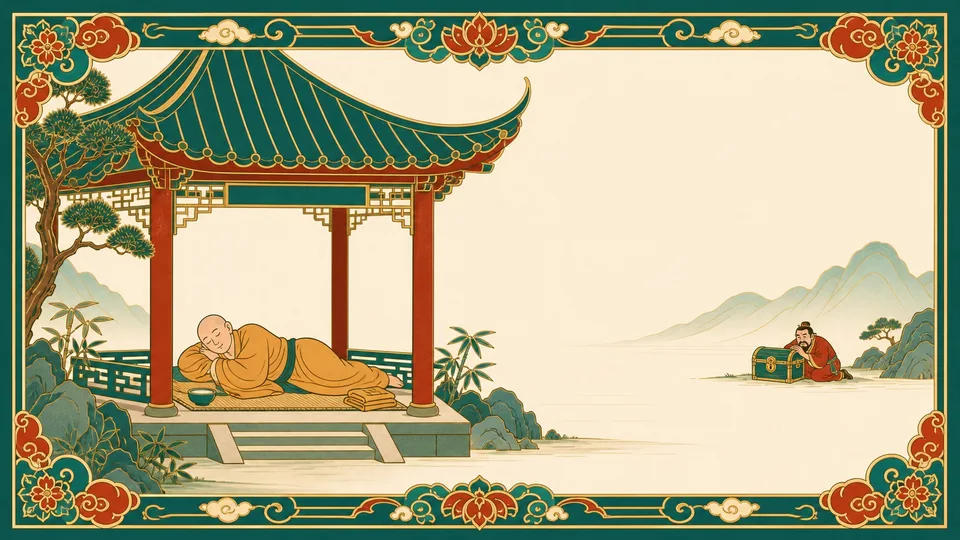
A rich man lies awake guarding the life his money bought. A monk sleeps under a roof he does not own. The spreadsheet says the first man is wealthy and the second is poor. The nervous system often says the opposite.
True wealth is anxiety-adjusted freedom: the amount of life you can inhabit without being owned by fear. Material wealth helps only when it reduces binding anxiety faster than it creates new anxieties of maintenance, status, loss, comparison, and identity.
This note grows from the intersection of The Psychology of Money, Capital as Stored Time, The Sanity Supply Curve, and Awareness. The question it answers: why can getting richer make a person feel poorer? The claim: wealth has to be marked to psychic liabilities, not just material assets. The deeper root of many of those liabilities is the fear behind fears: the terror that if the asset disappears, no one will hold the self through what follows.
The Simple Picture
ELI5: imagine two backpacks.
One backpack holds useful tools: food, shelter, savings, insurance, friends who would take your call, skills people value, a body that can sleep, a mind that can stop. This is positive wealth.
The other backpack holds locks, cameras, reputation maintenance, lifestyle obligations, comparison surfaces, family expectations, tax structures, debt covenants, fear of losing face, fear of falling behind, fear that the people who love you love the backpack. This is anxiety debt.
The ordinary accounting statement weighs only the first backpack. True wealth subtracts the second.
The Wealth Function
The crude equation:
true wealth = optionality + resilience + enoughness + inner quiet - anxiety liabilities
Net worth counts claims on resources. True wealth counts freedom from coercion. The coercion can come from outside — rent, medical bills, debt collectors, unstable income — or from inside: comparison, identity, craving, fear, the need to keep proving the story.
This is why Housel’s definition of wealth as invisible optionality is only the first half. Stored money gives you buttons on the remote control of your future. But if each new button installs a new panic about losing the remote, the balance sheet has grown while the person has shrunk.
The hidden variable is anxiety elasticity. The first dollars reduce catastrophic anxiety quickly: food, shelter, medicine, debt service, escape from humiliating dependency. After the basic ruin floor is cleared, the curve changes. Additional wealth buys smaller increments of real safety while opening larger surfaces for fear: asset protection, lifestyle lock-in, status comparison, inheritance conflict, tax complexity, market volatility, betrayal detection, security theater.
Material wealth has diminishing marginal anxiety relief. Status wealth often has increasing marginal anxiety production.
Poverty Has a Ruin Floor; Wealth Has a Loss Ceiling
The fear of homelessness has an asymptote. Once you are fed, housed, medically stable, and not one bill from disaster, the specific terror of immediate destitution falls fast. This is why basic money matters enormously. Poverty is not ennobling. It is a non-ergodic threat surface where one missed payment can become a cascade.
But wealth introduces a different geometry. It raises the ceiling from which you can fall.
The poor person fears the bottom. The wealthy person fears the delta: the distance between present self and possible diminished self. A person with little to lose can still be anxious, but there are fewer invented selves to defend. A person with much to lose can become haunted by every subtraction: market drawdown, reputation loss, relative decline, child’s underperformance, lifestyle downgrade, friends seeing the demotion.
This is the stage trap translated into money. Every altitude marker becomes evidence of a self that must be maintained. The higher the stage, the more catastrophic descent feels, even when the lower platform is objectively livable.
Negative True Wealth
A possession becomes negative true wealth when the anxiety it creates exceeds the freedom it provides.
Examples:
- A second home that turns weekends into maintenance logistics.
- A luxury car that makes every parking lot a threat surface.
- A public identity that requires continuous visible consumption.
- A portfolio so large and concentrated that ordinary volatility becomes a referendum on personhood.
- A career-income lifestyle where every raise raises the cost of exit.
- A family balance sheet that converts children into risk-bearing assets.
The object may be financially valuable and psychically bankrupting. It may appreciate in market price while depreciating in life-freedom.
Stories as Assets explains the mechanism. The object is not only an object. It is a story about who you are, who is allowed to admire you, who must not see you fall, and which future must remain believable. The story can create real opportunities. It can also become a hostage-taker.
This is the deepest consumer trap. You buy the thing to reduce anxiety: now I am secure, now I am respected, now I have arrived. But the thing becomes a sensor. It constantly reports whether security, respect, and arrival are still intact. The purchase did not end the audit. It installed the audit interface.
The same costly object can reverse sign when it becomes a door into sustained attention rather than a mirror of rank: use, knowledge, and repair remain after novelty fades, while the audit grows quiet.
The Monk Is Not Poor in the Same Unit
The monk discovered an accounting trick that modern finance rarely measures: reduce the claim before increasing the asset.
This is not romantic poverty. Hunger, untreated illness, and exposure are not spiritual teachers; they are biological emergencies. The serious monastic insight is narrower and sharper: many ordinary anxieties are not caused by insufficient assets but by excessive ownership-identification.
Operational Buddhism calls this fusion. The mind welds attention to an object and then performs ownership arithmetic: my money, my house, my reputation, my future, my rank, my proof that I am okay. Once the object is assigned to the self, its instability becomes self-instability.
The monk’s move is not “own nothing because things are bad.” The move is: stop asking unstable things to stabilize the self. A bowl can feed you. It cannot certify you. A robe can warm you. It cannot complete you. A shelter can protect the body. It cannot protect the fantasy of being protected forever.
That is why the monk can be materially homeless and psychically housed. The self has stopped trying to take shelter inside objects.
The Wrong Way to Seek True Wealth
The first wrong way is accumulation without enoughness.
This converts money from optionality into scoreboard. The moment money becomes self-verdict, every increase creates a new reference point and every loss becomes ontological threat. Dopamine keeps the chase alive because anticipation pays better than possession. The nervous system says one more level, and the level becomes the new floor.
The second wrong way is status laundering.
Weaponized Taste shows how money becomes the appearance of spiritual worth. Premium Mediocrity shows the middle-class version: consumption as an options contract on a future self. Both create anxiety because the signal must keep transmitting. The person is not enjoying the object. They are paying the monthly fee on a social hallucination.
The third wrong way is safety hoarding.
The Safety Trap applies directly. You can accumulate so much protection that protection becomes the main threat to life. The goal quietly shifts from living to preventing variance. The portfolio grows; the action-space narrows. Every new hedge requires another hedge against the hedge failing.
The fourth wrong way is spiritualized contempt for money.
This is the near enemy. Rejecting money because money can produce anxiety is like rejecting food because gluttony exists. Money is real stored agency. Capital is civilization’s battery. The monk’s freedom is not produced by hating the battery. It is produced by not mistaking the battery for the self.
The Right Way to Seek True Wealth
The first right way is ruin removal.
Pay down the threats that can delete your future: emergency vulnerability, predatory debt, health neglect, legal fragility, dependency on people who can humiliate you, skills that do not convert into income. This is not anxiety avoidance. It is correct non-ergodic math: do not go to zero.
The second right way is optionality without identity.
Save money that does not need to be seen. Own assets that do not demand a persona. Build skills that travel across contexts. Keep commitments that increase freedom rather than locking the self inside a decorative cage. True wealth is often invisible because visibility is one of the ways wealth becomes expensive.
The third right way is enoughness as a stopping rule.
Enoughness is not a ceiling on ambition. It is a kill switch for ruinous games. It says: this level of security has done its job; beyond this point, the next dollar must justify not only its opportunity cost but its anxiety cost.
The fourth right way is inner slack.
Sanity is a strategic reserve. Sleep, meditation, unstructured time, a non-performative home, friendships that do not require proof, and the capacity to be bored without reaching for a purchase are all wealth. They are not lifestyle accessories. They are the reserves that prevent a small disturbance from becoming a convex collapse.
The fifth right way is de-fusion.
Awareness names the wealth behind the diamond: the state that can give the diamond away. Meditation weakens the story-generation machinery that turns each asset into a self-extension. Pain still arrives; the portfolio still fluctuates; the roof still leaks. But the mind stops converting every fluctuation into a courtroom about the self.
Dimwit / Midwit / Better Take
The dimwit take is “money does not buy happiness, so just be spiritual and stop caring.”
The midwit take is “money buys freedom up to a point, then status consumption creates diminishing returns.”
The better take is that money has to be accounted for like a psychological derivative. The asset has cash value, option value, status value, maintenance cost, identity cost, and anxiety convexity. A dollar that lowers ruin risk is profoundly positive. A dollar that raises the reference point without increasing inner freedom can be negative. The question is not how much money you have, but how much of your nervous system the money has colonized.
One-Breath Summary
Standing on one foot: wealth is not the pile; wealth is the silence around the pile. Money is good when it buys time, options, dignity, and recoverability. Money turns bad when it becomes a shrine the self must guard. The monk and the prudent investor are secretly solving the same equation from opposite sides: reduce ruin, reduce clinging, widen freedom, stop buying new fear with old fear.
Main Payoff
Once true wealth is defined as anxiety-adjusted freedom, the practical question changes.
Not: Can I afford this?
But:
- What anxiety does this remove?
- What anxiety does this install?
- Does this increase my freedom to act, or my obligation to maintain a self-image?
- Does this protect against ruin, or merely decorate the fear of ruin?
- Would I still want this if nobody could see it?
- If I lost it, would I lose an object, or would I lose a self?
The successful player learns to buy assets that lower coercion and sell stories that raise maintenance cost. The monk learns to stop underwriting the self with unstable objects. Both converge on the same strange doctrine: the richest life is not the life with the most possessions, but the life with the fewest possessions that can threaten its peace.