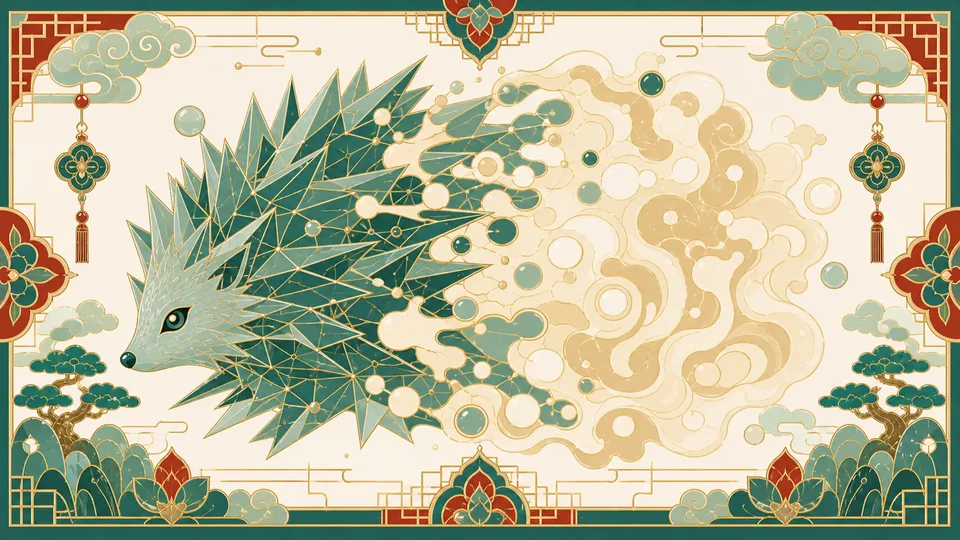
Identity is not a hidden essence. It is a topology: prickles are the hard conditions you require before a state counts as you, while goo is the larger field of states you are willing to include. The art is not becoming softer or harder in general. The art is deciding which parts of yourself must stay sharp, which parts must be allowed to melt, and which counterpart receives which face.
This note grows from the intersection of Watts, Kevin Simler’s “Prickles and Goo,” Venkatesh Rao’s “Getting Gooier,” fluid-plurality, mask-and-daemon, self-acceptance, and seeing-like-a-cat. The question it answers: how should a person construct identity without either calcifying into a skeleton or dissolving into soup? The claim it makes: identity works when your deepest commitments are prickly and your ordinary self-model is gooey enough to keep learning.
Simple Picture
Imagine drawing a circle around all the states you are willing to call “me.” If the circle has many rules, only a few states get inside. I am me only when I am sober, controlled, rational, independent, consistent, productive, and immune to the herd. That is a prickly identity: clear, legible, reliable, and brittle.
Now remove some rules. Drunk-you, tired-you, playful-you, socially influenced-you, grieving-you, foolish-you, dependent-you: all still count. The self gets smaller as a list of conditions and larger as a field of possible states. This is the Zen paradox Simler formalizes: shrink the hard self and the lived self expands.
Watts’ Temperamental Split
Watts names the two temperaments with exactly the right amount of contempt on both sides:
The prickly people are tough-minded, rigorous, and precise, and like to stress differences and divisions between things… The gooey people are tender-minded romanticists who love wide generalizations and grand syntheses… Prickly philosophers consider the gooey ones rather disgusting — undisciplined, vague dreamers who slide over hard facts like an intellectual slime which threatens to engulf the whole universe in an “undifferentiated aesthetic continuum”… But gooey philosophers think of their prickly colleagues as animated skeletons that rattle and click without any flesh or vital juices, as dry and dessicated mechanisms bereft of all finer feelings. — Alan Watts
The joke is load-bearing. Each side sees the other’s failure mode clearly. The prickly person sees that goo can become vagueness, sentimentality, intellectual rot. The gooey person sees that prickles can become dead mechanism, sterile precision, a mind all bones and no blood. Both are right. That is why neither temperament is the answer.
Conditions and States
Prickles are identity conditions. They define what must be true before an experience counts as yours. Goo is state inclusion. It defines how much variation you can metabolize without deciding you have betrayed yourself.
This reframes why altered states threaten some people. A person who identifies with control is not merely refusing a drink, a ritual, a trance, or a collective effervescence. He is refusing evidence that he can remain himself while his ordinary control system is offline. If he chooses the altered state and survives it, his old identity loses one of its necessary conditions. The prickly self shrinks. The possible self expands.
That expansion is not automatically good. The garden’s boundaries note exists because some hard lines should stay hard. A person with gooey moral boundaries is not enlightened; he is unreliable. A scientist with prickly empirical beliefs is not rigorous; he is sacrificing truth to ego. Boundary Identification gives the deeper rule: the boundary is healthy when it improves perception and action, and pathological when it becomes identity. The right question is always game-specific: what must be invariant here, and what must stay revisable?
AI as Goo Reallocator
Rao’s useful move is to refuse the usual “which human types win after AI?” question. The deep change is not that programmers lose to project managers, or specialists lose to generalists, or one familiar occupational shape replaces another. The change is that AI refactors the human interface. It alters the posture in which people meet intelligence.
A human facing another human has to manage humiliation, status loss, interruption, misinterpretation, and the future memory of the exchange. That makes the relationship naturally prickly. An AI counterparty, by contrast, feels safe enough to receive the embarrassing draft, the half-formed desire, the confused confession, the stupid question. Whether that safety is technically justified is separate. Phenomenologically, the user softens. The machine becomes the place where more states can become speakable.
That is the mechanism of getting gooier. Sustained AI use rewards a gooey machine-face: tentative prompts, incomplete intentions, affective steering, letting the agent run, letting surprise matter. The prickly interface is line-by-line verification, suspicion, and complete prior specification. It has its place, but as the default relation to an agent it often prevents the loop from doing anything interesting. Vibecoding is not just a silly name. It describes the softness required to collaborate with an alien compiler of intention.
The cost is redistribution. If AI absorbs more of the confessional, experimental, playful, and dependent states that used to require human witnesses, the human-facing self may grow cooler. Not necessarily harder at the core, but less willing to spend goo on people unless the expected reward is high. The person becomes more gooey overall and yet more prickly to other humans: soft toward the machine, reserved toward the room.
This gives atomization a different texture. Social media atomized by turning people into mutually policing surfaces. AI can molecularize by giving each person an intimate nonhuman solvent in which to dissolve and recombine privately. The open question is whether new human social forms can reaggregate those private transformations, or whether everyone becomes increasingly fluent with their agents and increasingly illegible to one another.
The Garden Mapping
mask-and-daemon is the prestige version of the same geometry. The mask is a prickly identity optimized for social recognition: these traits count, these behaviors belong, these performances are rewarded. The daemon is the excluded state-space: the parts that did not fit the mask but kept existing anyway. Self-actualization is not ripping off the mask and becoming goo. It is redesigning the mask so the daemon has a legal channel into the world.
fluid-plurality gives the operational warning: keep the labels ephemeral. Prickles become pathological when they stop being tools and become non-renounceable identity. “I am rational,” “I am independent,” “I am not the kind of person who needs people,” “I am always honest” — these may begin as useful constraints, but once they become conditions for being yourself, they prevent you from discovering the states that would make you larger.
self-acceptance names the inner move. Acceptance is the goo that lets more of your actual state-space count as you. It does not mean every impulse gets authority. It means fewer experiences get exiled as “not me.” The more you reject, the more energy goes into border enforcement. The more you can include without collapsing, the less identity has to be defended.
This also clarifies seeing-like-a-cat. Dog identities are socially prickly: they define themselves by position on the social mountain. Cat identities are often gooey toward the universe and prickly toward status games: open to strange perceptions, closed to social coercion. That is the better arrangement. Stay gooey toward reality. Stay prickly toward games that want to own your attention.
Strategic Identity Construction
The core question is not “am I prickly or gooey?” It is:
Which parts of my identity should be hard, and which should be soft?
Some useful defaults:
- Moral commitments should be prickly enough that convenience cannot melt them.
- Empirical beliefs should be gooey enough that evidence can reshape them.
- Aesthetic taste should be prickly enough to generate a real style and gooey enough to keep learning. Beauty is a search heuristic, not a verdict.
- Relationships need prickly commitments and gooey preferences. The vow is hard; the restaurant choice should not be.
- Creative identity needs prickly devotion and gooey method. The work matters; the route can mutate.
- AI work needs gooey interaction and prickly acceptance criteria. Vibe with generation; verify the parts that can create liability.
- Social status should be as gooey as you can tolerate. The more prickly your status identity, the more the audience owns you.
This is why experimentation is costly. To experiment on yourself is to move a trait from prickly to gooey long enough to see what else can be true. The old social world experiences this as betrayal because it built predictions around your prickles. You did not merely change behavior. You changed the API other people were using to call you.
Dimwit / Midwit / Better
The dimwit take is “prickly people are uptight; gooey people are free.”
The midwit take is “balance is best — be a little prickly and a little gooey.”
The better take is that identity is a portfolio of hardness and softness, and the allocation should match the game. Too much hardness makes you legible, reliable, and dead. Too much softness makes you adaptable, inclusive, and untrustworthy. The question is not temperament but placement. Put the prickles where invariance creates integrity. Put the goo where revision creates aliveness.
Main Payoff
Prickles give you form. Goo gives you range. Without form, nothing can trust you enough to build with you. Without range, nothing new can enter you without being treated as invasion.
The AI wrinkle is that identity hardness is face-specific. You can become tender, experimental, and porous with a machine while becoming oddly dry with people. Maturity means not letting the easiest counterparty monopolize your goo.
The mature self is not the hard self or the soft self. It is the self that can move the border deliberately. Hard where betrayal would destroy the game. Soft where learning would expand it. That is the practical version of Watts’ no-self: not the annihilation of identity, but the discovery that identity is something you can loosen without disappearing.
References:
- Kevin Simler, “Prickles and Goo” — Melting Asphalt
- Alan Watts, quoted in Simler’s essay
- Venkatesh Rao, “Getting Gooier” — Contraptions