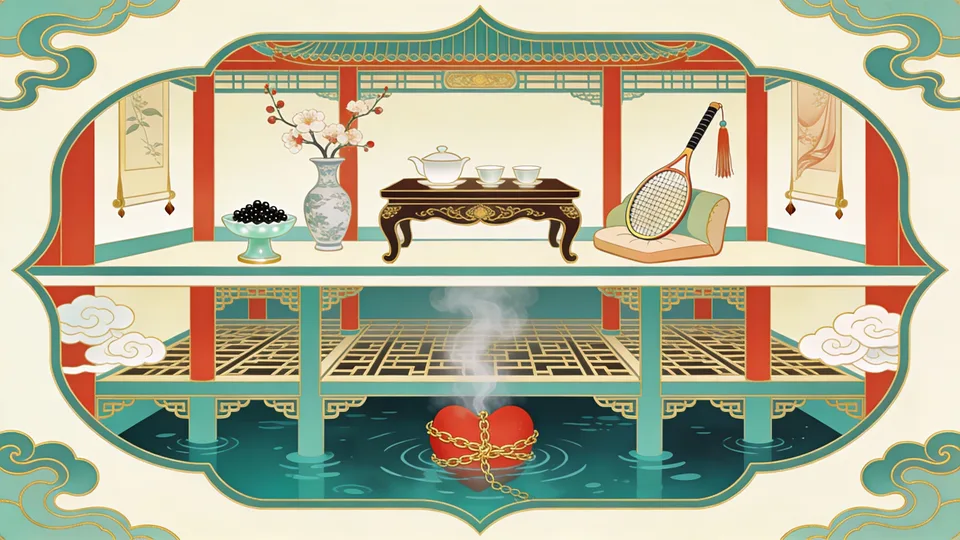
Snobbery — the demand for “elite taste” in oneself or one’s children — is often sublimated disgust from repressed bad taste in love. You cannot admit that you chose badly in the bedroom, so the disgust gets routed into “fancy” sensory experiences that conveniently happen to be high-status. The performance is impressive. The engine is unsatisfiable, because the disgust it is laundering is infinite.
Simple Picture
ELI5: imagine a household with a leak in the basement. Nobody can name the leak, because naming it would mean naming who left the tap on. So the family pours all its energy upstairs — the marble countertops, the curated bookshelf, the children’s tennis lessons. The water keeps rising, and the renovations keep getting fancier. Nobody addresses the basement, because the basement is where the real failure lives. The “fancy” is what you build over a wound you cannot afford to see.
The Engine
The argument has three moves.
1. Bad taste in love is unbearable to admit. It implicates the body — the partner you actually wanted, the desire that pulled you toward someone the daylight self disowns. Sexual repression is not merely not having sex; it is the inability to inspect what your erotic life actually selected for. Desire is the wound calling out to itself, and the wound’s selections are humiliating to look at clearly. The simplest defense is to refuse the inspection — and by refusing it, refuse the disgust the inspection would surface.
2. The disgust does not go away. Repressed material does not vanish; it relocates. What cannot be felt about one’s own taste in lovers is still felt — just routed elsewhere. The pressure is constant; only the target is variable.
3. The relocation lands on the “fancy.” Because the disgust needs an object, and “high culture” — caviar, tennis, hand-thrown ceramics, Tuscan villas, the right schools — is coded as the opposite of vulgar bodily desire. The more refined the sensory experience, the more it serves as evidence that you are not the kind of person who chose badly in the bedroom. Coincidentally — and not coincidentally at all — these refined experiences are also high-status. The same gesture launders the disgust and climbs the social ladder.
This is Bourdieu with the engine specified. Bourdieu gives the structural account: taste functions as cultural capital, sorting people by class while disguising the sorting as innate worth. The psychoanalytic reading underneath is that the energy powering a particular kind of snobbery is disgust looking for somewhere safe to land. The structure is the laundromat. The disgust is the cash that needs cleaning. The two readings do not compete; they layer.
The Tell: Caviar and Tennis But Not Love
The diagnostic is simple and brutal.
A parent who wants their children to have better taste in caviar and tennis but not in love is laundering their own bad taste.
You can desire for your children to discriminate in food, music, art, dress, school, neighborhood — every sensory and social register — except the one that would expose you. Better taste in love is the one form of refinement that cannot be transmitted, because if the children developed it they would immediately see through the parents. They would notice that the marriage was a settlement. That the desire was familiar pain dressed up as destiny. That the inheritance being passed down is not refinement at all but a particularly elegant cover story for unmetabolized shame.
So the taste portfolio gets carefully curated: “fancy” in everything that confirms the parental aesthetic; vague, sentimental, and unexamined in everything that would contest it. The children are taught to discriminate exquisitely between Bordeaux vintages and to never, ever ask why their parents are still in the same room together.
This is the phantom child in a specific register: the child is raised to validate the parental aesthetic, not to develop their own. The validation is purchased with refinement in safe domains and ignorance in unsafe ones. A child raised this way often arrives in adulthood with impeccable taste in everything that does not matter and no apparatus for evaluating love at all.
Why the Fancy Can Never Be Satisfied
Here the trap closes. The disgust being laundered is not finite. It is structurally infinite — because every act of laundering re-confirms what is being hidden. The marble countertop reminds you, every day, of what the marble countertop is for. The harder you work to make the upstairs beautiful, the more aware some part of you becomes that the basement still has water in it.
So the fancy escalates. Caviar is not enough; it must be a specific brand of caviar. The brand is not enough; it must be served at a specific kind of dinner. The dinner is not enough; the dinner must be hosted in a house, in a neighborhood, with a view, with a particular type of guest. Each upgrade is supposed to discharge the disgust. None of them do, because the disgust is not in the caviar.
This is the same engine Nietzsche names in slave morality: an entire moral system constructed not from what one loves but from a feeling one cannot bear to face directly. Slave morality runs on resentment; snobbery runs on disgust, which is resentment’s somatic form. The performance can be infinitely refined and never reach the bottom, because the bottom was never the target. The fancy is asked to cancel infinite disgust, so it can never be satisfied.
manufactured-scarcity explains the market layer: the system that sells the fancy has every incentive to keep the disgust alive, because a satisfied snob stops buying. The next-tier wine, the next-tier school, the next-tier vacation — each is a renewal of the same prescription, written by a system that profits from the patient’s failure to recover.
What the Children Inherit
What gets passed down is not the refinement. It is the structure of the laundering operation. The children learn that some sensory domains are sites of intense discrimination and others are not to be examined. They learn which questions are askable. They learn that “good taste” is a performance that protects against a question nobody is allowed to articulate.
If the children are lucky, they sense the gap and become suspicious of the whole apparatus — sometimes overcorrecting into the rebel stance, which is the same engine inverted: still organized around the parental aesthetic, just in negative. If they are unlucky, they internalize the laundering and replicate it in their own marriages — picking partners who confirm the parental aesthetic, refining their own children’s taste in safe domains, and arriving in their forties with the same basement leak.
富不过三代 sometimes describes this dynamic exactly. By the third generation the cover story has become so elaborate and so distant from any first-hand desire that the family runs out of fuel. The disgust the original generation needed to launder has been so successfully sublimated that nobody knows what the family is for anymore. The refinement persists for a beat longer than the engine that produced it; then both go quiet at once.
The Shadow Move
The exit is not “stop caring about taste.” Taste is real, refinement is real, and there are things worth discriminating between. The exit is separating the part of taste that is genuine pleasure from the part that is laundering disgust.
This is shadow formation applied to aesthetics. The disgust does not need to be eliminated — it needs to be named, located, and given its own form rather than smuggled into every dinner party. Ask the diagnostic question: what would I love about this if no one were watching, and what do I love about it precisely because someone is watching? The first answer is taste. The second is laundering. They can occupy the same object, but they are not the same operation, and a person who can tell them apart in their own life has stopped paying the disgust tax.
The deeper move — the one almost no one makes — is to look at the bad taste in love directly. Not to fix it retroactively (impossible) but to stop running from it. The wound is diagnostic information, not navigational guidance; the same is true of one’s own erotic history. The shame is not the verdict. The shame is smoke from a fire that has been burning for a long time, and turning toward the fire is what lets the smoke clear from the rest of the house.
Dimwit / Midwit / Better Take
The dimwit take is snobs are just classy people, you’re being bitter because you can’t afford the things they enjoy.
The midwit take is snobbery is social signaling, it’s all about status games and cultural capital. True but incomplete — it describes the structure without naming the engine. It tells you the laundromat exists; it does not tell you whose money is being washed.
The better take is that a particular flavor of elite taste is sublimated disgust from unmetabolized bad taste in love, and the giveaway is the asymmetry: relentless refinement in every sensory domain except the one that would expose the laundering. The fancy must cancel infinite disgust, so it can never be satisfied — which is why the snob is exhausted, why the children are anxious, and why the next vintage never tastes as good as the last one promised it would.
Main Payoff
The structural reading of taste tells you that the system is rigged. The psychoanalytic reading tells you why a specific person is willing to pay the rigged system’s prices indefinitely. They are not buying caviar. They are buying distance from a disgust they cannot name.
The diagnostic carries forward. When you watch a parent work obsessively to refine their children’s taste in domains the parent feels safe in — and watch the same parent fall silent or sentimental when the conversation turns to love — you are watching the laundering operation in real time. The children will inherit the refined taste. They will also inherit the silence. The silence is the actual heirloom; the refinement is just the box it came in.
The exit is small and unglamorous. Notice where your own discrimination is most aggressive, and ask whether the energy is pleasure or disgust. Notice where you are most willing to be sentimental, vague, or unexamined, and ask what is being protected. The fancy will keep selling. The disgust will keep escalating. The freedom is in stepping out of the line of customers whose pockets the operation runs through.