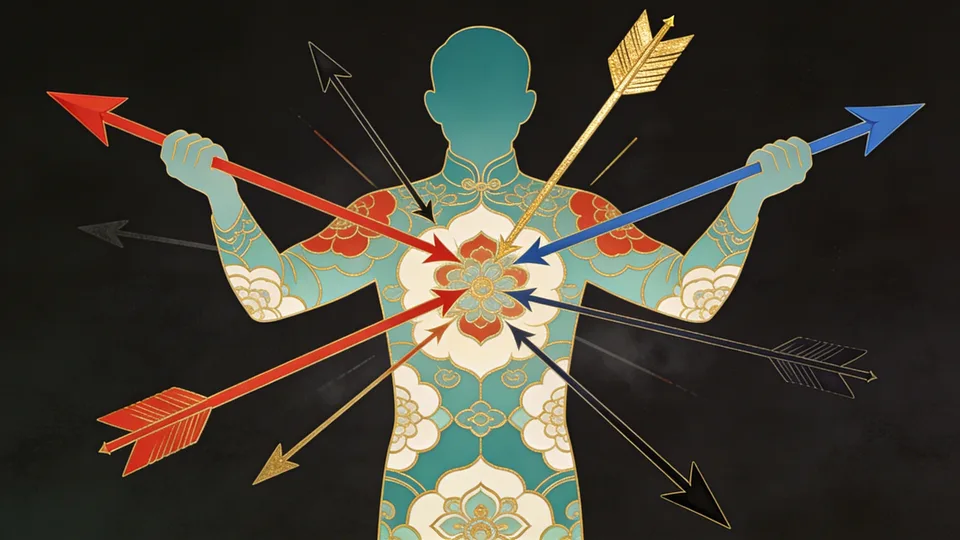
A personality assessment is not a verdict. It is a map of tensions — places where traits pull against each other, revealing where compensatory structures were built and where the system is under strain. The most diagnostic information is not in any single score but in the contradictions between scores.
The Core Tension: High Capacity, Low Self-Trust
The most revealing pattern in a profile is when high cognitive and creative capacity coexists with low self-esteem, low self-compassion, and low internal locus of control. This is the outlier-genius architecture made visible in data: a system that can think at extraordinary depth but does not trust its own outputs — that has built towering analytical machinery on a foundation of self-doubt.
High openness to experience combined with very low extraversion in warmth and positive emotions produces a mind that is hungry for ideas but aversive to the social environments where ideas are typically exchanged. The result is an interior life richer than the exterior one — which compounds isolation, which deepens the gap between capacity and expression.
Non-Conformity and Authority Defiance
Very high non-conformity paired with high perfectionism creates a specific bind: the system rejects external standards while simultaneously holding itself to impossibly rigorous internal ones. It refuses to submit to others’ frameworks but cannot forgive itself for failing to meet its own.
High authority defiance with low internal locus of control is particularly paradoxical — you refuse to be governed by others but do not believe you can govern yourself. This is the locally-optimal strategy of rebellion without sovereignty: tearing down the throne while refusing to sit in it.
In the king-warrior-magician-lover framework, this reads as strong Warrior energy (defiance, aggression, independence) paired with a collapsed King (no internal center, no capacity to bless or integrate). The defiance is real, but it has nowhere constructive to go.
Fearful Avoidance
A fearful-avoidant attachment style — high avoidance and high anxiety simultaneously — is the relational expression of wanting closeness while expecting it to be dangerous. The system reaches out and recoils in the same motion.
This maps directly onto desire-vs-love: the wound seeks familiarity. Inconsistent early attachment teaches the nervous system that closeness is both desperately needed and reliably painful. The dopamine system fires hardest for the unpredictable — so the avoidant gravitates toward intensity while fleeing the stability that would actually resolve the anxiety.
The conflict style that follows is avoiding — which is not peace but the absence of confrontation. It is boundaries failing at the source: the system would rather withdraw entirely than risk the vulnerability of honest disagreement.
High Neuroticism as Signal
Very high neuroticism in anger and depression, high in self-consciousness and impulsiveness — this is not a character flaw. In the neural-annealing framework, it is accumulated structural stress that has not been released. The system is brittle because it has not annealed.
The anger and depression are not opposites but the same unprocessed energy directed in different directions — anger outward (change the world) and depression inward (shut down rather than feel). The eristics framework would read this as a world-argument (fear/anger) that dominates while the self-argument (love/disgust) atrophies.
High impulsiveness alongside high orderliness reveals a system oscillating between rigid control and chaotic release — the signature of a nervous system that cannot find a middle register. When it holds, it holds too tight. When it breaks, it breaks completely.
The Character Strengths
Creativity, love of learning, perspective, curiosity, spirituality — these are not random. They are the natural outputs of a mind with high dimensionality and weak defaults (see autism-and-dimensionality). The same expanded search space that produces suffering also produces genuine cognitive gifts. The strengths and the difficulties share a root.
The investigative and artistic Holland codes confirm the pattern: a mind oriented toward understanding and creating rather than organizing or selling. This is the Magician archetype’s natural territory — mastery of knowledge, detached reflection, the capacity to see systems from the outside.
Common Misread
The dimwit take is “this profile shows someone who is broken and needs fixing.”
The midwit take is “this is just a snapshot — personality tests are unreliable and should not be taken seriously.”
The better take is that the tensions in a profile are more informative than the scores. A profile with no contradictions describes a simple person. A profile full of contradictions describes a person whose system is under load — pulling in multiple directions simultaneously because it has not yet integrated the competing demands. The contradictions are not the problem. They are the map of the work.
Main Payoff
The profile’s most important revelation is the gap between capacity and self-trust. Every strength listed is undermined by a corresponding insecurity. The creative mind does not believe its creations have value. The perspective-taking ability is paired with self-consciousness that makes presence difficult. The love of learning coexists with a conviction that learning will never be enough.
This is not a paradox. It is the outlier-genius architecture in miniature: a system that built extraordinary cognitive tools to compensate for a wounded foundation. The tools work. The foundation still needs repair. And the repair, as focusing suggests, is not more thinking but the slow, somatic work of learning to trust what the body already knows.